
The first question at most breast augmentation consults is not about implant shape or incision lines. It is the number. Breast implants cost roughly ₹1.4 lakh to ₹2.25 lakh in India for the majority of primary cases, with most landing near ₹1.6 lakh — yet two quotes for what sounds like the same surgery can differ by half a lakh within the same city. That spread is not random. It comes from a short list of identifiable decisions: which implant goes in; where it sits; how it gets there; what else is done in the same sitting.
This post breaks the quote down driver by driver, gives starting-from figures that patients in Gurgaon and Delhi NCR are actually quoted, explains what the fee does and does not include, and covers EMI and financing in the detail most cost pages skip.
One note on terminology before the numbers: searches phrase this many ways, including breast implantation cost, cost of breast enlargement in India, breast augmentation cost. All of them describe the same procedure, and the same pricing logic applies throughout.
Who this article is for
- Patients comparing quotes from multiple clinics and unsure why the numbers differ so widely
- Anyone budgeting for surgery who wants to know what a quoted fee typically includes before committing
- Patients deciding between implant brands, since brand choice moves the quote more than most expect (covered in depth in the Motiva vs Mentor vs Allergan comparison)
- Those still working out size and profile, where the implant sizing methodology explains how volume decisions are made at consult
- Out-of-station and NRI patients who need cost alongside travel logistics, addressed in the single-trip planning guide
What do breast implants cost in India?
Straightforward implant-only breast augmentation in India typically runs ₹1.4–2.25 lakh at an accredited private facility, and most primary cases land near ₹1.6 lakh. That fee generally covers the surgeon’s fee, a standard cohesive-gel silicone implant pair, operating theatre and anaesthesia charges, and the first follow-up visits. Premium implant lines push a quote toward the upper end of that band, while combined procedures such as a lift and revision cases are quoted individually above it. These are planning figures, not fixed prices; a firm quote requires an in-person assessment of anatomy and goals.
A quote is easier to compare once it is split into its components:
- Surgeon’s fee: the largest single line after the implants, reflecting training, experience and case complexity
- Implant pair: the most variable component; the silicone breast implant price alone accounts for most of the gap between a standard and a premium line
- Operating theatre and anaesthesia: general anaesthesia with an anaesthesiologist present, plus OT consumables and monitoring
- Facility and stay: day-care discharge versus one night of observation
- Follow-up visits and the first support garment: often bundled, sometimes not
City and facility type matter too. Metro-city quotes in Gurgaon, Delhi, Mumbai, and Bengaluru tend to run above tier-2 cities because facility and anaesthesia overheads are higher, though the implant pair costs roughly the same anywhere in India. If a quote sits well below the ranges above, ask what it includes: implant make and model, anaesthesiologist cover, facility accreditation, and number of follow-ups. Differences in inclusions explain most of the gap between quotes. How to probe a low quote is covered in choosing a breast augmentation surgeon in Gurgaon.
Why does the cost of breast enlargement in India vary so much?
Almost all of the variation between quotes comes from seven decisions: implant brand and type; pocket placement; incision technique; whether one or both sides are operated; whether a lift or fat transfer is combined; the anaesthesia and facility standard; whether the case is a primary surgery or a revision. Two patients can walk out of the same clinic with quotes a lakh apart purely because these choices differ, and neither quote is “wrong.”
Implant brand and type
This is the single biggest lever. A standard cohesive-gel silicone pair from manufacturers such as Mentor or Allergan sits at the more accessible end of the implant market and anchors quotes around the ₹1.6 lakh typical case. Higher-priced lines such as Motiva Ergonomix add materially to the pair cost and are the most common reason a quote moves toward the ₹2.25 lakh end. Price tier does not indicate clinical superiority — implant selection is matched to individual anatomy at consult, and this practice does not endorse any manufacturer. Implants are billed inside the surgical package in most quotes rather than as a separate line.
Saline implants sit at the lower end but are now uncommon in Indian practice. Round versus anatomical (teardrop) shape and the implant’s projection profile also shift the price within a brand. Anatomical (teardrop) implants have a textured surface by design. Because the rare lymphoma BIA-ALCL is associated with textured devices, shape is a clinical risk discussion at consult, not a price decision. Allergan’s Biocell macrotextured implants were recalled worldwide in 2019 at the FDA’s request following the BIA-ALCL association; some other textured devices remain available in certain markets. Smooth and micro-textured round implants are the devices most commonly used in Indian practice today. Where a shaped device is considered, the surface type and its risk profile are discussed explicitly at consult. Size itself changes cost less than patients assume: a 300 cc and a 375 cc implant from the same line are usually priced identically, which is why the sizing conversation is clinical, not financial.
Pocket placement
Submuscular and dual-plane placement involve working partially under the pectoral muscle, which adds operating time compared to a subglandular pocket. The effect on cost tends to be modest, but it is real, and placement should be chosen for anatomical reasons (soft-tissue coverage, animation concerns, mammography), never to trim the bill.
Incision technique
The inframammary crease incision is the standard approach and anchors most quotes. Periareolar incisions are broadly cost-neutral, while transaxillary (armpit) approaches can add cost where endoscopic equipment and additional OT time are involved. Incision choice, like placement, is an anatomical decision made at consult, and it also decides where the breast augmentation scar sits.
Unilateral vs bilateral
Most augmentation is bilateral, and published starting figures assume both sides. Single-side surgery, typically for congenital asymmetry or reconstruction after previous surgery, costs less than a bilateral case but not half, because anaesthesia and OT setup are largely fixed regardless of sides, as are facility charges.
Combining with a lift or fat transfer
Adding a mastopexy (lift) to augmentation is the most common cost escalator: combined lift-and-augment cases in Gurgaon are quoted above the implant-only band and rise with the degree of ptosis being corrected. A hybrid implant-plus-fat plan adds a liposuction and fat-processing stage to the same sitting, which raises the starting point above implant-only figures and is quoted case by case.
Anaesthesia and facility standard
General anaesthesia with a qualified anaesthesiologist, monitored recovery, and an accredited operating theatre all cost money; all belong in the quote. An overnight observation stay adds a facility charge over same-day discharge. A quote that sits well below the market on this layer is worth asking about before comparing on price alone.
Revision vs primary surgery
Revision surgery (implant exchange, capsulectomy for capsular contracture, or pocket correction) typically costs more than a primary augmentation. Scar tissue and capsule work add operating time, and a new implant pair is usually needed. Patients budgeting for implants long-term should also know that implants are not lifetime devices, though there is no fixed replacement interval: an exchange is done when there is an indication such as rupture, capsular contracture, malposition, or a change in goals, and the likelihood of needing one rises with implant age. That is a separate future cost rather than something bundled into today’s fee.
Cost is not the only consideration
Breast implants carry recognised risks: capsular contracture; implant rupture; infection; haematoma or seroma; delayed wound healing and scarring; implant malposition, rotation, rippling or visible edges; asymmetry; changes in nipple sensation; the risks of general anaesthesia; possible effect on breastfeeding, where most patients can still breastfeed but periareolar incisions carry a higher chance of reduced milk supply; interference with mammographic screening, where additional views or alternative imaging may be needed; systemic symptoms some patients report as breast implant illness; and the rare lymphoma associated with textured implants (BIA-ALCL). Reoperation is not rare — 10-year manufacturer core studies of primary augmentation report reoperation rates of roughly 25–36% depending on the manufacturer, for reasons including capsular contracture, rupture, malposition or a change in size preference. Budget for the possibility of a second procedure rather than treating today’s quote as a one-time cost. These risks are discussed in full at consultation.
EMI and financing: paying for breast augmentation in India
Cosmetic breast augmentation is not covered by health insurance in India: it is an elective aesthetic procedure, and standard policies exclude it. EMI is the main financing route: most established clinics, including in Gurgaon, offer instalment plans through medical-financing partners or credit-card EMI, with tenures commonly running 3 to 12 months. A typical arrangement converts a ₹1.6 lakh procedure into monthly instalments in the low-to-mid five figures, depending on tenure and interest terms.
A few practical points tend to matter more than the headline “EMI available” claim:
- No-cost vs interest-bearing EMI. “No-cost” plans usually build the interest into a processing fee or a foregone discount; ask for the total repayable amount, not the monthly figure alone.
- Eligibility and paperwork. Financing partners generally ask for identity and income proof, or run a credit check; credit-card EMI conversion is simpler but capped by the card limit.
- What happens on rescheduling. Confirm in writing how the plan is handled if surgery is postponed for medical reasons after the loan is booked.
- What the EMI covers. The plan should cover the full quoted package, not the surgery alone with implants billed separately at the last minute.
One caution: financing terms are a payment convenience, not a selection criterion. A surgeon should be chosen on training and results; the vetting checklist in how to choose a breast augmentation surgeon applies before any EMI conversation. The exception on insurance is breast reconstruction after mastectomy, which is a medically indicated procedure and assessed differently by insurers; that is a separate pathway from cosmetic augmentation.
Gurgaon context: starting-from figures and what the fee includes
For planning purposes, breast augmentation cost in Gurgaon runs roughly ₹1.4–2.25 lakh for straightforward implant-only surgery with a standard silicone implant pair, and most primary cases land near ₹1.6 lakh. Premium implant lines shift a quote toward the ₹2.25 lakh end, while combined lift-and-augment, hybrid, and revision cases are quoted individually above the implant-only band. All figures are planning ranges only, never fixed prices; a firm quote follows an in-person or video consult.
| Case type | Indicative range |
|---|---|
| Implant-only augmentation, standard silicone pair | ₹1.4–2.25 lakh; most cases near ₹1.6 lakh |
| Implant-only with a premium implant line (e.g., Motiva) | toward the ₹2.25 lakh end of the band |
| Augmentation with lift (augmentation-mastopexy) | above the implant-only band; quoted case by case |
| Hybrid implant plus fat transfer | above implant-only; quoted case by case |
| Revision / implant exchange | typically above a comparable primary case |
The quoted fee generally includes the surgeon’s fee, the implant pair, operating theatre and anaesthesia charges, plus the first two follow-up visits. It typically does not include hotel or recovery-stay costs for out-of-station patients, additional compression garments beyond the first, or long-term surveillance imaging. Silicone gel implants are monitored with ultrasound or MRI starting five to six years after surgery and then every two to three years, following FDA guidance, to check for silent rupture: this is a recommended part of long-term follow-up and is budgeted separately from the surgical package. Asking for the inclusion list in writing is reasonable and standard; out-of-station patients budgeting a full trip should read the day-by-day NRI planning guide alongside these figures.
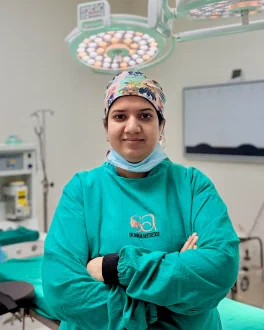
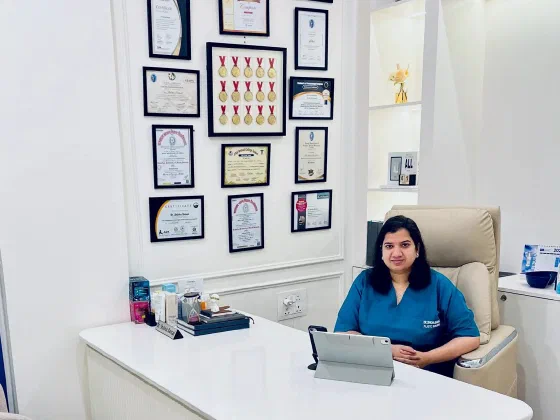
Consultations in Gurgaon are conducted by Dr. Shikha Bansal, MBBS (Gold Medalist), MS General Surgery, MCh Plastic & Reconstructive Surgery (SMS Medical College, Jaipur, 2022), registered with the Haryana Medical Council (Reg No. 24859). In her practice, the implant-brand decision moves the final quote more than any other single choice, which is why the brand conversation happens early in the consult rather than at billing.
This article is for general information only and is not a substitute for medical advice. Pricing and suitability vary with individual anatomy and health history; both should be confirmed with a qualified plastic surgeon at consultation.
Frequently asked questions
What is the breast implant cost in India for silicone implants? Implant-only augmentation with a cohesive-gel silicone pair typically runs ₹1.4–2.25 lakh at an accredited private facility, with most primary cases landing near ₹1.6 lakh, covering the surgeon’s fee, implants, operating theatre, and anaesthesia. Higher-priced silicone lines such as Motiva push a quote toward the ₹2.25 lakh end; price tier reflects the manufacturer’s positioning, not a clinical recommendation, and implant choice is matched to anatomy at consult.
What is the silicone breast implant price for the implants alone? In practice the pair is not quoted alone — it is billed inside the surgical package, which is why a meaningful comparison is package to package rather than implant to implant. Standard Mentor or Allergan cohesive-gel lines keep a quote around the ₹1.6 lakh typical case; higher-priced lines such as Motiva move it toward the ₹2.25 lakh upper end. Price tier does not indicate clinical superiority — implant selection is matched to individual anatomy at consult.
Is the cost of breast enlargement in India covered by health insurance? No, cosmetic augmentation is an elective aesthetic procedure and is excluded by standard Indian health policies. Breast reconstruction after mastectomy is assessed differently as a medically indicated procedure, but that is a separate pathway from cosmetic enlargement.
Can I pay the cost for breast implants in EMI instalments? Yes. EMI through medical-financing partners or credit-card conversion is widely available, with tenures commonly between 3 and 12 months. Ask for the total repayable amount rather than the monthly figure, and confirm the plan covers the full quoted package.
Why is the breast implants price different between two clinics in the same city? Usually because the underlying choices differ: implant brand; pocket placement; whether a lift is combined; anaesthesia and facility standard; surgeon experience. Comparing quotes line by line (implants, OT, anaesthesia, follow-ups) is more informative than comparing totals.
Does the breast augmentation cost include replacing implants years later? No. Implants are not lifetime devices, but there is no fixed replacement schedule: an exchange is done when there is an indication such as rupture, capsular contracture, malposition, or a change in goals, and the chance of needing one rises with implant age. It is a separate procedure with its own cost, typically higher than a primary case if capsule work is needed.
A breast augmentation quote becomes far less confusing once it is read as a set of decisions rather than a single number: brand, placement, incision, combination procedures, facility standard — plus primary versus revision status — account for nearly all the variation between clinics. Working through those decisions against a written, itemised quote, and confirming the numbers at a proper consult, is the most reliable way to know what a specific case will cost. Book a consultation