Lip Reduction Surgery in Gurgaon

Lip reduction — cheiloplasty — is a surgical procedure that removes a controlled wedge of inner lip tissue (mucosa and submucosa) through an incision hidden inside the mouth, so the visible vermilion is reduced in height without leaving a skin scar. Lip reduction surgery at Dr. Shikha Bansal's clinic in Gurgaon is offered for both upper and lower lips, with the technique chosen at consultation based on whether the fullness is genuine macrocheilia, post-filler over-augmentation, or perceived asymmetry that may not need surgery at all. This page covers when reduction is the right call versus leaving the lip alone, how the wedge and M-plasty techniques are matched to the upper lip, lower lip, or both, what the procedure and recovery actually look like, what it costs in Gurgaon, and why pulling the upper lip too thin is the commonest avoidable complication.

Wedge excision performed entirely from inside the mouth — no visible skin scar Technique matched to the lip and the cause: standard transverse wedge or M-plasty for asymmetry Conservative first-pass resection so a small touch-up is preferred over an irreversible over-reduction

What lip fullness actually is, and when reduction makes sense

The visible part of the lip — the pink vermilion — is mostly mucosa stretched over the orbicularis oris muscle, with a thin layer of submucosa and minor salivary glands in between. How “full” a lip looks at rest is decided by three things: the height of the dry vermilion (the smooth pink strip), the bulk of the wet mucosa that everts forward at rest, and the resting tone of the orbicularis muscle behind it. Lip reduction works on the first two. It does not change muscle bulk, and it does not change the position of the upper-lip-to-nose distance (philtral height) or the chin-to-lip distance (mentolabial fold).

Genuine macrocheilia — a lip that is genuinely larger than the rest of the face would balance with — is most often constitutional and bilateral, more commonly affecting the lower lip than the upper, and is more frequent in patients of African or South Indian descent. A second large group is post-filler over-augmentation: the lip was filled, then re-filled, the hyaluronidase dissolved part but not all, and a residual fibrotic bulk remains that no further dissolution will remove. A third, smaller group is asymmetric fullness from previous trauma, mucocele, or healed haemangioma.

What lip reduction is not: it is not a treatment for “perceived” oversize where the lip is in fact within normal proportion. The first job at consultation is to measure the lip against the rest of the face — vermilion height, philtral length, lower-third proportion — and tell the patient honestly when the answer is no surgery rather than yes. Reduction that should not have been done is much harder to undo than not doing it in the first place.
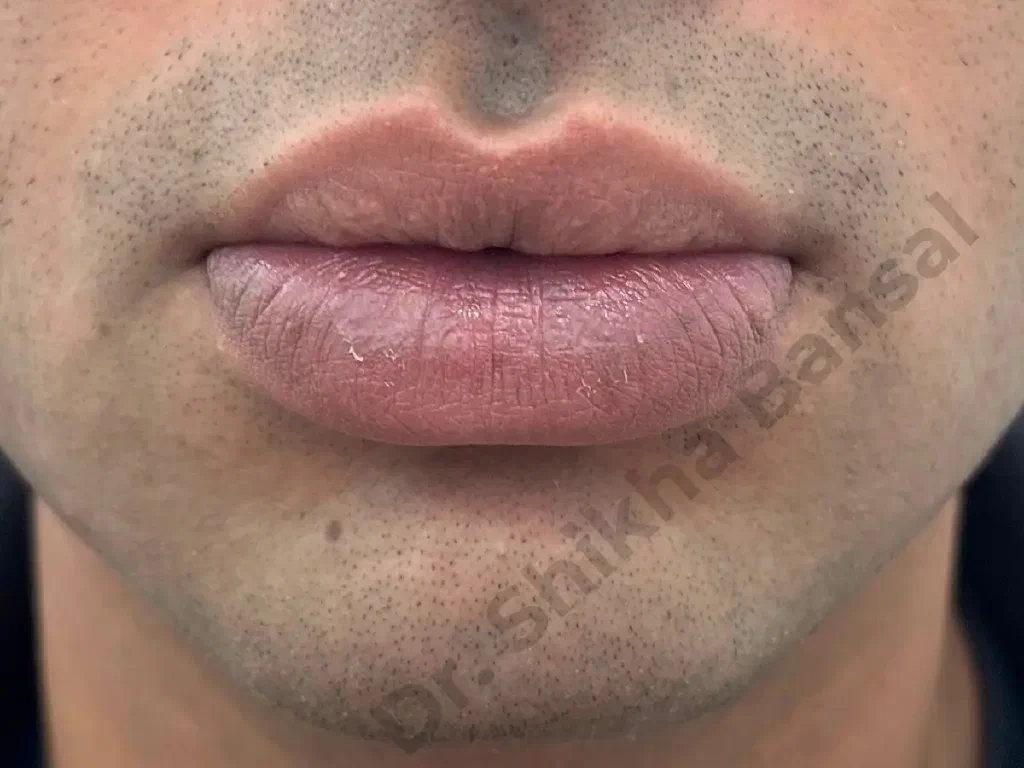
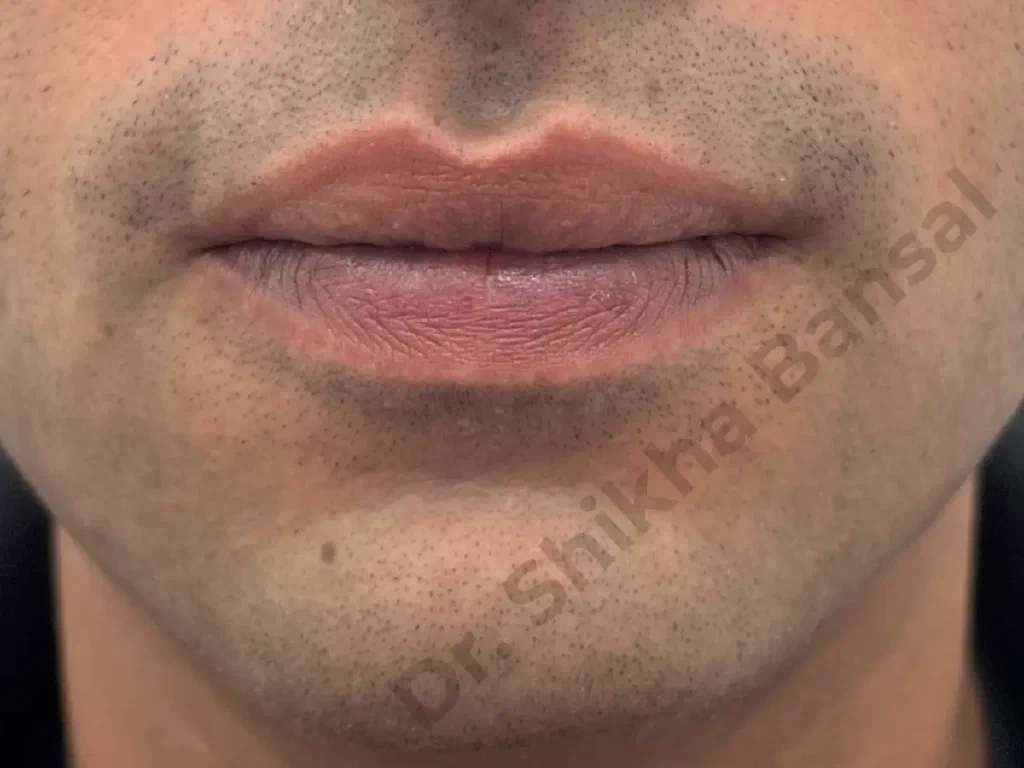
Expert Video Insights

Watch Dr. Shikha talk about specific details, recovery information, and patient experiences through these informative videos

Lip reduction techniques — transverse wedge excision and M-plasty

Lip reduction is a small operation with a precise plan. There is essentially one workhorse technique with one variation, both performed entirely from inside the mouth so no skin scar is created.

Transverse mucosal wedge excision is the standard technique. A horizontal elliptical strip of tissue is marked on the inner (wet) surface of the lip, just behind the wet–dry vermilion border. The strip includes mucosa and a measured thickness of submucosa with the underlying minor salivary glands; the orbicularis muscle is preserved intact so lip movement and competence are not affected. The wedge is removed and the wound is closed in two layers with fine absorbable sutures. The visible dry vermilion is preserved completely — it is simply pulled inward as the wound closes, reducing how much of it shows at rest. Both upper and lower lips can be reduced this way, in the same sitting or staged.

M-plasty modification is added when the fullness is asymmetric — heavier on one side than the other, or with a focal bulge from a healed mucocele or scarred filler — and a straight horizontal ellipse would either leave the asymmetry behind or create a step-off at the midline. The M-shape redistributes tension across the closure and lets the surgeon take more tissue from the heavier side without dragging the philtral columns or the corners of the mouth out of position.

Cryotherapy, laser ablation of the mucosa, injectable enzymatic dissolution, and “lip thread” reduction techniques are mentioned in some cosmetic literature but are not used at the clinic. None of them remove tissue in a way that produces predictable, durable reduction in genuine macrocheilia.

How the technique is matched to upper lip, lower lip, or both

The lip the patient wants reduced and the way the fullness is distributed both change the plan.

Lower lip reduction is the more common request. The lower lip can carry significantly more vermilion height before it looks disproportionate, and patients usually present when the lower lip pouts forward at rest or shows visible wet mucosa even with the mouth closed. The wedge is sized conservatively on the first pass — taking less and reassessing at three months is safer than taking too much and having to plan a flap reconstruction. Lower-lip reduction is also the more forgiving of the two: the lower lip naturally rests slightly fuller than the upper, and a small under-correction looks balanced whereas an over-correction looks tight and unnatural.

Upper lip reduction is technically similar but planned more cautiously. The upper lip frames the smile, supports the philtral columns, and contributes most of the visible animation when the patient talks. Pulling the upper lip too thin is the commonest avoidable complication of this operation and is covered in its own section below. Upper-lip reductions are generally taken in smaller increments, asymmetry is checked carefully because the upper lip is rarely perfectly symmetric to begin with, and the M-plasty modification is more often used to preserve the central tubercle and the corners of the cupid’s bow.

Bilateral upper and lower reduction in the same sitting is offered to patients with genuine bilateral macrocheilia or with post-filler over-augmentation that affected both lips. Total operating time is still under 90 minutes, the recovery timeline runs together, and the result is harmonised across the two lips at the same surgical session rather than over two separate operations.

Patients chasing a slimmer mid-face overall — narrower cheeks plus smaller lips — are sometimes assessed for a buccal fat removal plan in parallel, because the perceived bulk is often coming from the cheek pad rather than the lip itself. The two procedures are entirely separate decisions, considered independently and only combined when each makes sense on its own merits.

Lip reduction is not the opposite of lip filler

Many patients arrive on this page after searching for “lip filler” or “lip augmentation”, and a brief disambiguation matters at the top of the consultation.

Lip filler — hyaluronic-acid injection — adds volume to a lip that the patient feels is too thin or too flat. It is reversible with hyaluronidase, lasts six to twelve months, and is reapplied as the gel resorbs. Lip reduction surgery removes vermilion height and submucosal bulk from a lip that the patient feels is too full or too prominent. It is permanent and is not undone by stopping anything.

The two procedures treat opposite problems, and the patient who is right for one is rarely right for the other. The clinic is a surgical practice; the dermal fillers page covers the volumising, non-reductive end of the conversation as a separate decision. A patient who has had over-aggressive lip filler that no longer fully dissolves with hyaluronidase, however, sometimes does cross from the filler side to the reduction side — and that subset is one of the legitimate indications for surgical reduction.

The procedure, from consultation to same-day discharge

The first consultation takes 20 to 30 minutes. The lips are examined at rest, in animation, and on a smile, with photographs taken at each. Vermilion height, lip competence, philtral length, the position of the cupid’s bow, the corners of the mouth, and the lower-third facial proportion are measured and discussed. Previous filler, history of mucoceles or trauma, any history of cold sores (herpes simplex), bleeding tendency, blood-thinner use, and any history of hypertrophic or keloid scarring are all noted because each one changes the plan.

Patients with a history of recurrent cold sores are started on prophylactic antiviral medication before the procedure, because surgical trauma to the lip can trigger a recurrence and a fresh herpetic ulcer in a healing wound is best avoided. Patients on aspirin or other blood thinners are coordinated with the prescribing physician for a planned pause where it is safe to do so.

The procedure itself is performed at the clinic as a day case. Local anaesthesia — lignocaine with adrenaline, infiltrated into the lip after a topical numbing gel — is the default. Light oral sedation is offered for anxious patients but is rarely needed. The wedge is marked with the patient sitting upright before any swelling distorts the landmarks. The excision and closure are done with the patient supine. A bilateral upper-and-lower reduction takes 45 to 60 minutes total; a single-lip reduction is closer to 30 to 40 minutes. The patient leaves the same day, eats a soft meal that evening, and can return to a desk job within a few days.

Recovery after lip reduction, week by week

Lip recovery is fast on the surface and slower underneath. The visible swelling settles within the first two weeks, but the internal scar continues to soften for two to three months.

Day 0 to Day 3: significant swelling of the operated lip is expected and is most pronounced at 48 to 72 hours. The lips look bigger, not smaller, in this window — patients are warned about this in advance to avoid the common worry that nothing has changed. Cold compresses (not ice cubes directly on the lip) and head elevation while resting reduce the swelling. Speech feels stiff and certain consonants are awkward. A liquid or very soft diet — yoghurt, mashed dal, soft khichdi, smoothies — is followed for the first three to four days. Antibiotic and antiseptic mouth rinses are used after every meal.

Day 4 to Day 7: swelling halves. Most desk-based work is feasible from day three or four if speaking on calls is not constant. Bruising, when it appears, is usually faint and limited to the lip itself rather than spreading onto the chin or cheek. The absorbable sutures inside the mouth begin to loosen.

Week 2: swelling is largely settled. The reduced shape becomes visible for the first time and is usually an under-correction at this stage because residual swelling masks the final result. Sutures have dropped out by the end of this week. Lip make-up and lipstick can be reintroduced from around day ten once the wound is fully closed.

Week 4: shape continues to refine. The internal scar is still firm to the touch and the lip can feel “tight” on a wide smile or yawn — this is normal and softens with time. Most patients are comfortable in photographs from this point on.

Month 2 to Month 3: final shape settles. The internal scar has softened, the lip moves naturally on smile and speech, and any small asymmetry that was held by residual swelling has either resolved or is now stable enough to assess. This is the right time to decide whether a small touch-up is needed; in practice, fewer than one in ten cases come back for one.

Sensation changes — slight numbness or tingling of the dry vermilion — are common in the first weeks and resolve as small sensory nerve endings recover. Persistent numbness beyond three months is unusual.

Cost of lip reduction in Gurgaon

Lip reduction surgery at Dr. Shikha Bansal’s clinic in Gurgaon typically costs between ₹35,000 and ₹75,000 depending on whether one lip or both are being treated, whether an M-plasty modification is needed for asymmetry, and the complexity of any prior filler or scar tissue that has to be navigated. A straightforward single-lip reduction under local anaesthesia sits at the lower end of the range. A bilateral upper-and-lower reduction in the same sitting, or a revision of a previous reduction done elsewhere, sits at the upper end. Lower lip reduction surgery cost in India varies regionally; the band quoted here is for a senior plastic surgeon in Gurgaon NCR.

The main things that move the quote: how many lips are being treated, whether the case is primary or a revision, whether residual filler material has to be addressed in the same sitting, and whether prophylactic antiviral cover is added for a patient with a history of cold sores. Sedation, when chosen, is priced separately from the base local-anaesthesia case.

A written quote is given at the end of the consultation. The quote includes surgeon fee, local anaesthesia, consumables, the antiseptic mouth rinse pack for home use, and the follow-up visits at week one and at three months. Lip reduction is treated as a cosmetic procedure by Indian health insurers and is not covered by standard health insurance.

Why pulling the upper lip too thin is the commonest avoidable complication

The single most common preventable problem in lip reduction surgery is over-reduction of the upper lip. The lip looks “right” on the operating table — when local anaesthesia volume is making it look fuller than its true resting state — and a wedge that seemed conservative under the lights turns out, three months later, to have left the upper lip looking flatter, longer, and older than the patient wanted.

The result is not a complication in the strict surgical sense — there is no infection, no dehiscence, no nerve injury — but it is the outcome patients regret most because it cannot easily be reversed. Adding volume back to an over-reduced upper lip means filler, and filler in a previously operated lip is technically harder than in a virgin lip because the planes of the submucosa are no longer pristine.

Three habits reduce the risk. First, conservative initial resection — taking less on the first pass and accepting that a touch-up at three months is a better trade than over-correction. Second, marking the wedge with the patient sitting upright at consultation, photographed and reviewed before any anaesthesia volume distorts the lip. Third, declining the operation when the patient’s expectation is for a dramatic reduction on a lip that is actually within normal proportion — over-reduction of an already-normal lip is the worst version of this problem because it converts an aesthetic concern into a real one.

Asymmetry of the smile is the second concern patients raise. Some asymmetry is present in almost every face before any surgery — most patients have never looked closely enough at their own pre-operative photographs to notice. Pre-operative photographs reviewed with the patient at consultation make this conversation much easier than it is post-operatively, and any asymmetry that can be corrected is built into the wedge plan rather than left to be addressed later.

Lip reduction in Gurgaon and Delhi NCR — what to expect

The clinic sees patients from across Delhi NCR — Gurgaon, Delhi, Noida, Faridabad, Ghaziabad — for lip reduction surgery, lower lip reduction, upper lip reduction, and post-filler revision lip reduction. A meaningful share of patients are men asking about a lower lip that has always sat fuller than the rest of the face, and a meaningful share are patients who have had repeated lip filler over the past few years and are now looking to reset the lip surgically.

Ethnic-feature preservation matters in this group of patients. A naturally fuller lower lip is not a feature to be normalised toward a cosmetic ideal that does not match the rest of the face. The goal of reduction is proportion within the patient’s own face, not movement toward a standard lip shape. That conversation is held openly at consultation, and the operation is declined or deferred when the request is being driven by a comparison to a feature that does not belong to the patient’s own anatomy.

Out-of-town patients can complete the consultation, the procedure, and the week-one follow-up over a single short trip and review the three-month follow-up via photographs and video call. Walk-ins are accommodated when the calendar allows, but a planned appointment means the consultation is unhurried, photographs are taken properly, and a written quote is handed over before the patient leaves.

Frequently Asked Questions

Good candidates have genuine macrocheilia — a lip that is measurably out of proportion with the rest of the face — or have had previous lip filler that has left a residual bulk after hyaluronidase dissolution. Candidates should be in good general health, have no untreated bleeding tendency, and have realistic expectations about the size of the change (typically a 25–30% reduction in vermilion height, not a halving of the lip). At consultation the lips are measured against philtral length and lower-third facial proportion, and the operation is declined when the lip is in fact within normal proportion or when expectations are for a dramatic change that the procedure does not deliver.

No. The incision is placed inside the mouth on the wet (inner) surface of the lip, just behind the wet–dry vermilion border. There is no skin scar. The internal scar can be felt with the tongue for a few weeks and softens to the point of being imperceptible by the three-month mark. The visible dry vermilion is preserved intact; it is pulled inward as the wound closes, so the colour and texture of the lip surface look unchanged.

Lip reduction surgery at Dr. Shikha Bansal’s clinic in Gurgaon typically costs between ₹35,000 and ₹75,000 depending on whether one lip or both are being treated, whether an M-plasty modification is needed for asymmetry, and whether the case is a primary reduction or a revision after previous filler or surgery elsewhere. A written quote is handed over at the end of the consultation and includes surgeon fee, local anaesthesia, consumables, the antiseptic mouth-rinse pack, and the follow-up visits at week one and three months. The procedure is treated as cosmetic and is not covered by Indian health insurance.

Visible swelling peaks at 48 to 72 hours and halves by the end of the first week. Most patients return to desk-based work from day three or four if their job does not involve constant speaking. The reduced shape becomes visible from week two as the swelling settles, and the final shape is settled by month two to three as the internal scar softens. A liquid or very soft diet is followed for the first three to four days, and antiseptic mouth rinses are used after every meal. Lip make-up can be reintroduced from around day ten.

The wedge excision removes mucosa and submucosa but preserves the orbicularis oris muscle intact, so lip movement, lip competence, and the smile shape are not affected long-term. Speech feels stiff for the first week and certain consonants are awkward while the wound is healing; this resolves as swelling settles and the absorbable sutures dissolve. Eating is awkward only for the first few days while a liquid or soft-food diet is followed. Most patients describe the operated lip as feeling tight on a wide smile or yawn for two to three weeks, and entirely normal beyond that.

Yes. Lip reduction removes actual tissue and is not reversible by stopping any treatment, unlike lip filler which resorbs over six to twelve months. If a patient later decides they would prefer a fuller lip, hyaluronic-acid filler can add volume, but the original tissue composition cannot be exactly restored and filler in a previously operated lip is technically harder than in a virgin lip. This is one of the reasons the first-pass resection is kept conservative — adding back is harder than reducing further at a planned three-month touch-up.

Yes. Bilateral upper-and-lower reduction is routinely done in the same sitting and runs to about 45 to 60 minutes of operating time under local anaesthesia. Patients chasing a slimmer mid-face overall sometimes plan lip reduction alongside buccal fat removal, though those are separate decisions and each is considered on its own merits. Lip reduction can also be combined with revision of previous lip filler in the same sitting when residual fibrotic bulk needs to be addressed. Combination plans are quoted as a single written estimate at consultation.

Almost every face has some pre-existing asymmetry of the lips, the cupid’s bow, and the corners of the mouth before any surgery — most patients first notice it when they look at their own pre-operative photographs at consultation. The wedge is planned to sit symmetrically when the underlying anatomy is symmetric and to compensate for asymmetry when it is not, which is when an M-plasty modification is added. Some swelling-related asymmetry persists for the first two weeks and settles spontaneously. Persistent post-operative asymmetry beyond three months is uncommon and is reviewed at the three-month follow-up before any touch-up is planned.

They treat opposite problems. Lip filler — hyaluronic-acid injection — adds volume to a thin or flat lip, lasts six to twelve months, and is reversible with hyaluronidase. Lip reduction surgery removes vermilion height and submucosal bulk from a lip that is too full or too prominent, is permanent, and cannot be undone by stopping a treatment. The two procedures are completely separate decisions. The only group of patients who legitimately cross from one side to the other are those who have had over-aggressive filler that no longer fully dissolves with hyaluronidase and now have a residual fibrotic bulk that is best addressed surgically.

Book an appointment now!

Get in touch