
Labiaplasty is a surgical procedure that reduces or reshapes the labia minora - the inner lips - usually because projecting tissue is causing mechanical symptoms such as chafing during cycling or gym work, a visible outline in fitted clothing, or tissue catching during intercourse. Labiaplasty at Dr. Shikha Bansal’s clinic in Gurgaon is performed as a day-case procedure, and the consultation starts with whether surgery is indicated at all: labia minora vary enormously in length and symmetry, and projecting past the outer lips is a common anatomical configuration rather than a defect.
Key points
- Assessment that begins with whether surgery is indicated at all - normal anatomical variation is discussed before any operation is proposed
- Female plastic surgeon, female chaperone, and a consultation kept confidential
- Technique matched to the anatomy - edge resection or wedge resection - with the trade-offs of each explained
- Conservative surgical planning, with the smallest effective reduction as the goal rather than the largest achievable one
- Day-case procedure under local anaesthesia with sedation, or general anaesthesia where preferred
- Dissolving sutures throughout, so there are no stitches to remove
- A realistic recovery timeline given in writing, including the six-week restrictions
- No before-and-after imagery of this procedure published anywhere
What labiaplasty is - and what it does not do
Labiaplasty is the surgical reduction or reshaping of the labia minora, the inner lips of the vulva. In some cases the labia majora - the outer lips - or the clitoral hood are addressed in the same operation. It is a soft-tissue operation on the external genitalia, performed as a day case.
What it treats is a specific, mechanical problem: labial tissue that projects far enough to be caught, rubbed, or compressed. What it does not treat is a longer list, and it is worth being explicit about it before anything else, because a great deal of marketing in this category implies otherwise.
Labiaplasty does not tighten the vagina. The vaginal canal is a separate structure and is not touched by the operation. It does not treat urinary leaking or stress incontinence, which are pelvic floor and urethral problems requiring a different assessment altogether. It does not treat vaginal laxity after childbirth. It does not treat pelvic organ prolapse. It is not a treatment for reduced sensation, and it is not offered here as a way to change sexual function.
If the concern is any of the above, labiaplasty is the wrong operation and the consultation will say so. Symptoms of that kind need a diagnosis first - often from a gynaecologist or a pelvic floor physiotherapist rather than a plastic surgeon.
Normal variation comes first, before any discussion of surgery
Most patients who come in having noticed that the inner lips project beyond the outer ones, or that one side is longer, are asking a version of the same question: is mine normal. In the large majority of cases the answer is yes.
In a widely cited normative series, fifty premenopausal women had their external genitalia measured, and labia minora length ranged from roughly 2 cm to about 10 cm, with width varying just as widely. No statistically significant association was found with age, parity, ethnicity, hormonal use, or history of sexual activity (Lloyd et al., BJOG 2005). Asymmetry between the two sides is commonly reported across the published series. There is no medically defined normal length, and neither pigmentation nor symmetry follows a standard.
A good deal of the distress on this subject comes from comparison against hair-removed, digitally edited, or pornographic images, which do not represent the range of normal anatomy. That is discussed openly at consultation. Where the examination shows ordinary variation and there are no mechanical symptoms, the honest recommendation is no surgery, and a number of consultations end there.
The background to this - the common causes of labial enlargement, and why asymmetry is so frequent - is covered in more detail in the guide to what causes labia minora to stick out.
When protrusion is a functional problem rather than an appearance one
Protrusion becomes a functional problem when the tissue produces reproducible mechanical symptoms. The presentations seen most often at the clinic in Gurgaon are chafing or soreness with cycling and gym work, and a visible outline or discomfort in leggings and swimwear. The fuller list of mechanical complaints:- Chafing, rubbing, or soreness during cycling, running, spinning, or gym work
- A visible outline, pressure, or discomfort in leggings, swimwear, or fitted clothing
- Tissue folding inwards or catching during intercourse
- Difficulty with hygiene, with recurrent dampness or irritation in the folds
- Interference with tampon or menstrual cup use
- One side long enough that it is repeatedly caught or pinched, where the other is not
- Tissue distorted by a previous tear, piercing, or straddle injury
Talk it through with Dr. Shikha
Book a consultation at Dr. Shikha Aesthetics in Sushant Lok 1. Bring your questions about labiaplasty, and any previous reports.
Conservative measures, and appearance-only concerns
Appearance-only concerns, with no mechanical symptom present, are a different conversation. They are not dismissed, but they lead to a longer discussion about normal variation before surgery is considered, and they are not treated as an automatic indication.
Conservative measures come first, and for some patients they resolve the symptom without any operation: seamless cotton underwear, avoiding thongs and hard seams, padded shorts and a different saddle for cyclists, washing with water or a plain unscented emollient rather than soaps or douches, a barrier ointment before long rides, and treating any underlying dermatitis. Where symptoms persist despite all of that, surgery becomes reasonable to discuss.
Trim and wedge techniques, and what each one preserves
There are two established techniques. Neither is universally better, and the choice depends on the anatomy, where the excess tissue actually sits, and what the patient wants preserved. Both are discussed with reference to the patient’s own anatomy at consultation rather than in the abstract.
Edge resection, also called the trim technique, removes tissue along the free edge of the labium minus and closes the resulting margin directly. It is technically straightforward, it handles excess tissue distributed along the whole length well, and it can address a darkly pigmented edge if that is the specific complaint. Its trade-off is that it removes the natural labial edge itself, including the pigment border and the slightly irregular contour most people have. The scar runs along the length of the new margin.
Wedge resection removes a V-shaped or wedge-shaped section from the middle of the labium and rejoins the remaining upper and lower portions, which preserves the natural free edge, its pigment border, and its contour. Because it works away from the edge, it also keeps the edge’s nerve and blood supply more intact. Its trade-off is that it is technically more demanding, the wound is under more tension, and wound separation at the closure line is a recognised complication that occurs more often than with an edge resection.
Where the clitoral hood contributes to the appearance, a hood reduction may be discussed as part of the same operation. It is planned conservatively, because this is an area where removing too much is both easy and difficult to correct.
Regardless of technique, the operation is planned to remove the least tissue that resolves the symptom. Over-resection is the complication that cannot be reversed, and the surgical plan is built around avoiding it.
The procedure, from consultation to same-day discharge
The first consultation takes about 30 minutes. It is conducted with a female chaperone present. History covers the specific mechanical symptoms and how long they have been present, obstetric history, any skin conditions affecting the vulva, previous surgery or injury, and medication including blood thinners and hormonal treatment. Examination is brief and focused, and the anatomy is discussed with the patient rather than about her. Where a skin condition is suspected - lichen sclerosus in particular - that is investigated and treated before any surgery is planned.
The procedure itself is performed as a day case. It is usually done under local anaesthesia with sedation; general anaesthesia is used where the patient prefers it or where labiaplasty is being combined with another procedure. A unilateral or straightforward bilateral reduction takes about 45 to 60 minutes. Combined cases take longer. Fine absorbable sutures are used throughout, so there are no stitches to remove.
The patient is discharged the same day, and should be driven home rather than drive. A follow-up review is scheduled for the first week, with further reviews at six weeks and at three months, because the tissue continues to settle over that period and the final result is not assessable early.
Risks are stated before consent rather than afterwards, and they are set out in full further down this page.
Recovery after labiaplasty, week by week
Recovery is more prolonged than the small size of the operation suggests, largely because the area is difficult to keep still, dry, and unpressured. The timeline below is typical; wedge resections tend to run at the slower end of each stage.
Day 0 to Day 3: swelling and bruising build and can be marked - the area swells more than patients expect, and this is not a sign that something has gone wrong. Cold compresses over a cloth, not directly against the skin, and lying down with the hips slightly elevated both help. Prescribed analgesia is used regularly rather than waiting for pain. Loose clothing and no underwear seams across the area.
Day 4 to Day 10: swelling usually peaks around day three to five and then begins to settle. Desk work is usually manageable from around day five to seven, with the caveat that prolonged sitting is uncomfortable. The area is washed with water and patted dry, front to back. No baths, swimming, or submersion.
Week 2 to Week 4: much of the swelling has begun to settle and the sutures are dissolving, though noticeable swelling commonly persists to around six weeks. Walking is comfortable. Cycling, running, gym work, and anything with a saddle or a seam under pressure remain off-limits. The area may look uneven at this stage - asymmetric swelling during healing is common and is not the final result.
Week 4 to Week 6: light exercise resumes. Intercourse and tampon or menstrual cup use are avoided until at least six weeks and until reviewed, because the closure line is still gaining strength.
Week 6 to Month 3: normal activity including cycling and gym work resumes, usually from around week six to eight. Residual swelling continues to settle and the scar softens.
Month 3 to Month 6: the tissue reaches its settled shape and the scar matures. This is the point at which the result is assessed properly, and the earliest at which any revision would be considered.
Risks and recognised complications
Labiaplasty is an elective operation on healthy tissue, which raises rather than lowers the standard for disclosure. The recognised complications:- Bleeding, or a haematoma requiring drainage
- Infection, uncommon but requiring prompt treatment given the site
- Wound separation at the closure line - more frequent with wedge resection, and usually managed conservatively
- Partial tissue necrosis at the closure, more relevant to wedge resection than to edge resection
- Prolonged or asymmetric swelling during healing
- Residual or new asymmetry once healed, sometimes requiring a small revision
- Notching, or a visible step in the free edge
- Under-correction: persistent protrusion needing a further procedure
- Scarring that is tender, thickened, or tethered
- Altered sensation in the operated tissue - usually temporary, occasionally persistent
- Pain with intercourse, which can persist
- Dissatisfaction with the aesthetic result even where healing is uncomplicated
- Risks of sedation or general anaesthesia, which the anaesthetist assesses and discusses separately before the day of surgery
- Over-resection: removal of too much tissue
Over-resection - the one complication that cannot be undone
Over-resection is the complication that matters most, because it is the one that cannot reliably be undone. Labial tissue that has been removed cannot be replaced. Excessive removal can leave exposed, dry, or chronically irritated tissue, an unnatural appearance, tethering and scar discomfort, and pain with intercourse - and reconstruction after over-resection is difficult, incomplete, and sometimes not possible at all.
This is the reason the operation is planned conservatively, why the smallest effective reduction is the goal rather than the largest achievable one, and why a patient asking for maximal removal will be advised against it. The amount of tissue to be removed is planned in detail and agreed before consent.
Revision surgery, where it is needed, is not considered before the three- to six-month mark, because tissue that looks asymmetric at week four often settles on its own.
Age, consent, and when the answer is not surgery
Labial appearance changes through adolescence and into the early twenties, under the influence of oestrogen. A teenager whose labia minora project is usually observing normal development, and the appropriate response is reassurance and information, not resection. Appearance-only labiaplasty is not performed on minors at this clinic. Where a genuine functional problem exists in a younger patient, it is assessed on its own merits, conservatively, and with the parent or guardian involved throughout.
Surgery is also deferred or declined in several other situations. Active skin disease affecting the vulva - lichen sclerosus above all - needs a dermatological diagnosis and treatment first, because operating on active disease can worsen it. Lichen sclerosus additionally requires long-term follow-up and biopsy of any suspicious area, given a small associated risk of vulvar cancer. Labial change noticed after vaginal delivery is allowed to settle before anything is planned; the reasoning is set out in the guide to timing surgery after childbirth or a caesarean.
Surgery is also not the answer where the patient is being pressured by a partner or anyone else, where the expectation is a change in sexual function, or where the described concern does not match the examination. Those consultations end without an operation being booked, and that is a legitimate outcome rather than a failed appointment.
Consultation, privacy and discretion in Gurgaon
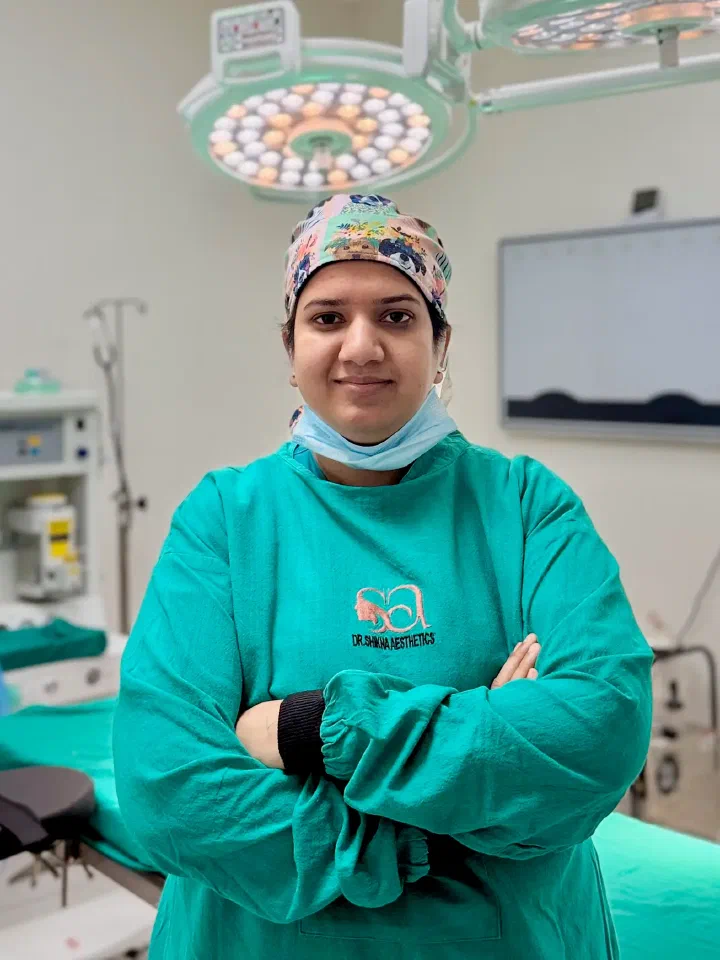
This is a private consultation for a sensitive complaint, and it is run accordingly. Dr. Shikha Bansal is a female plastic surgeon; a female chaperone is present for examination; and the consultation, examination, and any clinical photography are confined to the consulting room. Clinical photographs, where taken, are for the medical record and for surgical planning only. They are not used on the website, in advertising, or on social media, and no before-and-after imagery of this procedure is published anywhere.
Appointments can be made without stating the procedure to reception. Where a patient would prefer to ask questions before booking an in-person appointment, an initial enquiry over WhatsApp is possible, and out-of-town patients from across Delhi NCR - Delhi, Noida, Faridabad, Ghaziabad - can send follow-up queries the same way between visits.
The consultation carries no obligation to proceed. As set out above, a meaningful proportion of these consultations conclude with a recommendation against surgery, and that recommendation is given as readily as the alternative.