Puffy eyes, heavy or hooded upper eyelids, and stubborn under-eye bags are the three complaints that bring most patients to this consultation. Blepharoplasty - also called eyelid surgery or eyelid reshaping surgery - treats all three by removing or repositioning excess skin, fat, and muscle from the upper eyelids, lower eyelids, or both. At Dr. Shikha Bansal’s clinic in Gurgaon it is performed as a day-case procedure under local anaesthesia with light sedation. The technique is chosen to match the actual anatomy: upper-lid skin excess and hooding are corrected differently from lower-lid fat herniation, under-eye bags, or a tear-trough hollow, and patients with an Asian eyelid have a separate set of considerations.
Key points
- Hooded upper lids opened up so the lid sits cleanly inside its natural crease
- Under-eye bags reduced or repositioned, with the tear-trough filled by the patient’s own fat where appropriate
- Lid-support step (canthopexy or canthoplasty) added when the lid is lax, to reduce the risk of the lower lid pulling downward after surgery
- Upper-lid scar hidden inside the natural crease; lower-lid transconjunctival approach with no external scar
- Upper field of vision improved when heavy upper lids were the cause
- Same-day discharge under local plus sedation, no overnight hospital stay
What blepharoplasty treats: puffy eyes, hooded eyelids, and under-eye bags
Blepharoplasty is the surgical reshaping of the eyelid - upper, lower, or both - by removing or repositioning excess skin, herniated orbital fat, and, where needed, the underlying orbicularis muscle. The eyes are usually the first part of the face to show ageing because eyelid skin is the thinnest skin on the body and the orbital fat pads sit on top of bony rims that change subtly with time. The result is a tired, heavy, or puffy look that does not match how the patient feels.
The procedure addresses a small set of well-defined problems. On the upper lid: redundant skin that hoods the lash line, fullness from medial fat-pad bulge, and a heaviness severe enough in some patients to block the upper field of vision (functional rather than purely cosmetic). On the lower lid: under-eye bags from herniated orbital fat, a deep tear-trough hollow, fine wrinkling and crepey skin, and lower-lid laxity that lets the lid sit lower than it should.
Blepharoplasty does not lift the brow, smooth out crow’s feet, or change the colour of pigmented dark circles. The surgery stays inside the lid skin and the orbital fat pads; brow ptosis, crow’s feet, and pigmented dark circles are addressed with separate procedures and can be combined when relevant.
Dr. Shikha explains

Puffy eyes and under-eye bags, explained

Upper eyelid surgery for extra eyelid skin
Results
Blepharoplasty: before and after
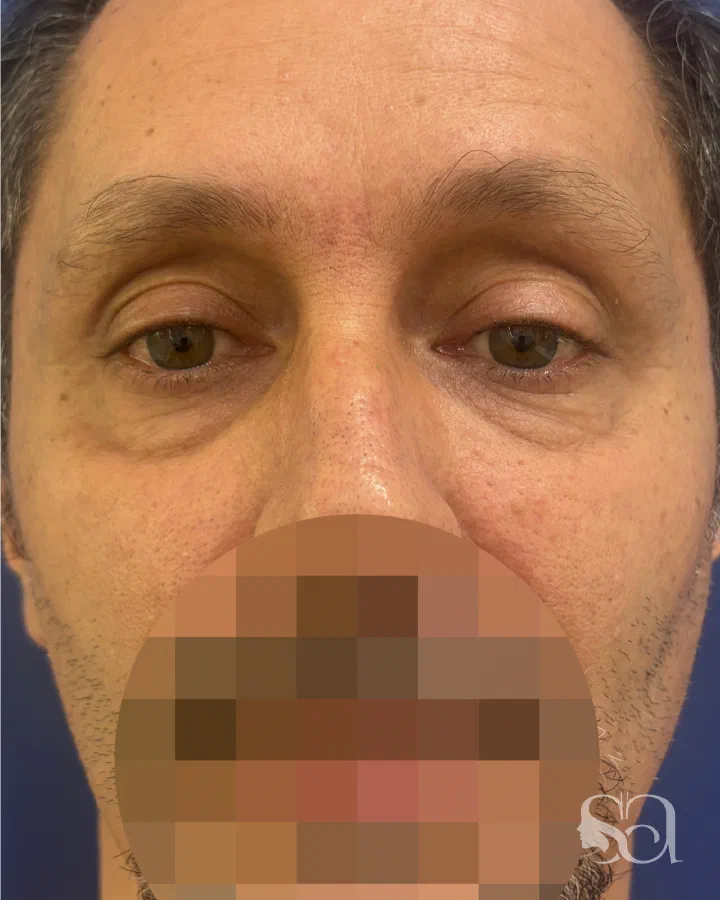 Before
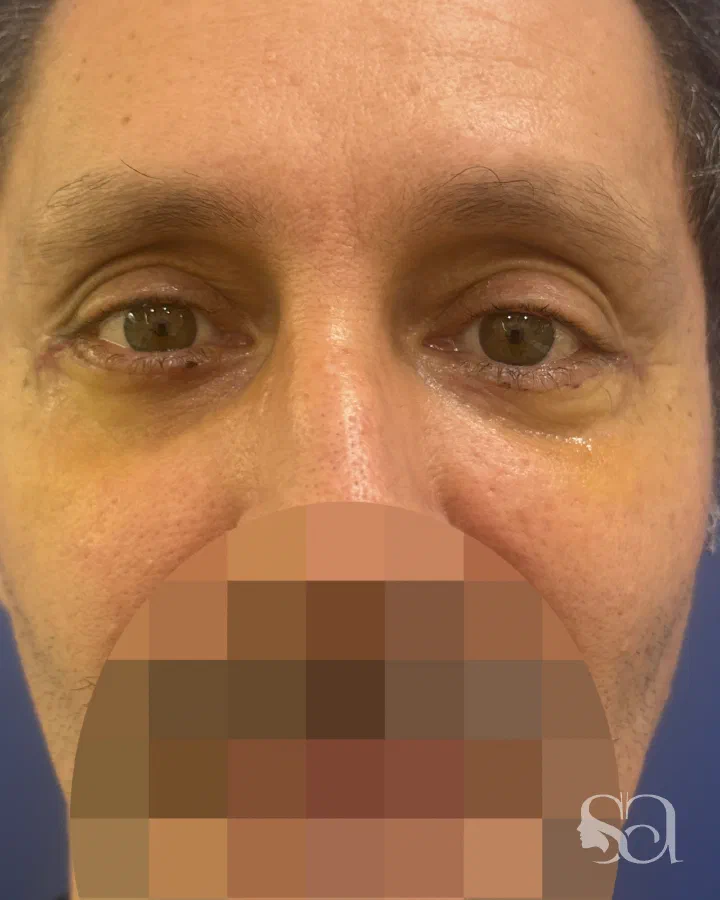 After
AfterBlepharoplasty
- 7 days after surgery
- Results vary between individuals
Photographs of the clinic's own patients, shown with their written consent, with faces blurred or covered as far as the result allows. They explain what an operation can change; they are not a promise of your result.
Eyelid surgery techniques - upper, lower transcutaneous, transconjunctival, canthoplasty, Asian-crease
There is no single best blepharoplasty technique. The right approach depends on which lid is being treated, what the dominant problem is (skin excess, fat herniation, lid laxity, hollow), and the patient’s pre-existing anatomy. Dr. Shikha walks through the upper-lid hooding case and the under-eye bags case in the videos below; the section here covers the full technique map.
Upper eyelid blepharoplasty is the workhorse for hooding and skin redundancy. A thin ellipse of skin is excised through an incision inside the natural upper-lid crease so the scar settles in a shadow line; a strip of orbicularis muscle and a small amount of medial fat are removed when present. This addresses heavy upper lids, excess eyelid skin, and the upper-field restriction patients describe as “having to lift the brows just to see”.
Lower eyelid transcutaneous blepharoplasty uses an incision just below the lash line. It gives access to all three lower-lid fat compartments and to the lower-lid skin, so it is used when both fat herniation and skin excess are present, and it is the route through which lid-tightening (canthopexy or canthoplasty) is added.
Lower eyelid transconjunctival blepharoplasty reaches the same fat compartments through an incision inside the lid, leaving no external scar. It is the technique of choice when fat herniation is dominant without significant skin excess. Mild skin excess is addressed separately with a chemical peel, laser resurfacing, or a small skin pinch.
Tear-trough fat repositioning mobilises herniated fat and tucks it into the tear-trough hollow rather than simply removing it. The bag is reduced and the hollow is filled with the patient’s own tissue - the technique most likely to give a natural lower-lid contour when both a bag and a tear-trough are present.
Canthopexy and canthoplasty are lid-support steps done alongside lower-lid blepharoplasty in patients with pre-existing laxity (round eyes, lower lid below the limbus, slow snap-back). Without lid support, transcutaneous lower-lid surgery in a lax-lid patient risks pulling the lid downward (ectropion or scleral show) - the single commonest avoidable complication of lower-lid work.
Asian-eyelid blepharoplasty is a separate procedure aimed at creating or refining an upper-lid crease while preserving the natural ethnic character of the eye - crease creation and pretarsal definition, with only conservative skin excision when true excess is present, not the more aggressive skin removal used in Western/non-Asian upper-lid blepharoplasty - evaluated as a distinct sub-conversation.
How the technique is matched to the patient's anatomy
At consultation the eyelid is examined in good light: skin laxity is assessed by pinching, fat herniation by gentle pressure on the globe, lid laxity by the snap-back test, the brow position is checked separately (a low brow can masquerade as upper-lid hooding), and any tear-trough hollow is graded. Dry eye history, prior LASIK, thyroid disease, and any facial palsy are noted explicitly because each changes the surgical plan.
Hooded upper lid, skin excess only - upper blepharoplasty with conservative skin-only excision. The commonest presentation, fast healing.
Hooded upper lid with medial fat fullness - skin excision plus medial fat-pad reduction. The central fat pad is treated conservatively, if at all, because over-removal hollows the lid; lateral fullness is often the lacrimal gland, which is not removed.
Heavy upper lid with brow ptosis as the actual driver - brow lift first, blepharoplasty assessed afterward. Operating on the lid alone in a low-brow patient pulls the brow lower and worsens the heaviness.
Lower-lid bags, younger patient with good skin tone - transconjunctival blepharoplasty with fat repositioning into the tear-trough. No external scar, fast recovery.
Lower-lid bags plus skin excess and fine wrinkling - transcutaneous blepharoplasty with fat repositioning, plus a skin pinch or laser resurfacing.
Lower-lid bags plus pre-existing lid laxity - transcutaneous blepharoplasty with canthopexy or canthoplasty added in the same sitting. Skipping the lid-support step is the commonest reason lower-lid blepharoplasty needs revision.
Tear-trough hollow without a true bag - fat repositioning if there is enough fat to mobilise; dermal fillers as a non-surgical alternative when the hollow is purely volume-loss. That filler-vs-surgery conversation continues on the dermal fillers in Gurgaon page.
Yellow plaque on the inner lid alongside upper-lid hooding - combined planning with the xanthelasma removal in Gurgaon approach so the plaque excision and the blepharoplasty are sequenced together.
Asian-eyelid patient wanting a defined crease without losing ethnic character - Asian-eyelid blepharoplasty as a distinct technique, planned around crease height and pretarsal show.
Talk it through with Dr. Shikha
Book a consultation at Dr. Shikha Aesthetics in Sushant Lok 1. Bring your questions about blepharoplasty, and any previous reports.
The procedure, from consultation to same-day discharge
The first consultation takes 30 to 40 minutes. The eyelids are examined under good light, the brow position is documented, the snap-back test is done on the lower lid, and a Schirmer test is offered when there is any history of dry eye. The patient is asked about prior LASIK or eyelid surgery, current medications (especially blood thinners, fish oil, anti-inflammatories), and any history of keloid scarring. A pre-operative ophthalmology check is recommended for any patient with significant dry eye, glaucoma, or thyroid eye disease before surgery is booked.
The procedure is performed as a day case. Local anaesthesia (lignocaine with adrenaline) is used for upper-lid surgery alone in most patients; combined upper-and-lower or lower-with-canthopexy procedures are typically done under local plus oral or intravenous sedation. The patient is awake but comfortable, and able to open and close the eye for intra-operative checks of symmetry - one of the reasons local-with-sedation is preferred over a fully asleep approach for eyelid work.
Operating times: upper-lid alone, 45 to 60 minutes; lower-lid alone, 60 to 75 minutes; combined upper and lower, 90 to 120 minutes; canthopexy or canthoplasty adds another 20 to 30 minutes. Fine 6-0 sutures close the upper-lid incision; the transconjunctival incision is closed with absorbable sutures or left to heal without sutures; the transcutaneous lower-lid incision is closed with fine 6-0 or 7-0 sutures. Discharge is the same day after 30 to 60 minutes of observation, accompanied home.
Recovery after blepharoplasty, week by week
Recovery follows a predictable arc. The numbers below are typical for a primary upper-lid, lower-lid, or combined procedure under local plus sedation; canthopexy or canthoplasty cases run a few days longer at each stage.
Day 0 to Day 3: swelling and bruising peak at 48 to 72 hours. Bruising is most visible on the lower lid because gravity pulls fluid downward. Cold compresses (over a clean cloth, not directly on the lid) for the first 48 hours and sleeping with the head elevated on two pillows make a measurable difference. Mild discomfort is managed with paracetamol; opiates are rarely needed. The eye is not patched - the lid is treated, not the globe - but artificial-tear drops are used liberally for the first week.
Day 4 to Day 7: swelling settles markedly. Sutures on the upper lid and on the transcutaneous lower lid are removed at day 5 to 7. Most patients can read comfortably and use a screen for short blocks by day 7. Make-up over the lid is held back until the suture site is fully closed.
Week 2: bruising fades from purple to yellow-green and is camouflage-able with concealer. Desk-based work is comfortable. The lid contour is starting to show, although the final shape is still 6 to 8 weeks away.
Weeks 4 to 6: residual pinkness at the incision line is the only remaining sign. Light cardio resumes from week 3, heavier activity (running, weightlifting, yoga inversions) from week 4. Contact lenses and swimming are usually cleared at the four-week review.
Month 3 and beyond: the upper-lid crease incision has settled into a thin line that is hard to see at conversational distance. The transcutaneous lower-lid line, when present, has flattened and faded. The lid contour has reached approximately 90% of its final shape, with final settling at month 6 to 12.
Patients flying in from outside NCR - Mumbai, Bangalore, Hyderabad, Pune, Chandigarh, the Gulf - typically plan a 7 to 10 day stay so suture removal and the first wound check happen in person.
Risks and complications of eyelid surgery
Bruising, swelling and temporary chemosis (swelling of the white of the eye) are expected. Dry, gritty or watery eyes are common in the first weeks and usually settle; pre-existing dry eye raises the chance that dryness persists. Infection and small wound breakdowns are uncommon.
Bleeding behind the eye (retrobulbar haematoma) is rare but is an emergency, because it can threaten vision. Sudden severe pain, rapidly increasing swelling, a bulging eye or any drop in vision after surgery needs urgent same-day review.
Other recognised risks include incomplete eye closure, lower-lid malposition, asymmetry, temporary double vision, visible or thickened scars, and the small risks of local anaesthesia and sedation. These are discussed before consent, not afterwards.
Revision, asymmetry, and when blepharoplasty needs to be redone
Most primary cases do not need revision. The small number that do fall into a few well-defined categories, and the conversation is opened only after the tissue has fully matured at 6 to 12 months.
Mild asymmetry between the two sides is the commonest finding at the 3-month review. Some asymmetry was almost always present before surgery - the two sides of any face are never identical - and the surgery does not erase it. A 1 to 2 millimetre difference in crease height or lower-lid contour does not warrant revision; a difference larger than 3 millimetres that is visible at conversational distance and bothers the patient is an indication.
Under-correction on the upper lid - residual hooding at 6 to 12 months. The easiest revision: a small additional skin excision through the same incision under local anaesthesia.
Over-correction on the upper lid - too much skin removed, leaving the lid feeling tight or causing incomplete closure (lagophthalmos). Mild lagophthalmos resolves over the first few months; persistent lagophthalmos at 6 months is uncommon and is corrected with a skin graft.
Lower-lid retraction or scleral show after transcutaneous surgery - the lid sits lower than before. This is the complication that canthopexy and canthoplasty are specifically designed to prevent, and it is the reason lax-lid patients should not have a transcutaneous lower-lid blepharoplasty without lid support. When retraction does occur, it is corrected with a canthoplasty and, in moderate cases, a hard-palate graft.
Persistent lower-lid bag - fat herniation that recurred or was not fully addressed at the index surgery. Revision is by transconjunctival fat reduction, which leaves no external scar.
Hollowing under the eye after over-aggressive fat removal - correction is by fat grafting from the abdomen or thigh into the tear-trough, with or without dermal fillers as a temporising measure.
Revision rates after primary blepharoplasty in published series are in the 5 to 10% range - lower in upper-lid-only cases and higher in lower-lid cases with fat-repositioning components.
Blepharoplasty in Gurgaon and Delhi NCR - what to expect
The clinic sees patients from across Delhi NCR - Gurgaon, Delhi, Noida, Faridabad, Ghaziabad - for blepharoplasty, eyelid surgery, eye lid surgery, and eyelid reshaping surgery. Patients also fly in from Mumbai, Bangalore, Hyderabad, Pune, Chandigarh, Jaipur, and the Gulf. The typical out-of-NCR itinerary: arrival the day before surgery, surgery on day one, suture removal at day five to seven, discharge home from day seven to ten. Progress photographs over WhatsApp keep the four-week and three-month reviews on schedule without a return visit.
Consultations are by appointment. A planned slot means the eyelids are examined under proper lighting, the brow position is documented, and the snap-back test is done unhurriedly. For uncomplicated upper-lid cases the consultation and the surgery can occasionally be scheduled in the same week; lower-lid, combined, and revision cases are booked across two or more visits so the pre-operative ophthalmology check (when needed) and the surgical plan are locked in without rushing. Patients are encouraged to bring photographs of how their eyelids looked 5 to 10 years earlier - that grounds the conversation in what has actually changed rather than an idealised target.