
Booking breast augmentation in Delhi NCR from outside the city, or from overseas, raises a different set of questions than the procedure itself. How many days does the trip actually need? Where does recovery happen, in a hotel or a dedicated recovery stay? When is it safe to board a flight home, and who checks the incision before departure? This post lays out a concrete day-by-day plan for NRI and out-of-station patients considering breast augmentation in Gurgaon, alongside the clinical basics any candidate needs before locking travel dates: procedure mechanics and recovery timeline, plus planning cost ranges.
Most guides on breast augmentation cover anatomy and implant types but skip the logistics that decide whether a trip is even feasible. This one is built around the travel question first, because for a patient flying in from Dubai or a smaller Indian city, the itinerary often determines whether surgery happens this quarter or gets pushed another year.
Who this article is for
- NRI patients based abroad planning a surgical trip to Gurgaon or Delhi NCR around annual leave or a family visit
- Out-of-station patients from other Indian cities weighing whether a single trip can cover consultation, surgery, and follow-up
- Patients who have already read about implant sizing and the in-person consult process and now need to plan the visit itself
- Patients deciding between implants and fat transfer who want the travel implications of each, covered in breast augmentation vs. fat transfer
- Anyone comparing surgeons before committing travel dates, addressed in choosing a breast augmentation surgeon in Gurgaon
What does the breast augmentation procedure involve?
Breast augmentation places a silicone or saline implant beneath the breast tissue or chest muscle to increase volume or adjust shape. The procedure is typically performed under general anesthesia and takes roughly 1.5 to 2.5 hours, depending on incision approach and whether a lift is combined with augmentation. Most patients go home the same day or after one night of observation.
Three incision sites are commonly used: inframammary (in the crease under the breast), periareolar (around the areola edge), and, less often, transaxillary (in the armpit). The choice between them depends on breast anatomy and implant size. Whether nipple sensation or breastfeeding capacity is a priority for the individual patient also factors in; this is one of the specific decisions made at the in-person consult, not before.
Implant placement is either subglandular (above the chest muscle, under breast tissue) or submuscular/dual-plane (partially under the pectoral muscle). Submuscular placement tends to give a more gradual upper-pole slope and may lower the visibility of implant edges in thinner patients, though it typically involves a slightly longer initial recovery of muscle soreness. The surgeon reshapes the breast pocket to seat the implant symmetrically and checks for even fold placement on the table before closing in layers and dressing the incision.
Post-operative care timeline: what happens each week
Recovery from breast augmentation follows a fairly predictable arc. Swelling and tightness dominate days 1–3. Discomfort eases through the first week, and most patients resume light daily activity by day 7–10, with full exercise clearance closer to week 6. Drains are uncommon for straightforward augmentation but may be used when combined with a lift. Compression garments or surgical bras are worn for several weeks to support implant positioning as swelling resolves.
- Day 0 (surgery day): procedure performed, short observation period, discharge same evening or next morning with a support garment already fitted
- Day 1–3: peak swelling and soreness; oral pain management; light walking encouraged, no lifting above shoulder height
- Day 4–7: soreness tapers; suture-line check and dressing change usually scheduled around day 6–7
- Week 2–3: early swelling has eased and desk-based work is generally comfortable; implants continue to settle, and the final shape usually settles over about three to six months
- Week 4–6: gradual return to gym activity and upper-body exercise, cleared individually at follow-up
For a more detailed week-by-week breakdown of when yoga, gym sessions, or breastfeeding-related activity can safely resume, see the lifestyle-return recovery timeline, a useful reference for deciding how long a companion or support person should plan to stay.
Breast augmentation surgery Gurgaon: the NRI travel itinerary
A workable trip for out-of-station and NRI patients generally spans 9–12 days. It starts with consultation and pre-op workup, followed by surgery day, then a 7-day post-op stay window near the clinic for wound checks and early recovery, ending with a final suture-check clearance before flying home. Shorter trips are sometimes possible for straightforward cases already assessed via video consult, but building in the 7-day buffer avoids rescheduling flights if healing is slower than average.
Day 1: arrival and consult. Arriving a day before surgery allows time for the in-person consultation and sizing discussion, along with pre-anesthesia bloodwork and any imaging the surgical team requests. This is also when incision approach and implant placement are finalized based on chest wall anatomy and patient goals.
Day 2: surgery day. Patients typically arrive fasting in the morning and undergo the 1.5–2.5 hour procedure. They are monitored for several hours post-anesthesia before being discharged to a hotel or recovery-stay facility with a support person present overnight.
Day 3–8: recovery stay. This is the window built for swelling to settle and for the surgical team to see the patient in person if anything feels off, such as a fever or unusual swelling on one side. A short in-clinic check is usually scheduled around day 6–7 to inspect the incision and remove any external dressing or non-dissolvable sutures.
Day 9 (or later): fly-home clearance. Before booking the return flight, the surgical team confirms the incision is healing cleanly and there is no sign of hematoma or infection. Arm mobility for standard airline travel is also checked; an aisle seat and compression stockings are commonly advised for long-haul flights, along with short walks every hour or two on flights over 4–5 hours. Long-haul international flights are generally deferred a few extra days compared to a short domestic hop, purely to build in a margin for swelling to stabilize.
Beyond day 9: remote follow-up. Photos and a video call are used to review healing at the 3-week and 6-week marks after the patient has returned home, with a plan to return in person only if something looks unexpected or a revision consult is needed. This remote-check model is what allows NRI patients to avoid a second long-haul trip for routine follow-up. Before flying home, arrange a local doctor or plastic surgeon who can examine you in person, and confirm how to reach the Gurgaon team urgently. Fever, spreading redness, wound discharge or sudden swelling on one side need in-person assessment locally rather than a photo review.
Hotel vs. dedicated recovery stay near Sector 43
Patients weigh two options for the 7-day post-op window: a standard hotel near the clinic in Sector 43, Sushant Lok, or a dedicated recovery-stay arrangement with more hands-on nursing support. A standard hotel works well for patients traveling with a capable support person who is comfortable helping with dressing changes and mobility in the first 48–72 hours. A recovery-stay option with attendant support is generally preferred by solo travelers and older patients, as well as anyone combining augmentation with a more involved procedure such as a lift or a broader mommy makeover, where post-op mobility is more limited in the first few days.
Gurgaon context: planning cost and what the fee includes
Breast augmentation cost in Gurgaon depends on implant type (saline vs. silicone) and brand. Incision technique also plays a role, and combining a lift with the augmentation moves a quote above the implant-only band. As a general planning figure, straightforward implant-only augmentation runs roughly ₹1.4–2.25 lakh, with most cases near ₹1.6 lakh and combined lift-and-augment cases running higher. These are planning ranges only; a firm quote requires an in-person or video consult where anatomy and implant choice are assessed, along with anesthesia type. The full cost breakdown covers what each factor moves and how EMI works.
The quoted fee generally includes the surgeon’s fee, operating theatre and anesthesia charges, and the implant itself, plus the first two follow-up visits. It typically does not include the hotel or recovery stay and travel expenses. Compression garments beyond the first set and any additional imaging are usually billed separately too. Patients budgeting for a trip should ask what is bundled into the quoted number versus billed separately, since this varies by clinic and is rarely itemized on public pricing pages.
Risks and complications to discuss at consult
Breast augmentation carries the general risks of any procedure done under anesthesia, plus implant-specific concerns that deserve individual review before consent. Capsular contracture, a tightening of scar tissue around the implant, and implant rupture are the most commonly discussed long-term risks; infection, haematoma or seroma, implant malposition or rippling and altered nipple sensation can occur in the early post-operative period, and augmentation may affect breastfeeding. Implants are also linked to BIA-ALCL (breast implant-associated anaplastic large cell lymphoma), a rare but recognized lymphoma most strongly associated with textured implants, which usually presents years later as persistent swelling or fluid around one implant, so any late one-sided swelling should be imaged rather than watched. The FDA requires a boxed warning and a patient decision checklist on implant labelling, and BIA-ALCL is a standard part of the informed-consent discussion here. Reoperation is also not rare: 10-year manufacturer core studies of primary augmentation report reoperation rates of roughly 25–36% depending on the manufacturer. For an out-of-station or NRI patient that is a planning question as much as a clinical one, since a future revision may mean a second trip. These risks vary from patient to patient and should be discussed in detail during the in-person consultation rather than assumed from a general article.
Surgeon credentials
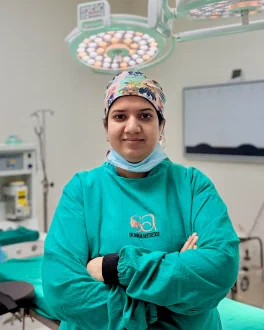
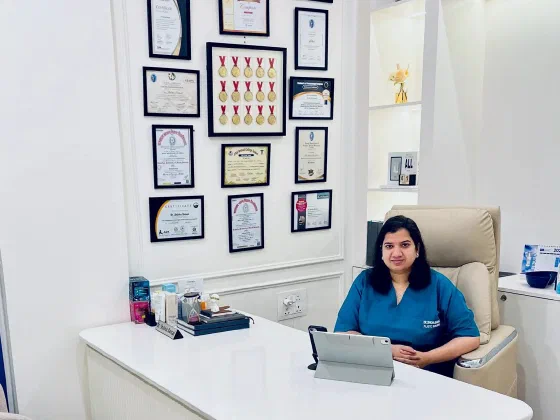
Consultations for breast augmentation in Gurgaon are conducted by Dr. Shikha Bansal, MBBS (Gold Medalist), MS General Surgery, MCh Plastic & Reconstructive Surgery (SMS Medical College, Jaipur, 2022), registered with the Haryana Medical Council (Reg No. 24859). In her Gurgaon practice, Dr. Shikha sees a steady stream of out-of-station and NRI patients specifically for breast procedures, which is part of why the travel-itinerary planning described above has become a routine part of the pre-consult conversation.
This article is for general information only and is not a substitute for personalized medical advice. Patient anatomy and health history vary enough that travel and recovery timelines should always be confirmed with a qualified plastic surgeon during consultation.
Frequently asked questions
How long does breast augmentation recovery take before flying home? Most out-of-station and NRI patients plan a 7-day post-op stay before the fly-home clearance check, though this can extend if swelling or healing is progressing more slowly than average. Long-haul international flights are generally deferred a few extra days beyond a short domestic flight to build in a comfort margin.
Is breast augmentation compatible with future mammograms? Yes. Implants do require informing the radiology technician beforehand, since additional displacement views (Eklund views) are used to image breast tissue around the implant. Routine screening mammograms remain possible and recommended on the same age-based schedule as for patients without implants. Implants can still obscure some breast tissue even with those views, so tell the imaging centre in advance and follow any supplementary imaging your radiologist advises.
How long do breast implants typically last? Modern silicone and saline implants are not considered lifetime devices; many last well over a decade, but replacement or revision may eventually be needed due to capsular contracture, implant rupture, or wear over time. For silicone implants, current FDA guidance recommends MRI screening starting five to six years after surgery and every two to three years thereafter to detect silent rupture, with ultrasound as an alternative where MRI is not accessible. If you live abroad, that surveillance is worth arranging near home rather than around return trips.
Can I schedule a virtual follow-up after flying home? Yes. Photo and video follow-ups are commonly used at the 3-week and 6-week marks for patients who have returned abroad or to another city, with an in-person visit reserved for cases where something looks unexpected. This is arranged during the pre-op consult so both sides know the follow-up schedule before the patient leaves Gurgaon.
Should I stay in a hotel or a dedicated recovery facility? A hotel near Sector 43 works for patients traveling with a support person comfortable helping with dressing changes and daily mobility in the first few days. A dedicated recovery stay with attendant support is generally better suited to solo travelers or those combining augmentation with a lift or a broader mommy makeover.
What is the starting cost for breast augmentation surgery in Gurgaon? Figures generally range from roughly ₹1.4–2.25 lakh for straightforward implant-only augmentation, with most cases near ₹1.6 lakh and combined procedures priced higher; the exact quote depends on implant type and incision technique, with anesthesia factored in separately. A firm number requires a consultation where these variables are assessed individually.
Planning a surgical trip around breast augmentation involves as much logistics as clinical decision-making. Flight timing and stay duration shape whether the trip is realistic within the time available, and follow-up scheduling determines how it wraps up. Working through the itinerary above alongside a proper in-person or video consult is the most reliable way to confirm what a specific case will need. Book a consultation