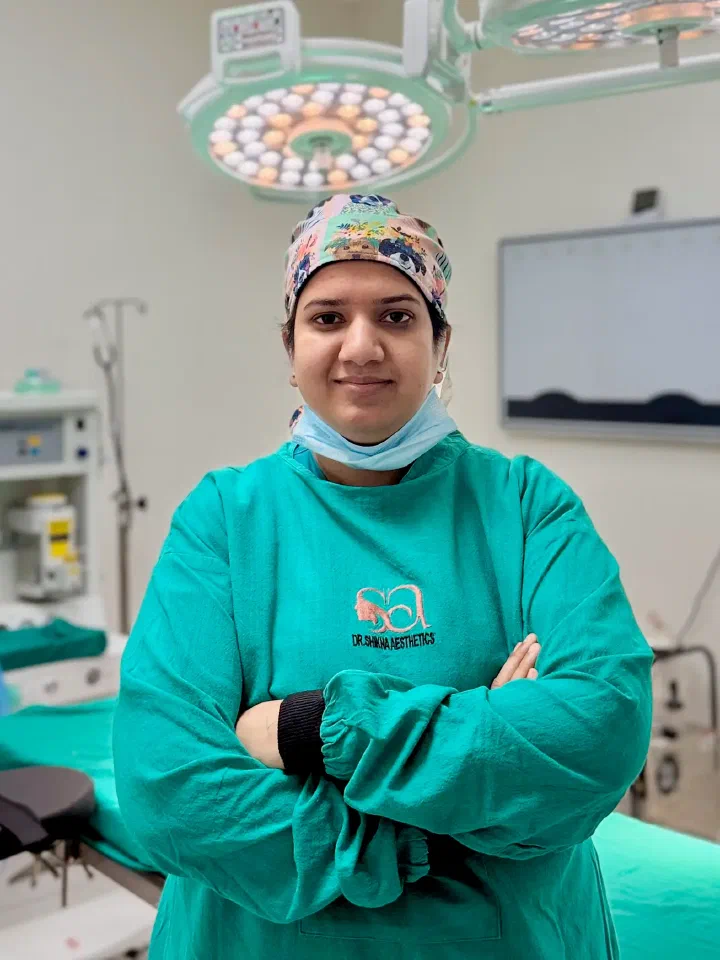

A breast lift - mastopexy - raises a sagging breast by reshaping the existing tissue, removing loose skin, and repositioning the nipple-areola complex to a more natural height. Breast lift surgery at Dr. Shikha Bansal’s clinic in Gurgaon is planned across four scar-pattern families: crescent, periareolar, vertical, and anchor lift. The right technique is chosen by ptosis grade, skin quality, breast volume, areola size, and whether volume restoration with an implant or fat transfer is also needed.
Key points
- Ptosis grade assessed before technique choice: crescent, periareolar, vertical, or anchor
- Breast lift planned for position and shape, with augmentation added only when volume is truly missing
- Nipple-areola position, areola size, asymmetry, and skin quality documented before surgery
- Recovery plan from Day 0 to Month 3 with support-bra, driving, work, and exercise milestones
- Scar pattern discussed before surgery instead of being hidden behind scarless-lift claims
- Combined lift, augmentation, reduction, or mommy makeover plans staged around medical fitness and safety
What a breast lift corrects, and what it cannot do alone
A breast lift corrects ptosis - the downward descent of the breast mound and nipple-areola complex on the chest wall. The procedure reshapes the patient’s own breast tissue into a higher, tighter mound, removes excess skin, reduces an enlarged areola when needed, and places the nipple at a forward-facing height rather than a downward-facing one. It is most often considered after pregnancy and breastfeeding, significant weight loss, age-related skin laxity, or a genetic tendency for the breast to sit low despite stable weight.
The key distinction is position versus volume. A patient with enough natural volume but a low nipple is usually a lift-only candidate. A patient with both drooping and upper-pole emptiness may need a lift combined with an implant or fat transfer - how that combined operation is planned, sized, and staged is covered in the guide on breast augmentation with a lift (auglift). Where the breast still has adequate volume and only the position is wrong, a lift without implants is usually the complete operation on its own; adding an implant simply because it is on offer increases scar tension and the weight the tightened skin has to hold, without addressing the problem the patient came in with. A patient whose main concern is small breast size but whose nipple still sits above the fold is usually better assessed for breast augmentation in Gurgaon rather than mastopexy alone.
The opposite mistake is adding an implant to a breast that actually needs lifting. An implant can fill volume, but it cannot reliably move a low nipple above the inframammary fold. Patients searching for “scarless breast lift” are counselled directly: a real surgical lift is not scarless, so the safe goal is the smallest scar pattern that can still reshape the breast properly.
Dr. Shikha explains

Breast reduction or breast lift?
Which mastopexy technique fits which degree of sagging
Mastopexy is a family of operations rather than one fixed procedure. The scar pattern follows the amount of lift and reshaping required. Choosing too small a pattern to avoid a scar usually leaves residual sagging, widened areola, or a flattened breast shape.
Crescent lift removes a small crescent of skin from the upper areola edge. It is reserved for very mild nipple asymmetry or roughly a centimetre of upward movement at most, and is rarely enough for true post-pregnancy ptosis.
Periareolar lift, also called donut lift, places the scar around the areola. It can correct mild ptosis, reduce areola diameter, and tighten a limited amount of skin. If used for too much lifting, it can widen the areola or flatten projection.
Vertical lift, also called lollipop lift, places a scar around the areola plus a vertical line down to the breast crease. It is the workhorse technique for moderate ptosis because it lifts the nipple, tightens the skin envelope, and reshapes the lower pole without a crease scar in most cases, though a short crease extension is occasionally added when skin excess demands it.
Anchor lift, also called Wise-pattern or inverted-T mastopexy, adds a horizontal scar in the breast crease. It is chosen for significant ptosis, larger or heavier breasts, major skin excess, or cases where the breast needs powerful lower-pole reshaping.
The scar trade-offs, how each line matures, and why “minimal scar” is not always the better operation are covered in more depth in the companion guide on breast lift scars and scar patterns.
How to read breast lift before and after photos
Before-and-after photographs are useful for understanding what a lift changes, and misleading when they are read as a forecast. It helps to know what to look at before looking at the pictures.
What to actually compare. Start with nipple height relative to the inframammary fold - that single relationship is the measurement the whole operation is built around, and it is the clearest thing a genuine lift changes. Then look at areola diameter, since most lift patterns reduce it. Then look at the lower pole and ask whether the tissue has been reshaped into a rounder, better-supported mound or merely pulled tighter over the same shape. Finally, look at the upper pole honestly: a lift moves and reshapes existing tissue and does not add volume, so an upper pole that looks fuller in an after photo is usually a repositioned mound sitting higher on the chest, not new volume.
Why the photo conditions matter. A comparable pair is taken standing, from the same angle, at the same distance, unsupported, and - the part most often ignored - at a stated time after surgery. Photographs taken lying down are close to useless for judging ptosis, because the breast falls back towards the chest wall and the nipple-to-fold relationship changes. That is precisely why the consultation examines the breast standing.
Why timing changes what you see. An early photograph flatters. At around six weeks the breast still sits high and tight because the tissues have not settled, and the scars are still pink. The six-to-twelve-month photograph is the honest one: by then the lower pole has softened, the breast has descended slightly onto the fold, and the scar has begun maturing. This is the same timeline described later on this page - shape is only reviewed meaningfully around Month 3, and scars continue maturing well beyond it.
Why another patient’s result is not a prediction. Two people can have the same operation and different photographs. Starting ptosis grade, skin thickness and recoil, breast weight, areola size, and whether any volume was added all change what a given technique produces. A grade 3 anchor result and a grade 1 periareolar result are not the same operation being compared, and neither one predicts what a third patient will get.
The scars are in the photographs. Any honest breast lift before-and-after set shows the scar pattern as well as the shape. A set that never shows a scar is not showing the trade being made - and as noted above, there is no scarless surgical lift. Looking at the scar alongside the shape change is the only way to judge whether the trade is one a patient is willing to accept.
Talk it through with Dr. Shikha
Book a consultation at Dr. Shikha Aesthetics in Sushant Lok 1. Bring your questions about breast lift, and any previous reports.
How ptosis grade, skin quality, and volume decide the plan
At consultation the breast is examined standing, because breast position cannot be judged accurately lying down. Nipple height is compared with the inframammary fold, the lowest point of the breast mound is assessed, the areola diameter is measured, and the skin envelope is checked for stretch marks, thinning, and recoil.
Regnault grade 1 ptosis means the nipple is near the level of the breast fold but still above the lowest part of the breast. A periareolar or short vertical lift may be enough when the skin is firm and the breast is not heavy. If the breast is also empty, a lift-plus-augmentation discussion may be more useful than lift alone.
Regnault grade 2 ptosis means the nipple sits below the fold but above the lowest contour of the breast. This is the common post-pregnancy lift presentation. A vertical lift is often the cleanest plan because it raises the nipple and reshapes the lower pole.
Regnault grade 3 ptosis means the nipple sits below the fold and at or near the lowest point of the breast, often pointing downward. An anchor lift is commonly needed because skin excess extends into the lower breast and crease.
Pseudoptosis means the nipple may still be at a reasonable height, but the lower breast tissue has fallen and the upper pole looks empty. Some cases need augmentation or fat transfer more than mastopexy; others need a short lift with volume restoration.
Skin quality changes the recommendation. Thin, stretch-marked skin does not hold a periareolar lift well; it tends to stretch again. Heavy breast tissue pushes the plan toward a vertical or anchor pattern, or toward breast reduction principles when weight symptoms are part of the concern.
Readers who want to locate their own grade against the fold before the consultation can work through the Regnault system step by step in the ptosis grading guide, which walks through each grade and the techniques usually matched to it.
For patients whose breast shape changed after pregnancy, the broader decision between lift, augmentation, reduction, and fat transfer is mapped in the post-pregnancy breast surgery options guide.
What happens from consultation to same-day discharge
The first consultation usually takes 30 to 45 minutes. The breast is examined in standard positions, photographs are taken, and ptosis grade, areola size, asymmetry, volume distribution, and skin quality are documented. The history covers pregnancies, breastfeeding, weight change, nicotine use, prior breast surgery, family history of breast cancer, medications, and future pregnancy plans.
Pre-operative work-up includes routine blood tests, ECG, anaesthesia fitness, and breast imaging when age or history makes it appropriate. A mammogram or ultrasound is commonly arranged above 40, with strong family history, or when there is a lump, discharge, or prior breast concern. Nicotine is stopped for at least four weeks before and after surgery because nipple blood supply and scar healing depend on good circulation.
The operation is performed under general anaesthesia in a day-care operating facility with a qualified anaesthetist. A standard lift usually takes two to three hours; combined lift-and-augmentation, lift-with-reduction, or major asymmetry cases take longer. The chosen incision pattern is marked standing before anaesthesia. During surgery, excess skin is removed, breast tissue is reshaped with internal sutures, the nipple-areola complex is moved to its planned height, and the skin is closed in layers.
Most primary mastopexy patients are discharged the same day, usually four to six hours after surgery once they are alert, drinking fluids, walking safely, and comfortable on oral medication. A support bra is applied before discharge. Drains are not routine, but may be used when the operation is combined with reduction, augmentation, or wider reshaping.
What recovery looks like from Day 0 to Month 3
Day 0 to Day 3: swelling, tightness, bruising, and breast heaviness are expected. Pain is usually moderate and controlled with oral medication. The support bra stays on day and night. Arm movement is kept gentle; lifting children, overhead reaching, and sleeping on the stomach are avoided.
Day 4 to Day 7: most patients are walking comfortably at home and can do light personal work. The first clinic review is usually around day five to seven for dressing check and swelling assessment. Desk work may resume from around day seven to ten, once pain medication no longer causes drowsiness.
Week 2: bruising fades, tightness reduces, and many patients return to office-based work. The scars are still pink and the lower breast may look tight or slightly high because tissues have not settled. Driving returns when shoulder movement is comfortable and no sedating pain medicine is being taken.
Weeks 4 to 6: light cardio and lower-body exercise are usually reintroduced. Upper-body weights, running, yoga inversions, swimming, and chest-loading activity wait until the wounds are mature enough and the surgeon clears them. The support bra continues through this phase.
Month 3: the breast shape has softened and settled enough for a meaningful result review. Scar maturation is still early; scars usually continue fading for 12 to 18 months.
Why scars, recurrence, and long-term shape are discussed before surgery
A breast lift trades lower breast position for a permanent scar. The scar pattern depends on the correction needed: crescent scars sit on the upper areola border, periareolar scars circle the areola, vertical scars run from areola to crease, and anchor scars add a line hidden in the breast fold. All of them are real scars. They are usually pink and firm for the first three to six months, then soften and fade over 12 to 18 months.
Scar quality depends on closure, tension, skin biology, pigmentation tendency, nicotine exposure, nutrition, and early movement. Silicone gel or sheeting is commonly started once wounds are fully closed, usually around week three, and continued for several months when appropriate. A history of hypertrophic or keloid scars is flagged before surgery.
A lift resets breast position; it does not stop ageing, gravity, pregnancy, breastfeeding, or major weight change. Most patients keep a clearly improved shape for many years, but a fixed number of years cannot be predicted: some settling of the lower pole in the first year is normal, and how long the correction holds depends on skin quality, breast weight, and weight stability. Thin skin and heavy tissue can stretch sooner. Revision is considered when ptosis recurs, a scar widens, the areola stretches, or a later pregnancy changes the result.
A lift can be combined with augmentation when upper-pole volume is the missing piece. The plan is deliberately conservative on implant size because the skin envelope is being tightened while volume is being added, and scar tension matters for long-term shape.
Risks, complications, and why some patients regret a lift
A lift is a real operation. Mastopexy is performed under general anaesthesia in a day-care operating facility with a qualified anaesthetist, so standard anaesthetic risk applies, as does perioperative risk including venous thromboembolism, and both are assessed at the pre-operative fitness work-up described above. Anyone asking whether a breast lift counts as major surgery deserves the straight answer: it is a planned surgical procedure under general anaesthesia with incisions, tissue reshaping, and a recovery period - not a walk-in treatment.
Early complications. Bleeding into the breast (haematoma), fluid collection (seroma), infection, and delayed wound healing are the recognised early problems. In an anchor lift, the T-junction where the vertical and horizontal limbs meet is the classic slow-healing point, because it carries the most tension and the least favourable blood supply; it can open superficially and take longer to close.
Nipple and areola complications. Altered nipple sensation is common in the early weeks - it can be reduced, heightened, or patchy. It usually improves over months, but a change in sensation can be permanent, and that possibility is discussed before surgery rather than after. Far less commonly, the blood supply to the nipple-areola complex can be compromised, causing partial or, rarely, full nipple-areola necrosis. This is the serious complication of a lift, and it is the reason nicotine in any form is stopped for at least four weeks before and after surgery: nicotine constricts the small vessels the repositioned nipple depends on. Because the nipple-areola complex is moved, future breastfeeding capacity can also be reduced, which is discussed before surgery with anyone planning a pregnancy.
Shape and scar complications. Fat necrosis can leave a firm lump in the reshaped tissue. Residual or recurrent asymmetry in nipple height, areola size, or lower-pole shape can persist, since the two breasts start out different. A periareolar lift asked to do more work than the pattern can carry may leave a widened or flattened areola. Patients with a history of hypertrophic or keloid scarring can form thickened scars again, which is why that history is flagged at consultation.
Combined cases carry more risk. When a lift is combined with augmentation, reduction, or a mommy makeover, operating time lengthens, and longer anaesthesia raises both anaesthetic and thromboembolic risk. That is the reason combined plans are assessed against medical fitness and sometimes staged rather than done in one sitting.
Why some patients regret a lift. Three reasons come up honestly, and all three are avoidable at the counselling stage rather than in the operating room. The first is the scar: it turned out more visible than the patient had pictured, which is why the scar pattern is agreed in advance rather than discovered afterwards. The second is size: because a lift removes skin and does not add volume, the breast can look smaller and tighter than the patient expected. The third is recurrence: in thin, stretch-marked skin with heavy tissue, sagging can return sooner than hoped. These are exactly why the consultation grades ptosis, examines skin quality, and settles the scar pattern before a date is booked - and why a patient who is not prepared to accept the scar is not yet ready for the operation.
Breast lift in Gurgaon and Delhi NCR - what to expect
The clinic sees breast lift patients from Gurgaon, Delhi, Noida, Faridabad, Ghaziabad, and other parts of Delhi NCR. Common presentations are post-pregnancy ptosis, weight-loss skin laxity, nipple position below the fold, enlarged areola, asymmetry, and the question of whether a lift should be paired with augmentation or reduction.
Consultations are by appointment because mastopexy planning depends on examination and measurements, not photographs alone. Patients travelling from outside NCR are usually advised to plan at least seven days around surgery so the first dressing review is completed before they fly back.
The consultation settles whether mastopexy is the right operation, which scar pattern is likely, and how recovery is planned.
Breast lift is also frequently considered inside a broader post-pregnancy body plan. When abdominal laxity, diastasis, or liposuction areas are part of the same consultation, the combined-procedure option is assessed through the mommy makeover surgery in Gurgaon page’s safety and staging logic.