A tummy tuck (abdominoplasty) is a surgical reshaping of the lower abdomen that removes loose skin, repairs separated abdominal muscles (rectus diastasis) where present, and restores a flatter contour after pregnancy or weight loss. Tummy tuck surgery at Dr. Shikha Bansal’s clinic in Gurgaon is offered across the full technique spectrum - mini abdominoplasty, full abdominoplasty, extended abdominoplasty, fleur-de-lis, and circumferential body lift - and the technique is chosen at consultation based on the pattern of skin laxity, the degree of muscle separation, and the patient’s tolerance for scar length.
Key points
- Technique matched to the abdomen - mini, full, extended, fleur-de-lis, or circumferential - not a one-size operation
- Rectus diastasis repair planned where examination shows real muscle separation, not added by default
- Low pubic-line scar position planned to sit beneath most underwear and swimwear
- Liposuction added in the same sitting when fat - not skin - is the limiting factor on contour
- Overnight stay so pain control, fluid balance and early walking are supervised after surgery
- Honest staging when a mommy makeover or post-bariatric body lift is the more appropriate plan
When a tummy tuck is the right call, and when liposuction is enough
The most useful thing the consultation does is decide whether the patient actually needs a tummy tuck at all or whether liposuction alone can deliver what they want. Three findings push the decision toward abdominoplasty: loose lower abdominal skin that does not retract on its own, separation of the rectus abdominis muscles in the midline (rectus diastasis), and a hanging apron of skin and fat (panniculus) that sits below the waistline.
Liposuction alone removes fat. It does not remove skin and it does not repair separated muscles. A patient with a thick fat layer but tight skin and intact muscles is a liposuction patient, not a tummy tuck patient. A patient with stretched, crepe-like skin and a midline bulge that gets worse on a sit-up is a tummy tuck patient, no matter how much weight has been lost. The middle group - moderate laxity, mild diastasis - is where the consultation matters most, and where a mini abdominoplasty or a lipoabdominoplasty (tummy tuck combined with liposuction in the same sitting) often makes more sense than either operation alone.
Non-surgical body contouring - radiofrequency, HIFU, ultrasound fat reduction - does not address skin redundancy or muscle separation. These devices are not offered at the clinic as alternatives to abdominoplasty, because for the patient who actually needs a tummy tuck, they cannot deliver the result. Panniculectomy - removal of the overhanging skin apron without muscle repair or umbilical repositioning - is a related procedure usually done after very large weight loss, and is part of the same technique family.
Dr. Shikha explains

Tummy tuck surgery for loose skin

How a tummy tuck works
Results
Tummy Tuck (Abdominoplasty): before and after
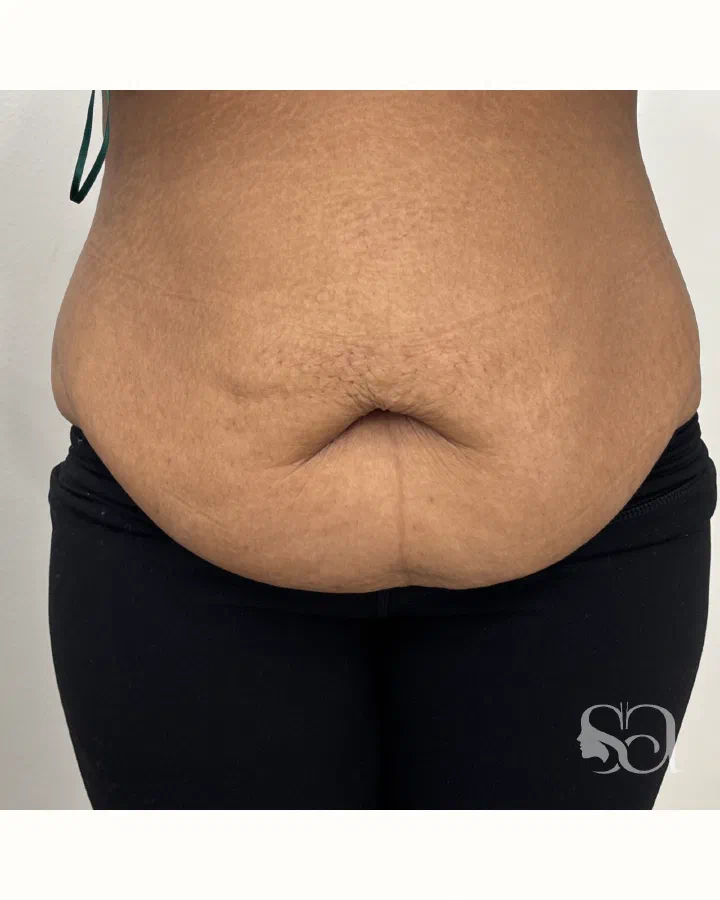 Before
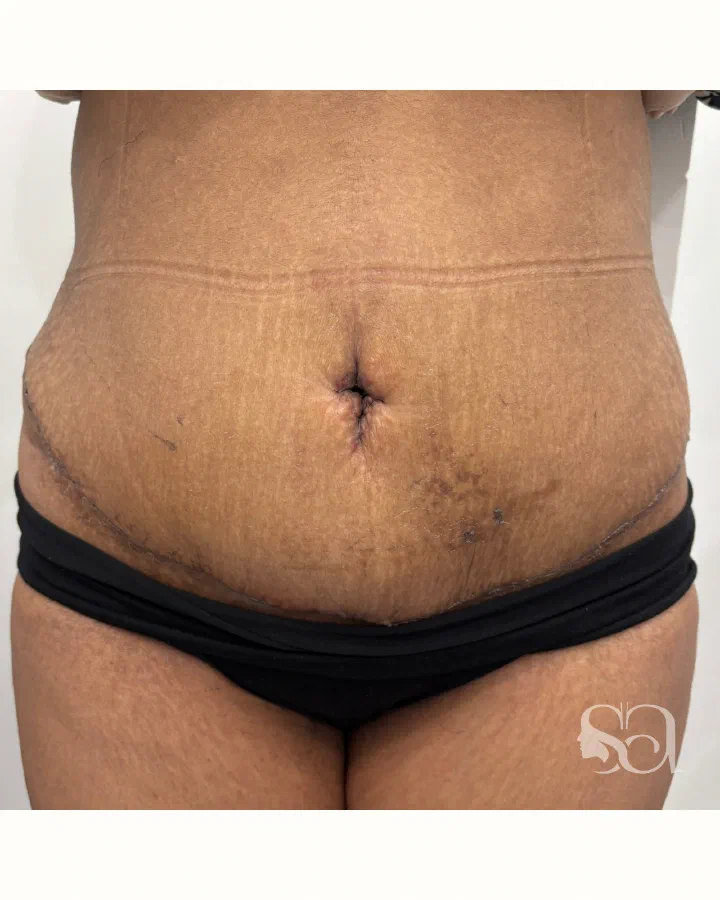 After
AfterThis result shows an unclothed body after surgery.
Tummy Tuck (Abdominoplasty)
- 4 weeks after surgery
- Results vary between individuals
Photographs of the clinic's own patients, shown with their written consent, with faces blurred or covered as far as the result allows. They explain what an operation can change; they are not a promise of your result.
The technique families: mini, full, extended, fleur-de-lis, and circumferential
Tummy tuck is a family of operations that share a low transverse scar but differ in how much skin is removed, whether the umbilicus (belly button) is repositioned, whether muscle repair extends above the navel, and how far the scar runs around the trunk.
Mini abdominoplasty addresses laxity limited to below the navel. The incision is short - usually pubic-line length - and the umbilicus is not repositioned. Muscle repair, if needed, is limited to the lower rectus. It is the right operation for isolated lower-abdominal skin redundancy and minimal upper-abdominal change, often a single C-section scar with overhanging skin and a small lower pouch.
Full abdominoplasty is the standard tummy tuck and the most commonly performed technique in post-pregnancy patients. The incision runs hip-bone to hip-bone, low enough to sit beneath most underwear. The skin is lifted from the lower ribcage to the pubic bone, the rectus is repaired in the midline from xiphoid to pubis when diastasis is present, excess skin is excised, and the umbilicus is repositioned through a new opening in the redraped skin. Flank liposuction is commonly added in the same sitting.
Extended abdominoplasty is the same operation with a longer incision that wraps onto the flanks, used when laxity continues onto the flanks and hips; when lower-back skin also needs lifting, a circumferential lift is considered.
Fleur-de-lis abdominoplasty adds a vertical midline incision to the horizontal one, creating an inverted-T scar pattern. It is reserved for extreme horizontal skin redundancy where a horizontal-only excision will not flatten the upper abdomen - almost always a post-bariatric patient. The scar trade-off is significant and is discussed openly before this technique is chosen.
Circumferential body lift (belt lipectomy) carries the incision all the way around the trunk and lifts the lower back, buttocks, and outer thighs at the same time. It is a major-weight-loss procedure that is staged carefully when offered.
How the technique is matched to laxity pattern, diastasis, and scar tolerance
The technique is decided in the examination, not in advance. Three findings drive the choice.
Where the loose skin actually sits. If laxity is confined to below the navel, mini abdominoplasty is on the table. If it extends from the lower ribcage to the pubis, full abdominoplasty is the floor. If it continues onto the flanks and lower back, extended or circumferential is needed. If the upper abdomen is so wide and lax that a horizontal excision alone will not flatten it, fleur-de-lis is considered.
Whether rectus diastasis is present and how wide it is. A gap of about 2 cm or more (roughly one and a half to two finger-widths), or a visible midline bulge, usually indicates a diastasis worth repairing. A wide gap makes muscle repair the central part of the operation rather than an add-on. When a wide diastasis is present, the question is rarely whether to repair it; it is how far up the repair needs to extend.
What scar length the patient will accept. A longer incision allows more skin removal and a flatter result; a shorter one limits how much loose skin can be excised. Patients who insist on the shortest possible scar but have full-abdomen laxity are walked through the trade-off honestly - undercorrection is harder to revise than to plan correctly the first time. The tummy tuck scar placement and care guide covers this trade-off in more depth.
Combined liposuction is added when fat - not skin - is the limiting factor on contour. A mommy makeover plan is considered when breast surgery is on the table alongside the abdomen; the mommy makeover page covers the staging logic.
Talk it through with Dr. Shikha
Book a consultation at Dr. Shikha Aesthetics in Sushant Lok 1. Bring your questions about tummy tuck (abdominoplasty), and any previous reports.
The procedure, from consultation to next-day discharge
The first consultation takes 30 to 40 minutes. The abdomen is examined standing and lying down, the rectus is checked on a sit-up for diastasis, skin laxity is pinched at multiple points, existing scars (C-section, laparoscopic ports, previous surgery) are mapped, and weight history and pregnancy plans are taken in detail. Standardised photographs are taken. Blood-thinner use, smoking history, and any history of DVT or wound-healing problems are noted carefully because they change the operation’s risk profile.
Pre-operative work-up is the routine pre-anaesthesia panel: complete blood count, coagulation, fasting sugar, ECG, chest X-ray, and an anaesthesia consultation. Stopping smoking for at least four weeks before and after surgery, including nicotine gum and patches, is required, not optional, because nicotine compromises wound healing along the long abdominal incision. Patients on blood thinners are coordinated with the prescribing physician to plan a safe pause. A weight-stable target - the same weight for at least three to six months - is set before the operation is booked.
The procedure itself is performed under general anaesthesia, given by an anaesthetist, in an operating theatre equipped for it. A full abdominoplasty takes three to four hours; a mini takes two to three; extended or fleur-de-lis can run longer. Surgical drains are placed and stay in for several days. A compression garment is fitted before the patient leaves the operating room. An overnight stay is standard so that pain control, fluid balance, and early mobilisation are supervised. Discharge is usually next-day with follow-up at day five to seven for the first dressing change and drain assessment.
Recovery after tummy tuck, week by week
Tummy tuck recovery is more involved than most body-contouring procedures. The summary below covers the broad shape of the timeline. The detailed week-by-week version - what is normal, what to flag, when to walk, when to stop the binder, when to return to lifting and the gym - is in the companion guide on week-by-week tummy tuck recovery in India.
Week 0 to Week 1: the most demanding stretch. The patient walks with a slight forward bend to keep tension off the repair. Drains are usually removed at day five to seven once output has dropped below the threshold. A compression garment is worn day and night. Pain is moderate for the first three days and tapers; help at home for cooking, childcare, and light tasks is genuinely needed.
Week 2 to Week 3: posture straightens, swelling shifts from the upper abdomen down toward the pubis, and most desk-based work becomes feasible from week two if the work allows breaks. Driving is avoided until the patient can perform an emergency stop without bracing the abdomen - usually around week two to three. Light walking is encouraged daily.
Week 4 to Week 6: most normal daily activity has returned. Light cardio (walking, stationary cycling) is reintroduced from week four. The compression garment is still worn through most of the day. Sexual activity is reintroduced based on comfort.
Month 2 to Month 3: core exercise is phased back in cautiously, starting with low-load stabilisation rather than crunches. The scar is still pink and slightly raised. Feeling the abdomen as “your own” again takes time; for most patients this settles between three and six months.
Month 6 to Month 12: the scar fades, residual swelling resolves, and the final contour settles. The final result is judged at around the 12-month mark, once swelling has fully settled and the scar has matured.
Risks and complications of a tummy tuck
A tummy tuck is major surgery, and its risks are gone through in detail at consultation before anything is booked.
Seroma, a collection of fluid under the lifted skin, is the most common complication. Drains and compression reduce the chance of it, and when it does happen it is usually drained with a needle in the clinic, sometimes more than once.
Haematoma, a collection of blood under the skin, is less common and sometimes needs a return to theatre.
Wound-healing problems, such as a slow-healing area or a small breakdown along the incision, are more likely in smokers, in people with diabetes, and at a higher BMI. This is why smoking and blood sugar are dealt with before surgery, not after.
Numbness of the skin below the navel is expected. Sensation usually improves over months, but some numbness can be partly permanent.
Blood clots in the leg veins (deep vein thrombosis, DVT), which can travel to the lungs (pulmonary embolism, PE), are uncommon but serious. The prevention plan includes walking early after surgery, compression, and clot-prevention medicine where your risk profile indicates it. Sudden breathlessness, chest pain, or a swollen, painful calf needs an immediate call to the clinic.
Wide or raised scars can happen even with careful closure and scar care, and are more likely in darker skin types and in people prone to hypertrophic or keloid scarring.
Infection, an uneven contour, poor healing around the belly button, and the general risks of anaesthesia are also possible. Some patients need a further procedure, usually minor, to refine the scar or remove residual loose skin; the scar section below explains when revision is considered.
Scar placement, scar care, and when revision is on the table
The horizontal abdominoplasty scar is the trade-off the patient accepts in exchange for a flat lower abdomen. The scar is planned to fall low on the pubic bone so it can be hidden under most underwear and swimwear, and its length is matched to the patient’s skin redundancy rather than to a generic template. In a full abdominoplasty there is also a small scar around the repositioned umbilicus, designed to sit inside the natural navel contour rather than around it.
Scar maturation runs over 12 to 18 months. The first three months it is pink and slightly raised; from month three to nine it pales and softens; by month 12 it is usually flatter and paler; some scars stay wider or darker, especially in darker skin types. Silicone sheeting or gel from week three to month six, sun protection for the first year, and not lifting heavy weights too early all reduce the risk of a wide or hypertrophic scar. Patients with a personal or family history of keloid scarring are flagged at consultation and managed proactively.
Revision is occasionally considered for one of three reasons: a small “dog-ear” at the lateral end of the scar that did not flatten on its own (treated with a short office procedure under local anaesthesia), residual skin laxity in a patient who would have been better served by an extended technique the first time, and recurrence of rectus diastasis after a subsequent pregnancy. Most revisions are minor and add-on rather than redo-everything; indications and timing are discussed at the year-mark follow-up.
Tummy tuck in Gurgaon and Delhi NCR - what to expect
The clinic sees patients from across Delhi NCR - Gurgaon, Delhi, Noida, Faridabad, Ghaziabad - for tummy tuck, abdominoplasty, lipoabdominoplasty, mini tummy tuck, and post-bariatric body contouring. Most are post-pregnancy women in their 30s and 40s who have completed their family, with a smaller group of post-bariatric patients who have stabilised at a target weight for at least six to twelve months.
Out-of-town patients flying into Gurgaon are usually advised to plan a 7-to-10-day stay around the procedure: a day for pre-operative work-up, surgery with overnight admission, and follow-ups for drain removal and the first dressing check before flying back. Short domestic flights after drain removal are planned with calf exercises, hydration and compression; long-haul flights wait at least two weeks, because the risk of deep vein thrombosis is higher after abdominal surgery.
Consultations are by appointment and scheduled in person whenever possible because the operation is examination-driven.