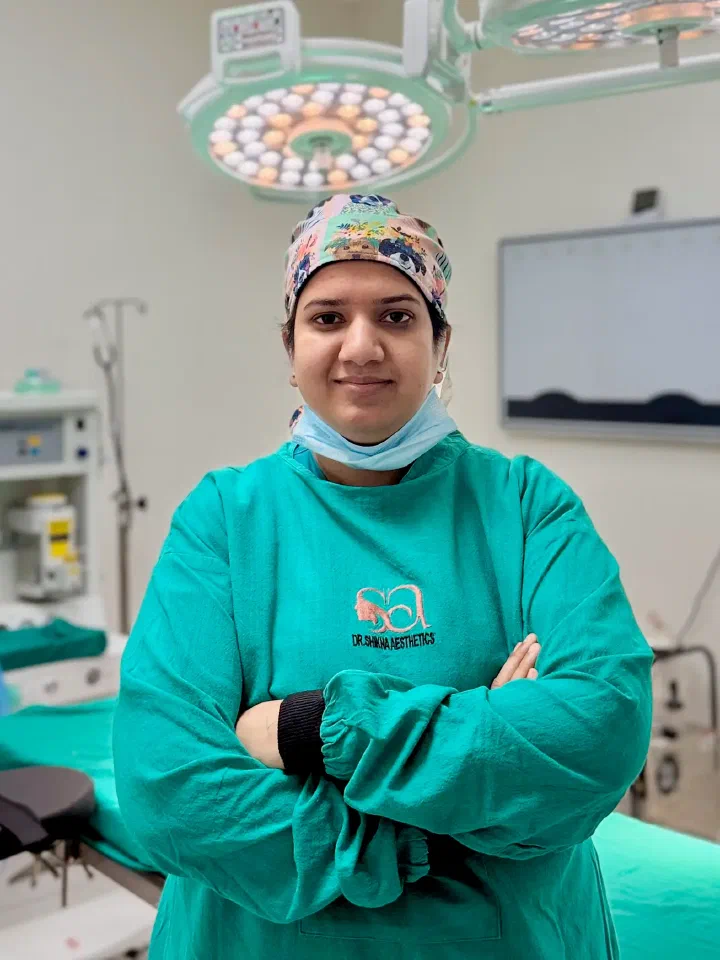

Ear lobe repair is a small, precise surgical procedure that rebuilds a torn, stretched, or gauged ear lobe so it looks natural again and - when the patient wants it - can hold an earring. Ear lobe repair at Dr. Shikha Bansal’s clinic in Gurgaon is done as a surgical day-case procedure under local anaesthesia. The technique is chosen to match the defect: a simple torn-through piercing is closed very differently from a completely split lobe, an elongated piercing hole, or a lobe stretched by gauge jewellery.
Key points
- Surgical repair that closes the lobe reliably - no glue, paste, or home remedies
- Technique matched to the defect: straight-line, Z-plasty, L-plasty, or wedge excision
- Local anaesthesia, same-day procedure, no hospital admission
- Scar placed inside or along the natural lobe line so it usually settles as a fine line
- Bilateral repairs done in one sitting when the patient prefers
- Re-piercing planned properly, with jewellery advice to reduce the chance of a second tear
What ear lobe repair is, and why surgery is the only reliable fix
Ear lobe repair - also called earlobe repair, ear hole repair, lobuloplasty, or ear stitching - is the surgical reconstruction of an ear lobe that has been torn, split, stretched, or enlarged. The damage is usually from heavy earrings that cut slowly through the lobe over years, from a single traumatic pull that splits the lobe in one go, or from deliberately worn gauge jewellery that stretches the piercing into a wide hole.
The common online questions - “can ear lobe tears be fixed without surgery”, “does ear hole repair glue work”, “can pasting close an earlobe tear” - have the same honest answer. No. Once the skin on both sides of a torn or stretched hole has healed over, the two edges are lined with mature skin, not raw tissue. Pressing them together with glue, tape, or pasting cannot fuse them, because healed skin does not re-stick to healed skin. The only way to close a torn or stretched lobe reliably is to remove the healed skin edges surgically and stitch the fresh wound edges together so they heal as one piece of tissue.
That is also why home remedies, “ear lobe pasting” services, and topical kits do not work even when they claim to. They are working against the biology of the tissue. Ear lobe repair is a small procedure, but it is a surgical one.
Ear lobe repair is also often confused online with otoplasty - a different procedure that reshapes the cartilage of the outer ear so a prominent or protruding ear sits closer to the head, rather than repairing a torn or stretched lobe. If the concern is how far the ear itself sticks out rather than damage to the lobe, see otoplasty.
Dr. Shikha explains

Why glue is not advised for earlobe repair

Ear lobe repair surgery, explained
Ear lobe conditions that ear lobe repair corrects
A single repair technique does not fit every kind of ear lobe damage. At consultation the lobe is examined, the defect is classified, and the technique is chosen from there. The commonest presentations at the clinic in Gurgaon are:- Complete traumatic tear: the earring has been pulled all the way through and the lobe is split into two separate flaps, usually from a child grabbing the earring or the earring catching on clothing.
- Partial tear or cheese-wired piercing: the piercing hole has slowly elongated downward over years of heavy earrings until only a thin bridge of skin remains at the bottom - or the bridge has already given way.
- Elongated piercing hole: the hole is intact but stretched into a vertical slit, large enough that studs fall through and only hoop or lever-back earrings stay in.
- Gauge-stretched lobe: the lobe has been deliberately stretched with plugs or tunnels and now has a wide, fixed hole that does not shrink back on its own after the jewellery is removed.
- Keloid at a piercing site: a raised, firm scar has grown at the front or back of the piercing hole and is being treated as part of the repair.
- Bilateral or multi-piercing damage: both lobes, or multiple piercings on the same lobe, need repair in the same planning cycle.
- Congenital ear lobe irregularity: a notch, cleft, or asymmetry present from birth is corrected using a similar set of techniques.
Surgical techniques for ear lobe repair
The repair is chosen from a small family of techniques. All are done under local anaesthesia as day-care procedures, and all aim to place the final scar inside or along a natural lobe line so it fades well.
Straight-line closure is the simplest technique. The healed skin edges of the tear or elongated hole are trimmed to create fresh wound margins, and the lobe is closed in layers - a deep layer that holds the lobe’s thickness and a skin layer of fine sutures. It is the right choice for a clean, recent tear with good tissue on both sides.
Z-plasty or L-plasty closure is used when a straight-line repair on its own would leave a notch at the bottom of the lobe or a scar that contracts and pulls the lobe edge upward over time. A small Z- or L-shaped flap is designed so the scar breaks across the direction of pull, which both reduces notching and places the final scar where it is less visible. This is the default for completely split lobes and for long-standing elongated piercings.
Purse-string or wedge excision is reserved for gauge-stretched lobes where the hole is too wide to close by simply trimming the edges. A wedge of lobe tissue is removed, and the remaining tissue is reshaped to recreate a natural contour and thickness. The lobe is smaller afterward - closer to an unstretched size - and the scar runs along the lobe edge.
Keloid excision with ear lobe repair is done when a keloid scar at a piercing site is part of the picture. The keloid is excised, the lobe is repaired in the appropriate technique from the list above, and a course of intralesional steroid injections is planned into the aftercare to reduce the chance of the keloid coming back.
Regardless of technique, the lobe is closed in layers. A skin-only closure may look fine on day seven but tends to thin out and notch over the following year. The deeper stitch is what gives the repair its long-term shape.
Talk it through with Dr. Shikha
Book a consultation at Dr. Shikha Aesthetics in Sushant Lok 1. Bring your questions about ear lobe repair, and any previous reports.
The procedure, from consultation to same-day discharge
The first consultation takes about 20 minutes. Both lobes are examined in good light even when only one is the obvious problem, because long-standing earring wear often affects the second lobe as well. Photographs are taken, the defect is classified, and the technique is explained with reference to the specific lobe in the mirror. Any history of keloid scarring, blood thinner use, or recent infection is noted.
The procedure itself is performed as a day case at the clinic. After marking the repair lines on the lobe, a small volume of lignocaine with adrenaline is injected for local anaesthesia. Once the lobe is fully numb the damaged skin edges are excised, the lobe is closed in layers with fine absorbable and non-absorbable sutures, and a small dressing is applied. A straight-line repair takes 20 to 30 minutes per lobe. A Z-plasty or wedge excision takes 30 to 45 minutes. Bilateral cases are done in one sitting.
The patient walks in, the procedure is done, and the patient walks out the same day. Driving home is fine for most patients, though being driven is easier for the first hour because of the small dressing over the lobe.
It is a small operation but still an operation, and the risks are stated before consent: bleeding or a small collection at the site, infection, delayed healing or partial separation of the wound edges, darkening or lightening of the skin around the scar, a notch or slight asymmetry in the lobe contour, and thickening of the scar itself. A minority of lobes need a small revision to refine the contour once the scar has settled.
Recovery after ear lobe repair, week by week
Recovery from ear lobe repair is predictable and short compared with most plastic surgery. The timeline below is typical for a straight-line or Z-plasty repair; wedge excisions for gauge-stretched lobes run about a week longer at each stage.
Day 0 to Day 2: the lobe is slightly swollen and tender. Cold compresses over a gauze pad, not directly on the skin, help with the swelling. Over-the-counter paracetamol is usually enough for discomfort. The dressing is kept dry.
Day 3 to Day 7: swelling settles, tenderness is gone, and most desk work is comfortable from day two or three. The first dressing change and wound check is usually at day five to seven, with non-absorbable sutures removed at the same visit. Dissolvable deeper sutures stay in and soften over the next few weeks.
Week 2 to Week 4: the repair line is pink and slightly raised but closed. Sleeping on the treated side is still avoided to keep pressure off the lobe. Light exercise is fine from week two; swimming and heavy sweating are avoided until week three.
Month 2 to Month 3: the pink line fades toward the surrounding skin tone. The lobe feels soft and normal to the touch. This is the window when most patients say the lobe looks normal again in photographs.
Month 3 to Month 6: the scar matures into a fine line that sits inside or along the natural lobe contour. Re-piercing, when the patient wants it, is planned from the three-month mark at the earliest and is usually done after six months for the best long-term result - longer where a keloid was excised, as set out below.
Re-piercing after ear lobe repair
Most patients who have ear lobe repair want to wear earrings again afterward, and most can - once the lobe has healed fully. Re-piercing is planned, not done in the same sitting as the repair, for one simple reason: the new piercing has to go through healed tissue that has settled into its final thickness, not through the fresh repair scar.
The earliest safe window for re-piercing is around three months after repair, and the preferred window is six months. The new hole is placed slightly away from the repair scar - usually a couple of millimetres forward or above the old position - so the piercing channel runs through undisturbed skin. A small-gauge, lightweight stud is used first. Heavy earrings are the reason most patients needed the repair in the first place, and going back to the same jewellery after re-piercing is the most common cause of a second tear.
Where a keloid was excised as part of the repair, the timeline is longer and the conditions are stricter: the site should have been flat and stable for six to twelve months, with no injection course running, and it is pierced with a needle rather than a gun. Even then, re-piercing a site that has keloided once carries a recognised risk of a fresh keloid at the new tract.
Keloid risk at the piercing site
A keloid is a raised, firm scar that grows beyond the original wound. Ear lobes - because of the repeated trauma of piercing and the genetic tendency in some patients - are one of the commoner sites for keloid scarring on the face. Any history of keloid, anywhere on the body, is flagged at consultation.
When a keloid is already present at the piercing site, it is excised along with the repair, and the aftercare includes a course of intralesional steroid injections in the months after surgery. That combination does not remove the risk of the keloid returning: recurrence after keloid excision with a completed intralesional steroid course is reported across published series at roughly 10 to 50 per cent, varying with site and how long patients were followed, and that figure is discussed before consent rather than afterwards.
When there is no keloid but the patient has a known tendency, the operation itself is straightforward, but the repair scar still carries a real risk of thickening. The scar is reviewed early so any thickening can be injected before it establishes itself. Patients with an active keloid elsewhere that is growing, rather than stable, are usually asked to have that treated first before ear lobe repair is planned. The full protocol is set out on the keloid treatment page.
Ear lobe repair in Gurgaon and Delhi NCR - what to expect
The clinic sees patients from across Delhi NCR - Gurgaon, Delhi, Noida, Faridabad, Ghaziabad - for ear lobe repair, ear hole repair, lobuloplasty, and gauge-stretched lobe correction. Most cases are single-visit procedures with one follow-up at the week mark for suture removal. Out-of-town patients can send progress photographs over WhatsApp between visits.
Consultations are by appointment. A planned appointment means both lobes are assessed properly, and photographs are taken in consistent lighting for before-and-after comparison. For uncomplicated unilateral tears, the consultation and the procedure can sometimes be done on the same day when the schedule allows; bilateral repairs, wedge excisions, and keloid cases are booked for a separate day.