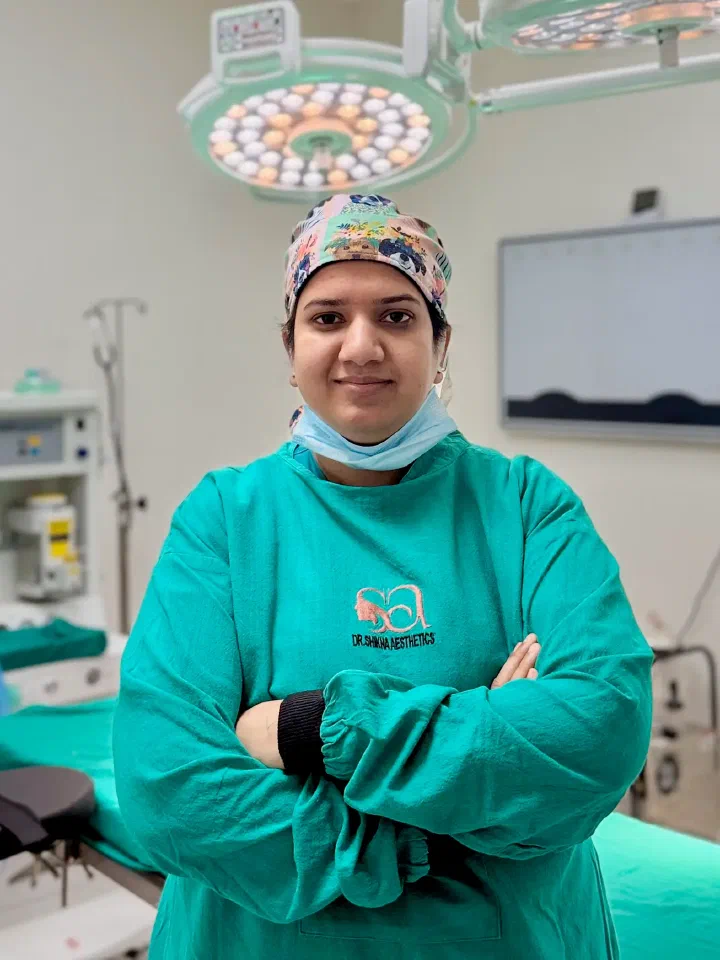

Double chin liposuction, also called submental liposuction, removes the pinchable fat pad under the chin that softens the jawline even when the rest of the face is proportionate. At Dr. Shikha Bansal’s clinic in Gurgaon, the plan is built around submental anatomy: fat thickness, skin elasticity, platysma tone, salivary-gland position, and whether a microcannula-only, RF-assisted, or laser-assisted approach is enough.
Key points
- Separates submental fat from loose skin, platysma bands, and glandular fullness before surgery is promised
- Microcannula access through chin-crease or hidden lateral entry points for discreet scars
- RF or laser assistance added only when skin retraction is the limiting factor
- Local anaesthesia and same-day discharge for most isolated double chin cases
- Compression and follow-up plan built around the first 6 weeks of swelling control
- Related facial-contouring decisions, such as buccal fat removal, kept separate unless each one makes sense
What submental fullness actually is, and why it is not always fat
A “double chin” is not a single diagnosis. The visible fullness under the chin can come from submental fat, loose neck skin, weak platysma muscle tone, low-positioned salivary glands, a short chin, or a combination of all of these. Liposuction treats the fat layer. It does not move a low hyoid bone, shrink a prominent submandibular gland, or tighten a neck that has heavy vertical bands.
The most liposuction-friendly presentation is a soft, pinchable pad of fat between the chin crease and the upper neck, with skin that springs back when it is lifted and released. That patient may have a full profile in side-view photographs despite a stable weight and otherwise balanced face. Removing the fat lets the skin redrape closer to the jawline and improves the angle between the chin and neck.
A different patient has little fat but a loose sheet of skin hanging below the jaw. Another has two vertical platysma bands visible when speaking or clenching. Another has fullness sitting deeper and lower, where glandular ptosis rather than fat is the main issue. These patients may still improve with a combined plan, but liposuction alone would under-deliver. The consultation therefore starts by separating fat from skin, muscle, and glandular causes before any technique is promised.
Which technique fits the neck: microcannula, RF-assisted, laser-assisted, or platysmaplasty
Double chin liposuction is usually a small-area contouring procedure, but the technique is still chosen deliberately rather than treated as one generic suction pass.
Microcannula submental liposuction is the baseline technique. After local anaesthesia is infiltrated, a fine cannula is passed through a tiny entry point hidden in or just behind the chin crease. The fat is loosened and removed in a controlled fan pattern so the jawline is sharpened without creating dents. This is the right choice when the fat pad is the main problem and skin elasticity is good.
RF-assisted liposuction adds radiofrequency energy to the undersurface of the skin and the remaining fat layer. It is considered when the patient has mild to moderate skin laxity and needs extra collagen contraction beyond what microcannula liposuction alone is likely to create. The amount of extra tightening varies from person to person and is not guaranteed. RF is an adjunct to surgery here, not a replacement for removing the fat.
Laser-assisted liposuction uses laser energy to heat and break down fat cells and encourage skin contraction. It can be useful in small, fibrous areas under the chin or in patients where controlled thermal tightening is part of the plan. For a broader comparison of energy-assisted body-contouring tools, see the VASER, laser, and traditional liposuction comparison.
Platysmaplasty or a surgical neck-tightening step enters the conversation when vertical neck bands, muscle separation, or real skin redundancy are the limiting factors. In those cases, removing fat alone may make the skin look emptier but not tighter. The plan may be staged or combined depending on age, skin quality, and how much downtime the patient accepts.
How the plan is matched to skin elasticity and jawline anatomy
Skin elasticity is the make-or-break factor in double chin liposuction. The same amount of fat removal can look crisp in one patient and loose in another because the skin response is different. At consultation the neck is examined in front view, side view, and with the chin lifted. The fat is pinched, the skin is stretched and released, the platysma is activated by clenching, and the jawline is assessed against the chin and cheek contour.
Good skin snap-back and isolated submental fat usually means microcannula liposuction is enough. These are often younger patients or weight-stable adults whose skin still has strong recoil.
Mild laxity with a clear fat pad is where RF-assisted or laser-assisted liposuction becomes useful. The goal is not to promise a neck-lift result through a pinhole entry; it is to improve skin contraction enough that the fat removal does not leave a soft pouch behind.
Visible platysma bands, heavy loose skin, or a deep central neck fold shifts the conversation toward platysmaplasty, neck lift, or staged treatment. Liposuction can still be one part of the plan, but it is not the whole answer.
Full cheeks plus submental fullness is a different facial-contouring pattern. Patients chasing a sharper lower face are sometimes assessed for buccal fat removal for cheek fullness as a separate decision, because cheek-pad fullness and submental fat are different fat compartments. Patients with fat deposits on the abdomen, arms, thighs, or flanks can also review the broader liposuction body-contouring procedure to understand how area selection changes recovery.
Talk it through with Dr. Shikha
Book a consultation at Dr. Shikha Aesthetics in Sushant Lok 1. Bring your questions about double chin liposuction, and any previous reports.
What happens during the procedure, from marking to same-day discharge
The first consultation usually takes 20 to 30 minutes. Standardised front, side, and three-quarter photographs are taken because the double chin is often most obvious in profile rather than straight-on. The patient is examined sitting upright so gravity shows the true contour. Weight history, previous facial procedures, blood-thinner use, smoking, diabetes, thyroid history, and any tendency toward keloid or hypertrophic scars are noted.
On the procedure day, the submental area and jawline are marked with the patient sitting up. Local anaesthesia with adrenaline is infiltrated into the planned treatment zone; this numbs the area, reduces bleeding, and creates the tumescent layer that lets the cannula move safely. Light sedation can be discussed for anxious patients, but most isolated double chin liposuction cases are done comfortably under local anaesthesia.
The usual entry point is a 2 to 3 mm opening in the natural chin crease. Some patients also need tiny lateral access points behind the jaw angle or below the ear when the fat extends sideways along the jawline. A fine cannula is passed in multiple directions to remove fat evenly. If RF or laser assistance is part of the plan, the energy step is performed before the final smoothing passes. The active procedure time is commonly 45 to 75 minutes for an isolated submental case.
A compression chin strap is fitted before the patient leaves. The patient walks out the same day with written instructions on compression, cold compresses, sleeping position, medicines, and warning signs. A follow-up is usually scheduled around day five to seven, with later review at six weeks and three months to judge skin retraction.
Risks and complications of double chin liposuction
Swelling, bruising, numbness and firmness under the chin are common and temporary. Less common are bleeding or a blood collection (haematoma), a fluid collection (seroma), infection, asymmetry, contour irregularities or dents, and loose skin if the skin does not retract.
Rarely, the nerve branch that moves the lower lip is stretched, causing temporary lip asymmetry that usually recovers over weeks to months. When RF or laser energy is used there is also a small risk of burns or skin injury. The risks for each person are discussed before consent.
How recovery changes from Day 0 to Month 3
Day 0 to Day 3: swelling, tightness, and a bruised feeling under the chin are expected. The chin strap is worn day and night except while eating, washing, or checking the skin. Mild fluid leakage from the entry point can happen during the first 24 hours. Pain is usually manageable with prescribed tablets or paracetamol; sharp worsening pain, expanding swelling, fever, or one-sided tense bruising is not normal and should be reported.
Day 4 to Day 7: bruising may move down the neck as gravity pulls it lower. Most desk work and video calls are possible if the patient is comfortable wearing or briefly removing the compression garment. The entry point has usually sealed, and the first review checks for evenness, skin irritation from the strap, and any early fluid pocket.
Week 2: swelling is lower but the neck can feel firm or rope-like under the skin. This firmness is part of the healing layer created by liposuction and thermal tightening. Gentle massage or lymphatic drainage is introduced only when the surgeon clears it; aggressive early massage can worsen swelling.
Weeks 4 to 6: the jawline begins to look cleaner in photographs. Light exercise is usually back by week two, but heavy training, inverted yoga poses, and high-impact activity are kept back until swelling is clearly settling. Compression use is usually reduced to night-time or selected hours based on the examination.
Month 3: the first reliable result assessment is possible. Residual firmness softens, the skin has contracted as much as it is likely to in the early phase, and decisions about any small touch-up, scar care, or added tightening are made from actual healing rather than from early swelling.
What if the fat is gone but the skin does not retract fully
The commonest reason for disappointment after submental liposuction is not that the fat was impossible to remove. It is that the skin did not contract enough to show the new contour sharply. This is why the consultation spends so much time on elasticity before surgery. Removing too much fat from a neck with poor skin recoil can leave a hollowed, loose look rather than a clean jawline.
In the early months, incomplete retraction is usually observed rather than rushed into revision. Swelling and firmness can make the neck look uneven for six to twelve weeks. By month three the pattern is clearer. A small residual pocket of fat can sometimes be touched up with a limited cannula pass. Mild laxity can be treated with planned RF-assisted tightening when it was not used in the first sitting, or with a repeat energy pass when the skin quality supports it.
Moderate to severe laxity, platysma bands, or a visible “turkey neck” are surgical-neck problems rather than liposuction problems. Platysmaplasty or neck lift is then the honest conversation. The goal is to avoid selling liposuction as a shortcut when the anatomy is asking for a tightening procedure. This is especially important in patients over 40, post-weight-loss patients, and patients whose neck looks loose even before the fat is removed.
Double chin liposuction in Gurgaon and Delhi NCR: what to expect
The clinic sees patients from Gurgaon, Delhi, Noida, Faridabad, Ghaziabad, and other NCR locations for double chin removal, submental fat removal, jawline contouring, and small-area facial liposuction. Many are working professionals who want a sharper profile for photographs and video calls but cannot take a long break from work. For isolated double chin liposuction, the usual downtime is measured in days rather than weeks, but visible bruising and the compression strap need to be planned around meetings and travel.
Patients coming from outside Gurgaon can often complete consultation, procedure, and the first follow-up over a short visit when the case is straightforward. The procedure is usually booked for a separate day so there is time to decide, and always when RF or laser assistance, sedation, medical clearance, or combination facial contouring is being considered.
Good before-and-after assessment depends on consistent photographs. Side-view photographs taken at the same distance, same chin position, and same lighting are more useful than selfies taken from above, which hide the submental area. The three-month follow-up is the meaningful comparison point because the neck has had time to settle and skin contraction can be judged fairly.