Dimple creation surgery, also called dimpleplasty or dimple surgery, makes a small cheek dimple that shows mainly when you smile. It is done through a small incision inside the mouth, usually as a day-care procedure under local anaesthesia taking about 30 to 45 minutes, so there is no scar on the face. For the first few weeks the new dimple usually shows even at rest, then it softens so it appears mainly when smiling. Many created dimples last long-term, but some become shallower or fade over months, and a repeat procedure is occasionally needed.
Key points
- A small cheek dimple that shows mainly when you smile, once it has settled
- Made through a small incision inside the mouth, with no cut on the face
- Usually day-care under local anaesthesia, desk work in 1 to 2 days for most, with the dimple visible at rest for the first 1 to 2 months
- Placement marked with you smiling, planned to suit your face
- Often long-lasting, though some dimples soften or fade and may need a repeat procedure
What dimple creation surgery is, and what it cannot change
Dimple creation, also called dimpleplasty or dimple surgery, makes a small cheek dimple that appears mainly when smiling. A natural cheek dimple is usually explained by a variation in one of the smile muscles (the zygomaticus major), which can be doubled or split so that some of its fibres tether the skin. When the muscle pulls during a smile, the skin at that point is drawn inwards.
Dimpleplasty recreates that tether from inside the mouth by attaching the underside of the skin to the cheek muscle. That is why there is no scar on the face.
It changes one small point on the cheek. It does not slim the face, reduce cheek fullness or change the smile itself. Fullness in the lower cheek is a separate question, covered on the buccal fat removal page.
Dr. Shikha explains
Dimple creation surgery, explained
Results
Dimple Creation: before and after
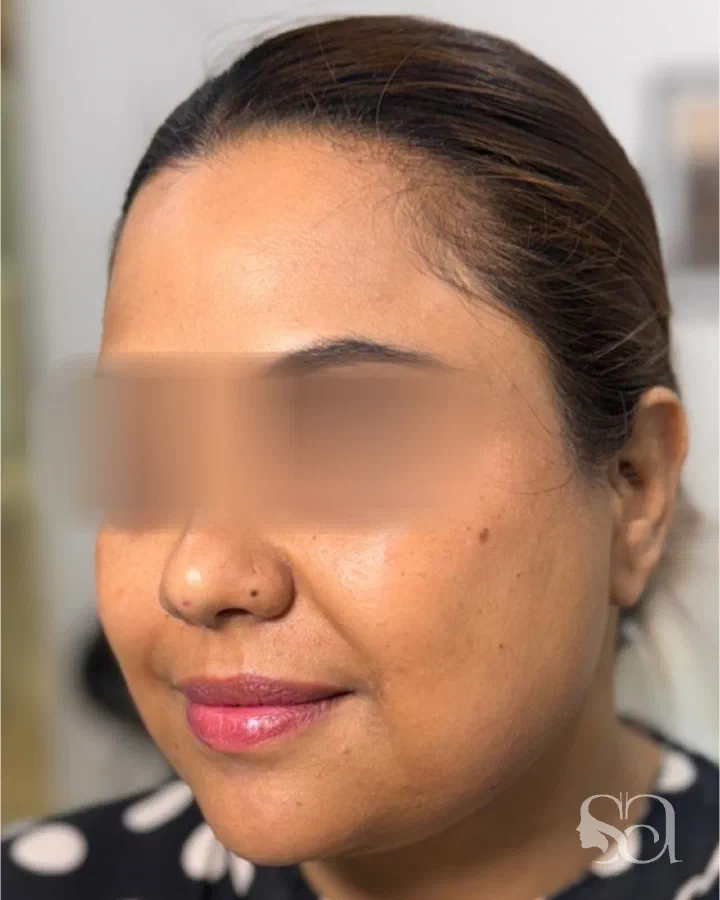 Before
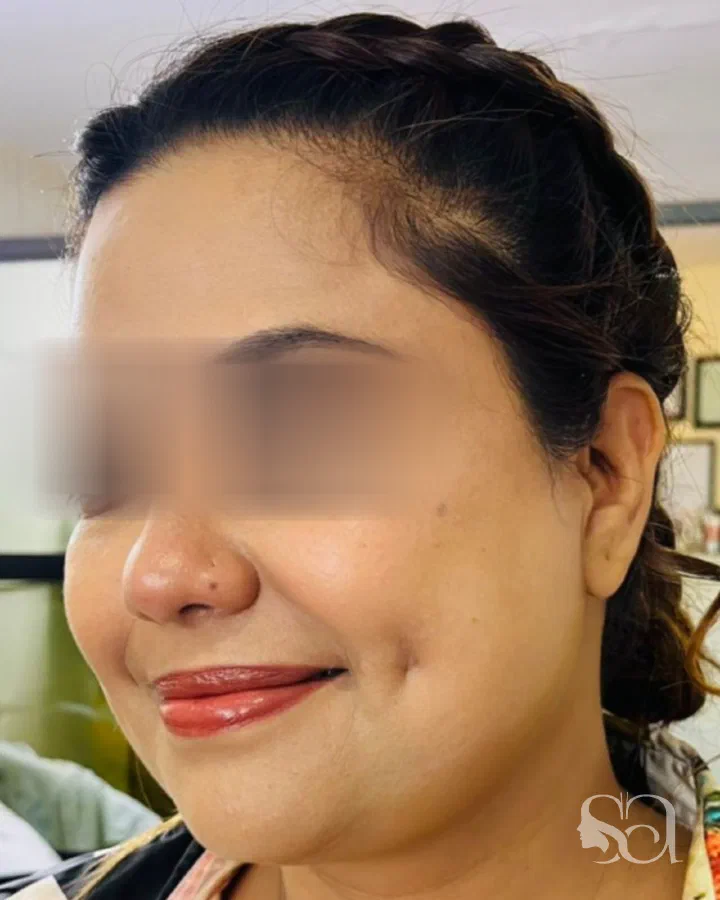 After
AfterDimple Creation
- Surgical
- Results vary between individuals
Photographs of the clinic's own patients, shown with their written consent, with faces blurred or covered as far as the result allows. They explain what an operation can change; they are not a promise of your result.
Who is a good candidate for dimple creation, and who should wait
A good candidate is an adult in good general health who wants a subtle dimple that shows when smiling, and who accepts that it may soften or fade over time. Healthy teeth and gums matter because the incision is inside the mouth. Not smoking, or being able to stop around the procedure date, supports healing. The consultation looks at cheek thickness, the smile and facial proportions before any placement is marked.- Under 18 - the face is still changing, and the decision is best made as an adult.
- An active mouth, gum or tooth infection - it is treated first, because the incision is inside the cheek.
- Smoking or chewing tobacco that cannot be stopped around the procedure - both slow healing inside the mouth.
- Very full cheeks - the dimple can be shallower or less visible, which is discussed before deciding.
- A medical condition or medicine that affects healing or bleeding, until it has been reviewed.
- Expecting an exact copy of someone else’s dimple, or a dimple guaranteed to last for life.
Dimple placement: where on the cheek the dimple goes
Placement is planned and customised to suit each face. The most common location is where an imaginary line from the corner of the mouth to the earlobe crosses another line running down from the outer corner of the eye. The precise point can be adjusted based on preference and facial structure. The point is marked with you sitting up and smiling, before any anaesthetic, because a spot that looks right at rest can sit in the wrong place in a smile.
A dimple can be made on one cheek or both. Natural dimples are rarely perfectly symmetrical, and small side-to-side differences can remain after surgery. Depth is kept conservative at the first procedure. At the consultation, Dr. Shikha Bansal discusses the position, the depth and whether to create a dimple on one side or both, so the plan suits the natural balance of the face.
Talk it through with Dr. Shikha
Book a consultation at Dr. Shikha Aesthetics in Sushant Lok 1. Bring your questions about dimple creation, and any previous reports.
How dimple surgery is done: a small incision inside the mouth, under local anaesthesia
Dimple creation is usually a day-care procedure under local anaesthesia, and most patients go home the same day. After the point is marked, the inside of the cheek is numbed and a small incision is made in the cheek lining at the matching spot, so there is no cut on the face.
In a commonly used approach, a tiny core of tissue is removed from the inner cheek and a stitch joins the underside of the skin to the cheek muscle, recreating the tether behind a natural dimple. Some techniques use a stitch alone, without removing tissue. Depending on the technique, the stitch is either absorbable or a permanent buried one. The technique is chosen at consultation.
The procedure usually takes about 30 to 45 minutes, depending on whether one or both cheeks are treated.
Dimple surgery recovery, from the first day to about 2 months
Mild swelling, bruising, some discomfort and a feeling of tightness in the cheek are normal after dimple creation. These usually settle over a few days to a week.
A soft diet is recommended for the first few days, along with the recommended antiseptic mouth rinse after meals to keep the incision inside the cheek clean.
Most patients return to desk work within 1 to 2 days. Strenuous exercise is avoided for about a week.
At first the dimple shows even with the face at rest. As healing progresses over about 1 to 2 months, it settles to appear mainly when smiling. Follow-up visits are planned at the consultation. The result is judged once it has settled, not in the first weeks.
Is dimple surgery permanent? How long created dimples last, and why some fade
For the first few weeks the new dimple usually shows even with the face at rest. As swelling settles and the tissues relax, usually over about 1 to 2 months, it softens into a dimple that appears mainly when smiling. This softening is expected.
Many created dimples last long-term, but permanence is not guaranteed. The dimple depends on an internal scar holding the skin to the muscle, and over months that attachment can loosen. A dimple can then become shallower, or in some people fade altogether. How durable it is depends on the technique used, how a person heals, how the cheek muscles move, and later changes in weight and facial fat. If a dimple fades, a repeat procedure can be discussed once the tissues have fully healed, usually after several months.
The opposite also happens: a dimple can stay visible at rest for longer than expected, or look deeper than wanted. Most settle with time. If one does not, an adjustment can be discussed at review.
Dimple creation at the Sushant Lok 1 clinic: consultation, follow-up and timing
The clinic is in Sector 43, Sushant Lok 1, Gurgaon, and sees patients from across Gurgaon and nearby Delhi, including Dwarka and South Delhi. Dr. Shikha Bansal (MCh Plastic & Reconstructive Surgery, Haryana Medical Council Reg. No. 24859) plans the placement with you and performs the procedure. Consultations are by appointment, and the procedure is usually booked for a separate day so there is time to decide.
Patients who live further away can send progress photos over WhatsApp after the first in-person review. Because the dimple can show at rest for several weeks, booking at least 2 months before a wedding or other event is advised.