
Anyone pricing eyelid surgery runs into the same problem: the figures online span ₹40,000 to ₹2 lakh with no explanation of why. Blepharoplasty cost in India typically starts from roughly ₹60,000 for an upper-lid procedure at an accredited private facility and rises past ₹1.7 lakh when all four lids are treated in one sitting. That spread is not padding. It comes from a short list of identifiable decisions: which lids are operated; what anaesthesia is used; where the surgery happens; who performs it; whether the case is cosmetic or functional; and whether it is a first surgery or a revision.
This post breaks the quote down driver by driver; gives the starting-from figures patients in Gurgaon and Delhi NCR tend to be quoted; explains the functional-versus-cosmetic distinction that decides whether insurance even enters the conversation; covers EMI in practical detail; and closes with a checklist of what a written quote should include. Candidacy and recovery, along with the risks involved (everything other than money), are covered in the full blepharoplasty guide.
One note on terminology before the numbers: searches phrase this many ways; blepharoplasty cost, eyelid surgery cost, eyelid lift price, cost for blepharoplasty. All of them describe the same operation, and the same pricing logic applies throughout.
Who this article is for
- Patients comparing eyelid-surgery quotes from multiple clinics and unsure why the numbers differ so widely
- Anyone budgeting for upper eyelid surgery (upper blepharoplasty), lower-lid surgery, or a combined four-lid procedure
- Patients with heavy upper-lid hooding wondering whether a functional classification changes what they pay
- Those still researching the procedure itself, for whom the blepharoplasty guide covers candidacy and recovery, along with the risks, in full
- Readers comparing facial-surgery budgets more broadly, where the rhinoplasty cost breakdown shows the same quote logic applied to the nose, the otoplasty ear pinning cost guide applies it to the ear, and the xanthelasma removal cost guide covers a similarly priced eyelid procedure
How much does blepharoplasty cost in India?
Upper eyelid surgery in India typically starts from roughly ₹60,000–85,000 at an accredited private facility. Lower eyelid surgery tends to start a little higher, at roughly ₹65,000–1,00,000, because the lower lid is the more delicate and technically demanding structure. A combined procedure on all four lids commonly starts from ₹1,10,000–1,70,000, less than the sum of two separate surgeries, because anaesthesia and theatre setup are shared. These are starting-from planning figures, not fixed prices; a firm quote requires an in-person assessment of the lids. Figures reflect accredited private-facility quotes in Delhi NCR as of 2026 and are reviewed periodically; they are planning ranges, not quotations.
A quote becomes easier to compare once it is split into its components:
- Surgeon’s fee: usually the largest single line, reflecting the surgeon’s training and track record, including case volume and revision rate
- Anaesthesia: local anaesthesia with sedation for most cases; general anaesthesia with an anaesthesiologist for longer combined cases
- Operating theatre and consumables: sterile setup and disposables, including patient monitoring
- Facility charge: day-care discharge in most cases; observation stays add cost
- Follow-up visits and suture removal: often bundled into the package, sometimes billed separately
City and facility type shift these bands. Quotes in Gurgaon, Delhi, Mumbai, and Bengaluru tend to run above tier-2 cities because facility and anaesthesia overheads are higher, though the surgical work itself is the same. Blepharoplasty cost in Gurgaon sits broadly within the national ranges above rather than at a premium to them.
Eyelid surgery is a real operation with real risks: dry eye and irritation, which is usually temporary but can persist, particularly in patients with pre-existing dry eye or previous laser vision correction; swelling and bruising; asymmetry; over- or under-correction; infection or delayed wound healing; rarely a lid-position problem such as ectropion; and very rarely bleeding behind the eye (retrobulbar haematoma), which is a surgical emergency because it can threaten vision. This is not a complete list — the full set of risks is covered in the blepharoplasty guide and should be discussed at consultation.
Why does the price of blepharoplasty vary so much?
Nearly all of the variation between quotes comes from six decisions: which lids are treated; the anaesthesia used; the grade of facility; the surgeon’s qualification; whether the case is classified functional or cosmetic; and whether it is a first surgery or a revision. Two patients can receive quotes ₹50,000 apart from the same city for what sounds like the same operation purely because these choices differ, and neither quote is necessarily wrong.
Which lids are treated: upper, lower, or all four
This is the biggest lever. Upper-lid surgery anchors the lower end of the range because the incision sits in the natural crease and the work is mostly skin and a measured amount of fat. Lower-lid surgery for eye bags costs more because the lower lid supports the eye and demands more conservative, technically careful handling, sometimes with added support to the lid margin. Combining all four lids raises the total but shares the fixed costs of anaesthesia and theatre time, which is why a four-lid quote tends to land below the price of two staged surgeries.
Anaesthesia: local with sedation vs general
Most isolated upper-lid procedures are done under local anaesthesia with sedation as a day-care case, which keeps the anaesthesia line modest. Longer combined cases, and patients who prefer to be fully asleep, may use general anaesthesia, which adds an anaesthesiologist’s fee; additional monitoring; and a longer recovery-room stay. The anaesthesia decision is made on clinical grounds and patient comfort, not to trim the bill.
Facility grade: clinic day-care vs hospital operating theatre
A day-care procedure in an accredited clinic OT costs less than the same operation in a full hospital theatre with an overnight observation stay. Neither is automatically better; the setting should match the case complexity and the patient’s health profile. What matters is that the facility is properly equipped and accredited; ask what the quoted facility charge includes and whether the setting is accredited before comparing on price alone.
Surgeon qualification and experience
An MCh-qualified plastic surgeon’s fee is typically higher than that of practitioners with less formal surgical training, and eyelid surgery is a poor place to economise on this line: over-resection of lower-lid skin can pull the lid margin down (ectropion), and revision of a poorly done blepharoplasty costs more than doing it correctly once. The vetting logic in choosing a facial surgeon in Gurgaon (verify the degree and council registration, and have the complication conversation) applies to eyelid surgery unchanged.
Functional vs cosmetic classification
When upper-lid skin droops far enough to obstruct the upper visual field, the surgery carries a functional rationale, documented with clinical measurements and, where relevant, a visual-field test. A distinction matters here: excess upper-lid skin (dermatochalasis) is corrected by blepharoplasty, while a drooping lid margin (ptosis) — most often caused by stretching or detachment of the levator aponeurosis, and less commonly by nerve or muscle disorders — needs a separate ptosis correction, which is why the cause is established at examination before the procedure is planned. The two are sometimes present together, and a combined procedure is quoted differently from a straightforward upper blepharoplasty. That classification can matter financially, because purely cosmetic surgery is excluded from Indian health-insurance policies while medically indicated procedures are assessed differently. How functional and cosmetic goals interact in one operation is discussed in the context of combined functional and cosmetic nose surgery; the same classification logic applies at the eyelids.
Revision cases
Revision blepharoplasty, correcting asymmetry, lid retraction, or under- or over-correction from a previous surgery, typically costs more than a primary case. Scarred tissue planes add operating time and demand more reconstructive technique, and some revisions need grafts or lid-support procedures that a primary case does not.
Does insurance cover blepharoplasty in India, and how does EMI work?
Cosmetic blepharoplasty is not covered by health insurance in India; it is an elective aesthetic procedure and standard policies exclude it. Functional blepharoplasty, where documented visual-field obstruction exists, may be considered by some insurers as a medically indicated procedure, but approval depends on the policy wording and the insurer’s assessment; it is decided case by case and should be confirmed in writing before surgery. It is never automatic. For the cosmetic majority, EMI is the main financing route.
Most established clinics, including in Gurgaon, offer instalment plans through medical-financing partners or credit-card EMI conversion, with tenures commonly running 3 to 12 months. A few practical points tend to matter more than the headline “EMI available” claim:
- No-cost vs interest-bearing EMI. “No-cost” plans usually recover the interest through a processing fee or a foregone discount; ask for the total repayable amount, not the monthly figure alone.
- Eligibility and paperwork. Financing partners generally ask for identity and income proof or run a credit check; credit-card conversion is simpler but capped by the card limit.
- What the EMI covers. The plan should cover the full quoted package: surgeon, anaesthesia, facility, follow-ups, not the surgery alone with the rest billed separately later.
- Rescheduling terms. Confirm in writing how the plan is handled if surgery is postponed for medical reasons after the loan is booked.
Financing is a payment convenience, not a selection criterion. The surgeon should be chosen on training and results first, with the EMI conversation coming after.
What a blepharoplasty quote should include
A comparable quote is a written, itemised one. Before treating two numbers as equivalent, confirm each covers the same things: the surgeon’s fee; the anaesthesia and anaesthesiologist; the operating theatre and consumables; the facility or day-care charge; and a stated number of follow-up visits including suture removal. If any of these are missing, the totals are not comparing like with like.
A practical checklist to take into any consult:
- Which lids are being treated, and the surgical approach planned
- Anaesthesia type and whether an anaesthesiologist’s fee is included
- Facility name and accreditation, and whether the price assumes day-care or an overnight stay
- Number of included follow-up visits and who removes the sutures
- Whether pre-operative tests are included — a tear-film/dry-eye check and lid-laxity assessment are a standard part of blepharoplasty planning, not an optional extra, so confirm whether they are inside the package or billed separately
- What happens financially if a small touch-up is needed after healing
- Before-and-after photographs of comparable cases: reviewing blepharoplasty before and after results of patients with similar lid anatomy is reasonable to request at consultation, and clinics following Indian advertising norms show them with identities protected
If a quote sits well below these ranges, ask which lines it includes: surgeon, anaesthesia, theatre, facility, follow-ups. Packages are scoped differently, and a lower total may simply cover less. Asking for the inclusion list in writing is standard practice, not an awkward request.
Gurgaon context: starting-from figures and what the fee includes
For planning purposes, blepharoplasty cost in Gurgaon starts from roughly ₹60,000–85,000 for upper eyelid surgery; ₹65,000–1,00,000 for lower eyelid surgery; and ₹1,10,000–1,70,000 for a combined four-lid procedure at an accredited private facility. Functional cases with visual-field documentation and revision cases are quoted individually. All figures are starting-from ranges only, never fixed prices; a firm quote follows an in-person assessment.
| Case type | Indicative starting range |
|---|---|
| Upper eyelid surgery (both upper lids) | from ₹60,000–85,000 |
| Lower eyelid surgery (both lower lids) | from ₹65,000–1,00,000 |
| Combined upper and lower (all four lids) | from ₹1,10,000–1,70,000 |
| Functional blepharoplasty with visual-field documentation | within upper-lid range; insurance assessed case by case |
| Revision blepharoplasty | typically above a comparable primary case; quoted individually |
Figures reflect accredited private-facility quotes in Delhi NCR as of 2026 and are reviewed periodically; they are planning ranges, not quotations.
The quoted fee generally includes the surgeon’s fee; anaesthesia; operating theatre and facility charges; and the first follow-up visits with suture removal. It typically does not include pre-operative blood work or medications after discharge. A tear-film/dry-eye check and lid-laxity assessment are a standard part of blepharoplasty planning rather than an optional extra, so confirm whether that assessment sits inside the quoted fee or is billed separately. These are small lines relative to the surgery, but confirming them avoids surprises.
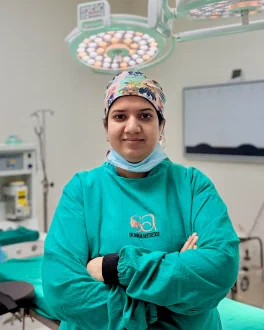
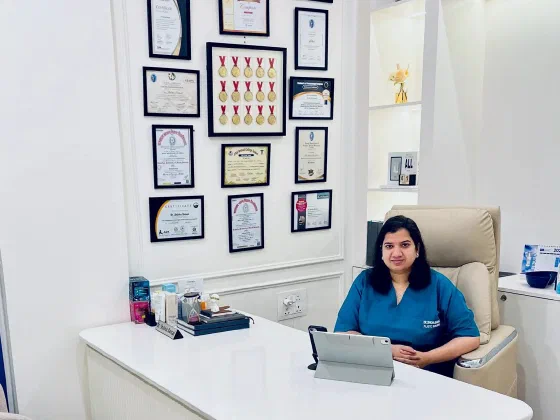
Consultations in Gurgaon are conducted by Dr. Shikha Bansal, MBBS (Gold Medalist), MS General Surgery, MCh Plastic & Reconstructive Surgery (SMS Medical College, Jaipur, 2022), registered with the Haryana Medical Council (Reg No. 24859). In her practice, the lid-count decision (upper only versus all four) moves the final quote more than any other single choice, which is why that assessment happens before any number is put on paper.
This article is for general information only and is not a substitute for medical advice. Pricing and suitability vary with individual anatomy and overall health history; both should be confirmed with a qualified plastic surgeon at consultation.
Frequently asked questions
What is the blepharoplasty cost in Gurgaon? Upper eyelid surgery in Gurgaon typically starts from roughly ₹60,000–85,000; lower eyelid surgery from roughly ₹65,000–1,00,000; and a combined four-lid procedure from roughly ₹1,10,000–1,70,000. These are starting-from ranges at accredited private facilities, confirmed only after an in-person assessment of the lids.
Is upper eyelid surgery cheaper than lower eyelid surgery? Usually, yes. Upper blepharoplasty is the more straightforward operation, with the incision hidden in the natural crease, so it anchors the lower end of the price range. Lower-lid surgery tends to cost more because the lower lid is a delicate, mobile structure that demands more conservative technique and sometimes additional lid support.
Does health insurance cover the cost for blepharoplasty in India? Not for cosmetic cases: elective aesthetic surgery is excluded by standard Indian health policies. Functional blepharoplasty with documented visual-field obstruction may be assessed differently by some insurers, but approval is case by case and should be confirmed in writing with the insurer before surgery.
Can I pay the price of blepharoplasty in EMI instalments? Yes. Most established clinics offer EMI through medical-financing partners or credit-card conversion, with tenures commonly between 3 and 12 months. Ask for the total repayable amount rather than the monthly figure, and confirm the plan covers the full quoted package.
Can I see blepharoplasty before and after photos before deciding? Yes, and asking is reasonable. Reviewing before-and-after results of patients with similar lid anatomy at consultation is a standard part of setting expectations; clinics following Indian medical-advertising norms show real cases with identities protected, and no photograph guarantees an individual outcome.
Why do two clinics quote different blepharoplasty costs for the same surgery? Usually because the underlying decisions differ: lids treated; anaesthesia type; facility grade; surgeon qualification; and what the package includes. Comparing quotes line by line (surgeon, anaesthesia, theatre, follow-ups) is more informative than comparing totals.
An eyelid-surgery quote stops being confusing once it is read as a set of decisions rather than a single number: lid count; anaesthesia; facility; surgeon; classification; and primary-versus-revision status account for nearly all the variation between clinics. Working through those decisions against a written, itemised quote, and confirming the figure at a proper assessment of your own lids, is the most reliable way to know what a specific case will cost. Book a consultation