
“My eyes make me look tired even when I’ve slept well.” That sentence, more than any other, brings people to ask about eyelid surgery. The skin over the upper lid has begun to hang, or the lower lid carries a puffy bag that no concealer hides. The face looks older or more fatigued than the person feels.
Blepharoplasty is the surgical procedure that addresses exactly this. It removes or repositions excess skin and fat — and, where needed, a little muscle — around the eyes to produce a more rested, open appearance. It is one of the most requested facial procedures worldwide, and it splits cleanly into two operations that are often confused: upper eyelid surgery and lower eyelid surgery.
This guide explains what blepharoplasty treats, how upper and lower procedures differ, who is and is not a suitable candidate, what recovery actually looks like day by day, the real risks, and what it costs in India and Gurgaon. The aim is a single honest reference, not a sales page.
Who this article is for
This post is written for adults weighing eyelid surgery as a real option, and for those simply trying to understand what is involved before booking a consultation. It will be most useful if you:
- See heavy or hooded upper lids that make the eyes look smaller or perpetually tired
- Have under-eye bags or puffiness that persists regardless of sleep or skincare
- Have been told, or suspect, that drooping upper-lid skin is starting to block part of your upper vision
- Are comparing eyelid surgery against non-surgical options and want to know where the line sits
- Are researching cost and recovery before committing to a procedure
If your interest is in facial procedures more broadly, the same anatomy-first reasoning applies to the nose and the ear. Our breakdown of rhinoplasty cost in India and Gurgaon explains what actually moves a facial-surgery quote, the discussion of open vs closed rhinoplasty shows how surgical technique is chosen by anatomy rather than preference, and the guide to otoplasty ear pinning shows the same reasoning applied to prominent ears. The same principle drives every eyelid plan.
What blepharoplasty is and what it treats
Blepharoplasty, also called an eyelid lift or eyelid surgery, reshapes the tissue around the eyes. With age, the skin loses elasticity and the orbital fat that cushions the eye can bulge forward as the supporting membrane (the orbital septum) weakens. The result is one or more of the following patterns:
- Hooded or droopy upper lids — excess skin folds over the lash line, sometimes resting on the lashes themselves
- Under-eye bags — fat herniation in the lower lid that creates a puffy, shadowed look
- Fine crepey skin below the lash line that crumples when you smile
- A tired or heavy appearance that does not match how rested you feel
It is worth being precise about what the surgery does and does not address. Blepharoplasty treats the eyelid itself. It does not erase dark circles caused by pigmentation, clear xanthelasma plaques, or lift sagging brows, and it leaves untouched the fine lines radiating from the outer corner of the eye (crow’s feet). Those concerns are managed separately, sometimes alongside eyelid surgery and sometimes instead of it, and a small bump on the lid is worth identifying first, since xanthelasma and milia are treated in different ways. A consultation that promises blepharoplasty will fix dark circles should be treated with caution.
How the surgery is performed
For an upper eyelid lift, the incision is hidden in the natural crease of the lid. Excess skin is removed and fat is repositioned or reduced where needed, with a small amount of muscle trimmed in some cases. Because the incision sits in the crease, the resulting line tends to become nearly invisible once healed.
For a lower eyelid procedure, the approach depends on the problem. When the main issue is bulging fat with little excess skin, the incision can be placed inside the lid (a transconjunctival approach) leaving no external scar. When loose skin also needs removing, the incision runs just below the lash line. Many blepharoplasties, particularly isolated upper-lid procedures, are performed under local anaesthesia with sedation as a day-care procedure; more extensive or combined cases may use general anaesthesia. The operation itself usually takes between one and two hours depending on whether one or both lids are treated.
Upper vs lower eyelid surgery
This is the distinction that most online sources blur, yet it is the single most useful thing to understand before a consultation. The two operations solve different problems and carry different recovery profiles, and they are frequently quoted at different prices.
Upper eyelid surgery
Upper blepharoplasty targets the skin and fat of the upper lid. It is the more common request and tends to be the more straightforward of the two. Candidates typically describe a hood of skin that has crept down over the lid, occasionally heavy enough to brush the lashes or narrow the visible eye opening, though a heavy upper eyelid can also come from ptosis or a low brow. Because the incision hides in the lid crease and the tissue removed is mostly skin, recovery is generally quicker and bruising tends to be milder than with lower-lid work.
Lower eyelid surgery
Lower blepharoplasty addresses the bags and puffiness beneath the eye, along with any loose skin there. It is technically more demanding because the lower lid is a delicate, mobile structure that supports the eye, and over-aggressive skin removal here can pull the lid downward. For this reason, careful surgeons are conservative with the lower lid and often combine the fat work with techniques that support the lid margin. Bruising and swelling after lower-lid surgery tend to be more pronounced and last a little longer.
The double-eyelid distinction
A separate request, common among patients of East and Southeast Asian descent, is double-eyelid surgery — creating or defining a crease in an upper lid that naturally has little or none. While it is performed on the upper lid, its goal is reshaping the crease rather than removing aged, excess skin, so it is planned differently from a standard upper blepharoplasty. If a defined crease is your goal, say so explicitly at consultation, because the surgical plan changes.
Many patients eventually have both upper and lower lids treated, either together or staged. Whether to combine depends on your anatomy and your recovery bandwidth, weighed against what bothers you most. Which combination is right for you is best settled at a consultation, where your eyelid anatomy can be assessed directly against what bothers you most. The blepharoplasty procedure page sets out the upper and lower options, along with the transconjunctival and Asian-eyelid variations, in more detail.
Functional vs cosmetic blepharoplasty
Not all eyelid surgery is cosmetic. When upper-lid skin droops far enough, it can physically obstruct the upper part of the visual field — patients describe lifting their brows or tilting their head back to see properly, and the brow muscles ache from the constant effort. This is functional blepharoplasty, and it sits in a different category from surgery done purely for appearance.
The clinical distinction matters for two reasons. First, severe hooding that blocks vision is a medical concern, not a vanity one, and the surgical priority shifts toward restoring the visual field. Second, where a measurable visual obstruction exists, the procedure may carry a functional rationale that is worth documenting. A proper assessment includes checking how far the lid skin encroaches on the eye and, where relevant, a visual-field evaluation. If you find yourself constantly raising your eyebrows to see, mention it specifically — it changes the conversation.
Who is and is not a good candidate
Good candidacy is about more than having loose eyelid skin. A careful surgeon screens for several conditions that change the plan or rule out surgery entirely. This honesty at the front end is what separates a safe practice from a transactional one.
You are likely to be a suitable candidate if you are in reasonable general health, are a non-smoker or willing to stop around surgery, have realistic expectations, and have a specific eyelid concern that surgery can actually address.
Surgery should be approached with extra caution or deferred, and sometimes avoided altogether, if any of the following apply:
- Dry eye disease — blepharoplasty can worsen dry-eye symptoms, so existing dry eye is assessed carefully before proceeding
- Thyroid eye disease or an unstable thyroid condition — this affects the eye tissues directly and usually needs to be stabilised first
- Uncontrolled diabetes or high blood pressure, or a bleeding tendency — these raise surgical and healing risks
- Recent eye surgery or certain glaucoma conditions — these require ophthalmology input before any eyelid procedure
- Unrealistic expectations — if the underlying concern is dark circles or brow position, or a hope that surgery will resolve unrelated dissatisfaction, eyelid surgery is the wrong tool
A consultation that simply confirms what you already want to hear is not serving you. Expect questions about your eye health, your tear film, your thyroid history, and what specifically prompted you to consider surgery.
Recovery: a day-by-day timeline
Recovery is the part patients most often underestimate, and the part competitors most often skip. Eyelid surgery heals well, but the early days look dramatic. Knowing what to expect removes most of the anxiety. The timeline below is typical; individual healing varies, and lower-lid surgery generally runs a few days longer than upper-lid alone.
- Day 0 (surgery day): Performed as day-care under local anaesthesia with sedation. Vision may be blurry from ointment. Cold compresses begin almost immediately, and rest with the head elevated is advised.
- Days 1–3: Swelling and bruising peak. Bruising can be a deep purple and may spread below the eye. Mild discomfort and a tight, watery feeling are normal. Cold compresses and keeping the head elevated, including while sleeping, make a real difference here.
- Days 4–7: Swelling begins to settle and bruising starts to fade toward yellow-green. Stitches, where used, are typically removed around day 5 to 7. Many people feel presentable enough for low-key activity by the end of this window.
- Week 2: Most visible bruising has resolved or is easily covered with makeup. A good proportion of patients return to desk work and light routine around this point, though tinted glasses outdoors help with light sensitivity.
- Weeks 3–6: Residual swelling continues to subside. Incision lines, initially pink, begin to soften. Strenuous exercise and heavy lifting are reintroduced gradually on the surgeon’s advice.
- Months 2–6: Fine scars continue to mature and fade. The final, settled result becomes apparent as the last of the deep swelling resolves — typically by around three to six months.
A few recovery realities worth flagging: screen time strains the eyes early on, so plan for reduced computer and phone use in the first week. Sun protection and avoiding eye rubbing protect the healing incisions. And contact-lens wearers usually switch to glasses for the first couple of weeks. Following the post-operative instructions closely is the single biggest factor in a smooth recovery.
Risks and how they are managed
Every surgery carries risk, and eyelid surgery is no exception. A trustworthy discussion names them plainly rather than glossing over them. The common, usually temporary effects include swelling and bruising, often with watering and some light sensitivity. A period of dry or gritty-feeling eyes is common too. These tend to settle within the recovery window described above.
Less common but more significant risks include prolonged dry eye, temporary difficulty closing the eye fully, asymmetry between the two sides, visible scarring, and — in lower-lid surgery specifically — downward pull of the lid margin (ectropion) if too much skin is removed. Rare complications include infection and bleeding behind the eye; very rarely, this bleeding can lead to vision loss, which is why post-operative warning signs are reviewed with every patient.
These risks are managed in three ways. Careful screening before surgery (the dry-eye and thyroid checks above exist precisely to reduce them) is paired with conservative surgical technique that removes only what is necessary. Close follow-up afterward then ensures any concern is caught early. The reassurance is not that complications never happen, but that a properly assessed, conservatively operated patient under proper follow-up carries a low risk of a serious one.
Eyelid surgery cost in Gurgaon and India
Cost is usually the first question, so here is a straight answer with the necessary caveat: these are starting-from ranges, and a precise quote is only possible after an in-person assessment. In India, blepharoplasty is typically quoted in these bands:
- Upper eyelid surgery: starting from roughly INR 60,000–85,000
- Lower eyelid surgery: starting from roughly INR 65,000–1,00,000
- Combined upper and lower (all four lids): starting from roughly INR 1,10,000–1,70,000
These bands are indicative of private practice in Delhi NCR as of 2026 and are estimates, not fixed prices; they vary from clinic to clinic. Blepharoplasty cost in Gurgaon sits broadly within these national ranges. What moves a quote up or down includes the extent of correction needed and whether one or both lids are treated, the type of anaesthesia, and the surgeon’s qualification and facility — the full blepharoplasty cost breakdown walks through each driver individually. A transparent quote should make clear what is included — the surgeon’s fee, the anaesthesia, the operating-room and facility charges, and the follow-up visits — so you can compare like with like rather than being surprised later.
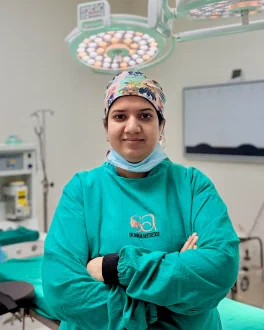
In her practice in Gurgaon, Dr. Shikha sees patients in their thirties to fifties presenting with hooded upper lids and a tired appearance, and a smaller group with functional hooding heavy enough to affect vision. Each plan is anchored to the specific anatomy in front of her, which is why an honest range, not a fixed headline price, is the responsible way to talk about cost before assessment.
This article is general information only and is not a substitute for medical advice. Eyelid surgery is an individual decision that depends on your eye health and anatomy as much as on your goals. Please consult a qualified plastic surgeon before making any decision.
Frequently asked questions
What is the blepharoplasty cost in India?
In India, upper eyelid surgery typically starts from around INR 60,000–85,000, lower eyelid surgery from around INR 65,000–1,00,000, and a combined four-lid procedure from around INR 1,10,000–1,70,000. These are starting-from ranges. The actual figure depends on the extent of correction and the anaesthesia used, alongside the surgeon’s experience, and is confirmed only after an in-person assessment.
How long does recovery from eyelid surgery take?
Most visible bruising settles within about two weeks, which is when many people return to desk work and light routine. Upper-lid surgery generally heals a little faster than lower-lid surgery. The final, settled result usually becomes apparent over three to six months as residual swelling resolves and incision lines fade.
Will I have a visible scar after eyelid surgery double or single?
For upper eyelid surgery, the incision is hidden in the natural lid crease and tends to become nearly invisible once healed. For lower-lid surgery, an incision placed inside the lid leaves no external scar, while an under-lash incision settles into a fine line that typically fades over several months. Scarring is also influenced by individual healing and sun protection during recovery.
Can eyelid surgery improve my vision?
It can, when drooping upper-lid skin is heavy enough to block part of the upper visual field — this is functional blepharoplasty. If you find yourself lifting your eyebrows or tilting your head back to see clearly, mention it at consultation, as it may warrant a visual-field assessment and changes the surgical priority.
Is blepharoplasty painful?
Most patients report tightness and mild soreness, along with some watering, rather than significant pain, and any discomfort is usually well controlled with simple medication. The procedure itself is generally done under local anaesthesia with sedation, so it is not felt during surgery. The first few days involve more swelling and bruising than pain.
How do I know if I’m a good candidate?
Suitable candidates are generally in reasonable health and have realistic expectations, with a specific eyelid concern that surgery can address. Conditions such as dry eye disease or thyroid eye disease, along with certain other eye conditions, need careful assessment first and may defer or rule out surgery. A proper consultation screens for exactly these before recommending a procedure.
Eyelid surgery is one of the more rewarding facial procedures when the right candidate meets a careful plan — but the value lies in the assessment as much as the operation. If hooded lids or under-eye bags are making your eyes look tired or are affecting your vision, the most useful next step is a proper evaluation — and eyelid surgery in Gurgaon always begins with assessing your eye health and anatomy against what you hope to change. Dr. Shikha Bansal — MBBS (Gold Medalist), MS General Surgery, MCh Plastic & Reconstructive Surgery (SMS Medical College, Jaipur), Haryana Medical Council Reg No. 24859 — assesses each case individually before any plan is made. Book a consultation