

“Will surgery get rid of my eye bags, or is that the wrong fix?” It is a fair question, because under-eye swelling has several causes and only some respond to an operation. Eye surgery for bags, properly called lower eyelid blepharoplasty, works well for one specific cause. For the others it does little, or makes things worse.
This post covers the lower lid only. It explains what produces an under-eye bag and how to check yours in a mirror at home. It then compares the two main ways lower-lid surgery is performed with filler, or with no treatment at all, which is sometimes the more honest answer. It also explains the lower-lid complications that set a careful plan apart from a fast one.
For upper and lower eyelid surgery together, recovery and candidacy, see our complete guide to blepharoplasty in India. This article is general information only and is not a substitute for medical advice.
Who this article is for
- Adults with puffy lower lids that persist however much they sleep
- People unsure whether they have true bags or something else, such as hollows or dark circles
- Anyone comparing under eye filler with eye bag removal surgery
- Patients curious about the scarless approach and its limits
- Those planning eyelid surgery in Gurgaon who want to arrive at a consultation knowing the right questions
What causes eye bags, and which ones does surgery fix?
Surgery reliably fixes one type of eye bag: fat that has pushed forward from behind the lower lid as its supporting membrane weakens. Bags made of fluid, allergic swelling, tear-trough hollowing, cheek-level festoons and the puffiness of thyroid eye disease each have a different cause and need a different plan. Telling them apart is the most important step, because the wrong diagnosis leads to the wrong operation.
Herniated fat
The lower lid holds three small fat pads behind a thin membrane, the orbital septum. With age, and sometimes from a family tendency in younger people, the septum loosens and the fat bulges forward. These bags look much the same morning and evening, and they are the classic indication for lower blepharoplasty.
Fluid and allergic puffiness
Swelling that is worst on waking and settles by midday is usually fluid. Salty food and alcohol make it worse. So do allergic rhinitis and frequent eye rubbing. Surgery does not treat fluid.
Tear-trough hollowing
Sometimes the “bag” is really a groove. The tear trough, running down and out from the inner corner of the eye, deepens as the cheek loses volume, and its shadow makes the lid above look fuller than it is. The fix is adding volume, not removing fat.
Festoons and malar bags
Festoons sit lower, on the upper cheek below the bony rim of the eye socket. They are often soft, fluctuate with fluid, and are not corrected by a standard lower blepharoplasty.
Thyroid eye disease
Puffy lids with eyes that look prominent or staring may point to thyroid eye disease. This needs a thyroid work-up and an eye examination first, and cosmetic eyelid surgery is generally deferred until the disease has been stable for some time.
Dark circles are not bags
In Indian skin, the most common under-eye complaint is often periorbital hyperpigmentation, a brown or grey darkening of the skin, rather than a bag. Surgery does not remove pigment. Where a bag and pigmentation coexist, surgery can reduce the shadow cast by the bulge, but the skin colour tends to stay the same. Small yellow plaques or bumps near the lids are different again; see our post on xanthelasma, milia and syringoma.
Simple self-checks
These are clues, not a diagnosis:
- Look up. Hold a mirror at chin level and look toward the ceiling. Herniated fat usually bulges more.
- Morning versus evening. Photograph the lids in the same light on waking and in the evening. A big difference suggests fluid.
- Overhead light. A bulb directly above shows a shadowed groove (tear trough) beneath a bulge (fat). Many people have both.
- Pinch the skin. A generous, crepey fold below the lashes suggests skin excess as well as fat.
- Smile. Swelling on the cheek that puffs when you smile is more likely a festoon.
How eye bag removal surgery is done
Lower eyelid blepharoplasty uses one of two routes: from inside the lid, leaving no visible scar, or through a fine cut just below the lashes. Within either route, part of the fat can be trimmed and part moved into the tear trough, and a lax lid can be supported at its outer corner. The combination is chosen from the examination, not from a fixed menu.
Transconjunctival (scarless) approach
The incision is made on the inner surface of the lower lid, so no skin scar is visible. It suits bulging fat with good skin quality, which often includes younger patients. Because the muscle that supports the lid is left largely undisturbed, this route tends to carry a lower risk of the lid pulling down afterwards.
Transcutaneous (skin-pinch or subciliary) approach
Where there is genuine loose skin, an incision is placed a millimetre or two below the lash line and a strip of skin is removed. A limited “skin pinch” can also be added to a transconjunctival operation without opening the muscle layer. The external route gives more access but asks more of the lid’s support, which is why skin removal is kept conservative.
Fat removal versus fat repositioning
Removing too much fat was once common, and it left a hollow, sunken look years later. Many current plans reposition part of the fat instead, draping it over the bony rim into the tear trough to smooth the step between lid and cheek. Removal still has a place where there is clear excess and no hollow beneath it. In our practice, we often see a fat bulge and a tear-trough hollow in the same lid, so the plan usually addresses both.
Canthopexy: supporting the lid
Some lower lids are already lax before surgery. A lid that is slow to snap back after being gently pulled away from the eye needs support. A canthopexy is a stitch that anchors the outer corner of the lid to the bone so it holds position while healing.
Under eye filler or surgery: which is right?
Under eye filler suits a tear-trough hollow with little or no fat bulge, and can soften a mild bag by blending the step below it. It does not remove herniated fat, and filler placed over a true bag can make puffiness look worse. Surgery suits a true fat bulge. When the problem is fluid or allergy, or the darkness is pigment, neither is the right first step.
When filler fits
Hyaluronic acid filler has little downtime. Results are temporary, though under-eye filler often lasts a year or longer, and it can cause delayed puffiness because it draws in water. It can be dissolved if needed. Risks include swelling, lumps, a bluish tint under thin skin and, rarely, blockage of a blood vessel, which in the most serious cases can affect vision. It should be placed by a trained injector.
Fat transfer
A patient’s own fat can also fill the tear trough, alone or during surgery. How much survives varies, and small lumps under thin lid skin are a recognised drawback. Under eye fat transfer cost is covered in our lower eyelid surgery cost guide.
When the honest answer is nothing
Morning puffiness from allergy or salt is often best managed without surgery, through allergy treatment and better sleep. Pigment-based dark circles respond better to sun protection and skincare. Very early bags visible only in harsh light can simply be watched. A consultation that ends with “not yet” is a reasonable outcome.
Lower-lid risks: ectropion and scleral show
The lower lid’s specific risks are malposition: scleral show, where white appears below the iris, and ectropion, where the lid edge turns outward. Both tend to arise from removing too much skin or from scarring that pulls the lid down. Operating on a lax lid without support raises the risk too. They are uncommon with careful planning, though some need a further operation to correct.
Other risks include dry or watery eyes, swelling of the white of the eye (chemosis), asymmetry, a hollowed look from over-removal, infection, rarely temporary double vision and, rarely, bleeding behind the eye. This is a surgical emergency because it can threaten vision, so sudden severe pain, increasing swelling or any change in vision after surgery needs urgent attention. People with prominent eyes carry a higher risk of lid pull-down, so their plans tend to favour the inside approach and lid support. The full risk list and recovery timeline are in our blepharoplasty guide.
Planning eye bag surgery in Gurgaon
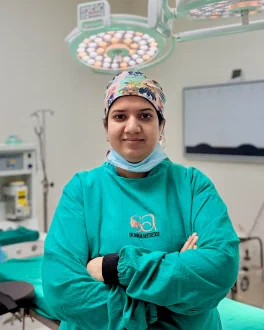
Lower eyelid surgery at the Sushant Lok 1 clinic is performed by Dr. Shikha Bansal, MBBS (Gold Medalist), MS General Surgery, MCh Plastic and Reconstructive Surgery, registered with the Haryana Medical Council. The first visit repeats the checks above under clinical conditions. It adds a lid-laxity test and an assessment of eye prominence and dryness, with standardised photographs taken for planning.
Fees are quoted after examination, because they depend on the technique and any additions such as canthopexy or fat transfer. Treating the upper lids at the same time also changes the quote. Starting ranges and typical inclusions are in our lower eyelid blepharoplasty cost post. If your concern is the upper lid crease, see double eyelid surgery for Indian eyes.
Frequently asked questions
Is eye bag removal surgery permanent?
Fat that is removed or repositioned tends not to return in the same way, so results are typically long-lasting. The face keeps ageing, though, and skin and cheek volume continue to change.
Will lower eyelid blepharoplasty leave a scar?
The transconjunctival approach leaves no visible skin scar. When loose skin is removed, a fine line sits just below the lashes and usually fades well, though healing varies between individuals.
Can under eye filler replace eye bag surgery?
Filler can soften a hollow or blend a mild bag, but it cannot remove herniated fat. In true bags it may add bulk and make puffiness look heavier.
What is the lower eyelid blepharoplasty cost in India?
Cost depends on the technique and any additions such as fat repositioning or canthopexy. Anaesthesia and facility charges also vary. Our blepharoplasty cost guide explains the factors and what a quote should include.
Does surgery fix dark circles under my eyes?
Not when the darkness comes from skin pigment. Surgery can reduce the shadow cast by a bulging bag, but pigmentation usually needs dermatological care, including sun protection.
How do I choose under eye bags treatment in Gurgaon?
Start with a diagnosis rather than a procedure. Look for a consultation that tests lid laxity and checks the tear trough, and that will recommend filler or no treatment where that fits. Always consult a qualified plastic surgeon before any eyelid procedure.
For the right kind of bag, lower blepharoplasty tends to give a natural, lasting improvement. The decision rests on an accurate diagnosis and a well-supported lid, so the aim is a result that looks rested rather than operated on. If you would like your lower lids assessed, we are happy to talk it through.