

“I want to fix the bump on my nose, but I also can’t breathe through one side. Do I need two separate surgeries?” That single question sits behind most septorhinoplasty consultations. The honest answer is reassuring: when a blocked nose and an unhappy nasal shape exist in the same person, they can usually be corrected together, in one operation, under one anaesthetic.
That is what septorhinoplasty means. It combines a septoplasty (the functional repair that straightens the wall of cartilage and bone dividing the two nostrils) with a rhinoplasty, the cosmetic reshaping of the external nose. The two share one surgical field and one recovery under a single anaesthetic, which is why doing them as a single procedure tends to make more sense than scheduling them apart.
This article is built to do something most nose-surgery pages skip. It helps you self-screen whether your concern is a genuine breathing problem, a purely cosmetic one, or a mix of the two. It explains in plain terms how the septal correction is integrated with reshaping inside one operation. And it separates the breathing-recovery timeline from the much slower cosmetic-settling timeline so you know what to expect at each stage. Cost and the insurance question are covered, but kept short and linked out, because that ground is already covered in detail elsewhere.
Who this article is for
This post is written for people weighing nose surgery in Gurgaon, Delhi NCR or elsewhere in India who fall into one of these groups:
- You breathe better through one nostril than the other, snore, or get blocked up at night, and you also dislike a hump or a crooked look to the nose.
- You were told years ago that you have a deviated septum and now want to know if reshaping can be done at the same time.
- You are researching what septorhinoplasty is versus a plain rhinoplasty or a standalone septoplasty.
- You had a nasal injury, such as a sports knock or an old fracture, that left both a breathing problem and a visible deformity.
- You want to understand recovery realistically before committing, including when normal breathing returns and when the final shape settles.
If your interest is purely cosmetic with no breathing trouble, a standard rhinoplasty may be all you need, and the comparison of surgical approaches in open vs closed rhinoplasty is the better starting point. And if you are exploring facial procedures that combine a functional and a cosmetic benefit, the same logic appears in eyelid surgery, where drooping skin can both obstruct vision and age the eye.
What septorhinoplasty is, and how it differs from rhinoplasty and septoplasty
Three operations sound similar and are routinely confused. The cleanest way to separate them is by what each one targets.
A septoplasty is purely functional. It corrects a deviated septum (the partition inside the nose) to open up the airway. It does not change how the nose looks from the outside.
A rhinoplasty is, in its classic form, cosmetic. It reshapes the visible nose: lowering a dorsal hump, refining a bulbous or drooping tip, narrowing a wide bridge, straightening a crooked profile.
A septorhinoplasty does both in the same sitting. The surgeon straightens the septum to restore airflow and reshapes the external nose for appearance, working through the same incisions and using the same exposure. The word itself, septo (septum) plus rhinoplasty (nose reshaping), describes exactly that combination. Some clinics use the term rhinoseptoplasty, which means the same thing.
The reason this matters is structural, not just labelling. The septum is not only a partition; it is the central support beam of the nose. Reshaping the outside without addressing a badly deviated septum can leave breathing worse, and straightening the septum without considering the external shape can leave a functionally open but cosmetically untouched nose. Combining them lets one plan respect both jobs at once.
How it improves breathing: the functional payoff
A deviated septum narrows or blocks one or both nasal passages. People describe this as breathing better on one side, a nose that “stuffs up” when lying down, mouth-breathing at night, snoring, or a feeling that one nostril never fully clears. Recurrent sinus congestion can ride along with it because poor airflow and drainage tend to go together.
Straightening the septum widens the airway on the obstructed side. Where the deviation is the main driver, the breathing change after recovery can be substantial. Where collapsed or weak sidewalls also contribute, a common finding, the same operation can reinforce them, which is where grafting comes in below. In some people, other factors such as allergy or enlarged turbinates also limit airflow, so the improvement varies from patient to patient and is not guaranteed by septal correction alone. The functional payoff is the part that motivates many patients far more than the cosmetic change, and it is the part insurance sometimes engages with, addressed briefly later on.
Candidacy: a self-screen for functional and cosmetic concerns
Before any surgery is discussed, the first useful exercise is sorting which problem you actually have. This is the single most overlooked step in most online nose-surgery content, and it is the natural place to start.
Signs your concern is genuinely functional
A functional deviated septum tends to show itself through breathing, not appearance. Common signals include:
- One-sided blockage: you consistently breathe more easily through one nostril than the other.
- Positional congestion: the nose blocks up more when you lie down or change which side you sleep on.
- Snoring or mouth-breathing, especially noticed by a partner, or waking with a dry mouth.
- Recurrent sinus infections or facial pressure that keep returning.
- A history of nasal injury: an old fracture or knock that changed your breathing afterwards.
- Limited relief from decongestant sprays over the long term, suggesting the obstruction is structural rather than from temporary swelling.
None of these are diagnostic on their own. They are flags worth raising at consultation, where an internal examination, sometimes with a small endoscope, confirms whether the septum is genuinely deviated and by how much.
Signs your concern is primarily cosmetic
A purely cosmetic concern usually centres on how the nose looks, with breathing that is comfortable on both sides: a dorsal hump in profile, a tip that feels too round or droops when smiling, a bridge that reads too wide, or asymmetry from the front. If breathing is unrestricted and only the shape bothers you, the functional half of a septorhinoplasty may not be needed at all.
When both apply
Many people sit in the overlap: a visible deformity and a real breathing problem, often after an injury that bent both the outside and the inside of the nose. For this group, septorhinoplasty is the natural fit: one operation that addresses the airway and the appearance together rather than treating them as separate problems on separate days.
For those whose concern is cosmetic and modest, it is also worth knowing that not every reshaping requires surgery. A non-surgical rhinoplasty using injectable fillers can camouflage a small dip or soften a minor irregularity temporarily, but it cannot straighten a septum or improve breathing, and it cannot reduce a hump. It is a different tool for a different, purely cosmetic, problem.
The technique: how septal correction integrates with reshaping
This is where septorhinoplasty earns its “one operation, two goals” description. The integration is not two procedures bolted together. The septum is used as both the thing being repaired and the source of material for reshaping.
Open versus closed approach
The surgery can be done through a closed approach, with all incisions hidden inside the nostrils, or an open approach, which adds a small incision across the columella (the strip of skin between the nostrils) to lift the skin and expose the framework directly. Open access tends to be favoured when the reshaping is complex, the septal deviation is significant, or grafting is planned, because it gives clearer sight of the structures being rebuilt. The trade-offs between the two are set out in detail in open vs closed rhinoplasty, and which approach suits the correction.
Spreader grafts and cartilage from the septum
Here is the part that makes combining the two operations elegant. When the septum is straightened, the surgeon removes the deviated cartilage and bone causing the blockage. That removed cartilage is not discarded. It becomes the raw material for the reshaping and reinforcement.
Two structural moves are common:
- Spreader grafts: thin strips of cartilage placed alongside the upper septum to hold the middle vault open. These widen and stabilise the internal nasal valve, the narrowest part of the airway, so that straightening the septum also keeps the airway from collapsing inward. They double as a way to straighten a crooked bridge.
- Tip and structural grafts: small pieces used to support or refine the tip and to brace the rebuilt framework so the shape holds over time.
Because the septum supplies this cartilage, septorhinoplasty often avoids harvesting graft material from elsewhere (such as the ear or rib) in straightforward cases. One operative site provides both the problem to fix and the solution to reshape with.
The one-operation rationale
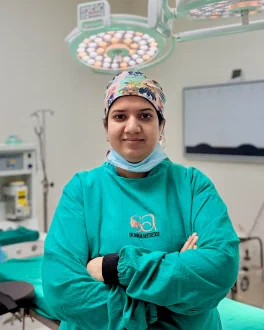
Doing both jobs together has a clear logic. There is a single anaesthetic instead of two and one recovery period instead of two. The cartilage source is shared, and, importantly, the structural work is planned as a whole, so the airway repair and the cosmetic outcome are designed to support each other rather than compete. Splitting them risks a second surgery on a nose whose internal architecture has already been altered, which is generally harder, not easier. In her Gurgaon practice, Dr. Shikha sees patients whose breathing complaint and cosmetic concern most often stem from the same underlying deviation, the case where one combined operation is the sensible plan.
The procedure is usually performed under general anaesthesia and commonly takes in the region of two to three hours, depending on the complexity of the deviation and the reshaping involved. These are general ranges, not promises, and every nose is different.
Recovery: breathing normalisation versus cosmetic settling
Most pages blur recovery into one vague paragraph. The reality is that a septorhinoplasty has two recovery clocks running at different speeds: the functional one (breathing) and the cosmetic one (final shape). Keeping them separate prevents needless worry.
The functional timeline: breathing
- Week 1. Expect congestion and a blocked feeling, often more blocked than before surgery. This is swelling and crusting inside the nose, not the operation failing. Internal silicone splints may be placed to support the straightened septum and are usually removed at the first follow-up. An external cast or splint protecting the bridge typically comes off around day 7. Saline sprays and gentle care keep the passages clearer. Most early congestion is normal swelling; however, persistent obstruction, heavy bleeding, fever, or a worsening shape beyond the expected timeline should be reviewed by your surgeon promptly.
- Weeks 2–4. Internal swelling and crusting settle steadily; the airway begins to open as the lining heals. Many people notice breathing improving meaningfully in this window once splints are out and congestion clears.
- Months 1–3. Internal swelling continues to resolve, and the breathing benefit of the straightened septum becomes more apparent and stable.
The headline: breathing tends to normalise over weeks to a few months, faster than the cosmetic result settles.
The cosmetic timeline: final shape
- Weeks 1–2. Bruising and swelling around the eyes and bridge are common early and fade over this period. The cast comes off, but the nose underneath is still swollen.
- Weeks 2–6. The obvious swelling subsides and you look presentable, but the nose is not yet showing its final shape, particularly the tip, which holds swelling longest.
- Months 3–12+. Subtle swelling, especially at the tip, resolves gradually. The refined final shape can take up to a year, sometimes longer, to fully settle.
This split is what matters most on recovery: do not judge the cosmetic outcome at six weeks, and do not assume the breathing has failed because the nose feels congested in week one. The broader picture on healing milestones is covered in the general overview of rhinoplasty recovery time. As with any surgery, recovery varies between individuals; the timelines above are typical patterns, not guarantees.
Risks and complications
Like any surgery, septorhinoplasty carries risks: bleeding, infection, persistent or worsened nasal obstruction, septal perforation, changes in the nasal tip or bridge that may need revision (revision is needed in roughly 1 in 10 primary cases, with published rates ranging about 5–15%), temporary numbness of the nasal tip or front teeth, rarely a loss of bridge support such as saddling from cartilage removal, altered sense of smell, and the usual risks of general anaesthesia. These are discussed individually at consultation, where your own anatomy and history determine which matter most for you. The guide to the side effects of rhinoplasty and when to call your surgeon covers how to separate normal post-operative healing from the complications worth acting on.
The insurance question, briefly
Whether any part of a septorhinoplasty is covered hinges on medical necessity. Indian insurers may engage with the functional septoplasty component when a deviated septum causes documented breathing problems, but the cosmetic reshaping is treated as an elective expense and is not covered. In practice the surgical fee and the way a combined operation is quoted depend on this functional-versus-cosmetic split. Rather than repeat the detail here, the full breakdown, including how Indian insurers generally separate medically necessary from cosmetic procedures and what documentation tends to matter, is laid out in the rhinoplasty cost and insurance breakdown, and the same principle is explained at length in the guide to how Indian insurers treat cosmetic versus medically necessary surgery.
Septorhinoplasty cost and planning in Gurgaon
Cost in India varies widely with the complexity of the deviation, the extent of reshaping, whether grafting is needed, the level of anaesthesia and facility used, and the surgeon’s experience. A combined septorhinoplasty generally sits higher than a standalone septoplasty because it includes the reshaping work, but lower than the total of two separate operations, since the anaesthesia and recovery are needed only once.
For that reason, fees are best understood as starting-from ranges confirmed at consultation, never fixed quotes given before an examination. A transparent estimate normally accounts for the surgeon’s fee, anaesthesia, operating-theatre and facility charges, implants or grafts if used, and follow-up visits. A current itemised view of what goes into a nose-surgery quote in Gurgaon and Delhi NCR is kept in the rhinoplasty cost in India breakdown.
The most reliable way to get an accurate figure is an in-person assessment, where the internal examination establishes how much functional correction is needed alongside the cosmetic plan, and the two together determine the quote.
Frequently asked questions
What is septorhinoplasty, in simple terms?
Septorhinoplasty is a single operation that combines a septoplasty (straightening the internal wall of the nose to improve breathing) with a rhinoplasty (reshaping the external nose for appearance). It treats a functional airway problem and a cosmetic concern together rather than in two separate surgeries.
What is the difference between septorhinoplasty and rhinoplasty?
A rhinoplasty reshapes only the outside of the nose and is typically cosmetic. A septorhinoplasty does the same reshaping but also straightens the deviated septum inside to improve breathing. If you have no breathing problem, a plain rhinoplasty may be enough; if you do, the combined procedure addresses both.
How long is the rhinoplasty recovery time after a septorhinoplasty?
Most people return to light routine within one to two weeks once the external cast and internal splints are removed. Breathing tends to normalise over several weeks to a few months as internal swelling settles, while the final cosmetic shape can take up to a year to fully refine. The two timelines run at different speeds.
Can I just have a non-surgical rhinoplasty instead?
A non-surgical rhinoplasty uses fillers to camouflage small surface irregularities temporarily. It cannot straighten a septum or improve breathing, and it cannot remove a hump, so it is not an alternative to septorhinoplasty when a functional or structural correction is needed. It is only an option for minor, purely cosmetic concerns.
Is septorhinoplasty done as open or closed surgery?
Both approaches are used. The open approach, with a small incision across the columella, is often chosen when the deviation is significant or grafting is planned, because it gives clearer access to rebuild the framework. The closed approach keeps all incisions inside the nostrils. The right choice is decided at consultation based on what the correction requires.
What does septorhinoplasty cost in India?
There is no single figure. The cost depends mainly on how complex the deviation is and how much reshaping or grafting is needed, plus anaesthesia and facility charges. A combined procedure usually costs more than a septoplasty alone but less than two separate surgeries. An accurate, starting-from estimate is given after an in-person examination.
A note before you decide
The most useful thing to settle before any nose surgery is what you are actually treating: a breathing problem, an appearance you want changed, or sometimes both at once. That answer shapes everything that follows: whether septorhinoplasty is the right operation for your nose and what a realistic recovery looks like. This article is general information only and is not a substitute for medical advice; an examination is the only way to assess your septum and plan accurately. A consultation with Dr. Shikha Bansal, MBBS (Gold Medalist), MS General Surgery, MCh Plastic & Reconstructive Surgery, Haryana Medical Council Reg No. 24859, can clarify whether one combined operation is the right path for your nose. Book a consultation