

A few soft flaps of skin along the collar line tend to start as one, then become five, then catch on a chain every morning. Skin tags on neck skin are harmless in the large majority of cases, yet the questions that follow are practical: why are there so many, should they come off, and is it safe to tie a thread around them at home?
This post answers those questions for the neck specifically: why tags cluster there, when a crop of them is a reason to check blood sugar, how in-clinic removal options compare for many tags, and why home methods are riskier than they look. If the growth has not yet been confirmed as a skin tag, start with our guide on how to tell a skin tag from a mole or wart.
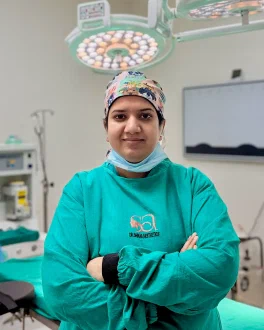
In her Gurgaon practice, Dr. Shikha most often hears about neck tags at the end of a visit booked for something else.
Who this article is for
- Anyone with several soft, skin-coloured tags that rub on collars, chains or dupattas
- Anyone noticing new neck tags alongside weight gain, a darkened neck fold or pregnancy
- Anyone weighing skin tag removal before a mole and skin growth removal consultation
- Anyone tempted by a thread, cream or removal pen at home
- Anyone with a soft lump under the neck skin rather than a hanging tag: that may be a lipoma, which is managed differently
Why do skin tags form on the neck?
Skin tags (acrochordons) are small outgrowths of normal skin on a narrow stalk, and they form where skin folds and rubs. The neck combines constant friction from collars, chains and creases with skin that responds to hormonal and metabolic signals. Tags become more common after 40, with weight gain, during pregnancy and with insulin resistance or type 2 diabetes, and they often run in families. They are benign and are not considered precancerous.
Friction from collars, chains and folds
Tags often line up exactly where a gold chain, mangalsutra or stiff collar sits, and along the natural side crease. Heat and sweat in a Delhi NCR summer add to the rubbing.
Weight, insulin and hormones
High circulating insulin acts as a growth signal for skin cells, which is why tags are linked with insulin resistance. Extra weight deepens neck folds and adds friction at the same time. In pregnancy, hormonal shifts can bring on new tags; some shrink after delivery, though many stay.
When many neck skin tags are worth a blood sugar check
A handful of neck tags is common and usually needs no tests. A blood sugar check is reasonable when there are many tags together with dark, velvety skin on the back or sides of the neck (acanthosis nigricans), weight gain around the waist, a family history of diabetes, PCOS, or tags appearing quickly over a few months. A fasting glucose or HbA1c test, arranged through a physician, is the usual starting point.
Most people with neck tags do not have diabetes. Skin can, however, be an early visible signal of insulin resistance. Removing the tags treats the tags, not the cause, so where insulin resistance is present, new tags tend to keep forming until it is addressed.
Skin tag removal on the neck: comparing in-clinic options
For several neck tags, the three common in-clinic methods are snip excision, radiofrequency or electrocautery, and cryotherapy (freezing). Snip excision and cautery can usually clear many tags in one sitting under numbing cream or a small local anaesthetic injection. Cryotherapy suits small tags and may need repeat sessions. On pigmented Indian skin, the main trade-off is the temporary dark or light mark left behind, which depends as much on technique and aftercare as on the method.
| Method | Best suited to | Sittings, typically | Mark risk on Indian skin |
|---|---|---|---|
| Snip excision | Larger tags on a clear stalk | One | Low; small dot that fades |
| Radiofrequency or cautery | Many small to medium tags | One, occasionally a touch-up | Low to moderate; temporary darkening if heat spreads |
| Cryotherapy | A few tiny tags | One to three | Higher; pale spots can persist |
Snip excision
The tag is cut at its base with fine sterile scissors, and any small bleed is stopped with pressure or a light touch of cautery. The removed tissue can be sent for histopathology if anything looks atypical.
Radiofrequency or electrocautery
A fine probe delivers controlled heat that cuts and seals in one step, which makes it practical for dozens of small tags. Crusts typically fall away within a week to ten days. Low, precise settings matter on brown skin, since heat spreading into surrounding skin is what tends to leave darker patches.
Cryotherapy and laser
Liquid nitrogen freezes the tag, which blisters and drops off over one to two weeks. Freezing can damage pigment cells and leave long-lasting pale spots on brown skin, so we use it selectively on the neck. A CO2 laser works much like cautery, with similar trade-offs; see our post on surgical vs laser removal of small skin growths.
Healing marks, recurrence and new tags
Indian skin commonly darkens at each site after removal, and this tends to fade over weeks to a few months. Leaving crusts alone, skipping chains and tight collars for about two weeks, and daily sunscreen all help; anyone with a history of keloids should mention it beforehand. Our guide to minimising marks after removing a growth on visible skin applies to the neck too.
A tag removed cleanly at its base rarely regrows in the same spot, but new tags tend to form nearby over time because the friction and metabolic factors remain.
Can you remove skin tags at home safely?
Home removal of neck tags carries real risks and is not recommended. Tying a thread cuts off the blood supply slowly and painfully, can leave a stump, and leaves a dying, sometimes infected tag against a collar for days. Nail clippers and household scissors are not sterile, and neck tags can bleed more than expected. Removal creams often contain acids or caustic agents that burn surrounding skin, and on brown skin those burns tend to leave dark patches or scars.
Removal pens sold online deliver heat with no control over depth. The bigger problem with every home method is that nobody has confirmed the growth is a skin tag at all; a stalked mole, a wart or, rarely, something that needs a biopsy can look similar.
Planning neck skin tag removal in Gurgaon
There is no fixed price for neck skin tags, because the fee depends on how many there are, their size and the method that suits them; a quote is given after examination. Removal is a short procedure under local numbing, and most people return to work the same day.
Bring a list of current medicines, particularly blood thinners, and any recent blood sugar reports. Procedures at the clinic in Sushant Lok 1 are performed by Dr. Shikha Bansal, MCh Plastic & Reconstructive Surgery (Haryana Medical Council Reg. No. 24859).
Frequently asked questions
Are skin tags on the neck a sign of diabetes?
Not on their own. Many tags with a darkened neck fold, weight gain or a family history of diabetes are a reasonable prompt for a blood sugar test through a physician. Most people with a few neck tags have normal blood sugar.
What is the best skin tag removal method for the neck?
For several tags, snip excision and radiofrequency cautery tend to work best because many can be cleared in one sitting. Cryotherapy is used more selectively on brown skin because of the risk of pale spots.
Will removing skin tags make more grow?
No. Removal does not cause new tags. New ones may still appear over time because the underlying friction or metabolic factors remain.
Can neck moles and skin tags be removed in the same sitting?
In many cases, yes. A mole may be removed differently and sent for histopathology if it shows any changes.
Does skin tag removal on the neck leave marks?
Small marks are expected at first. On Indian skin they usually appear as darker dots that tend to fade over weeks to months with sun protection and careful aftercare.
Neck tags are rarely a medical concern, but a growing crop is worth a proper look, both for safe removal and for what it may signal about blood sugar. This post is general information only and not a substitute for medical advice; consult a qualified plastic surgeon about your own skin.