

A mole on the cheek or nose has sat there for years and shows in every photograph. The real question is whether removing it will leave something worse. That worry sits behind most searches for face mole removal without scarring. The honest answer is that no method leaves the skin untouched, but the right technique for the right mole tends to leave a mark that is small and flat.
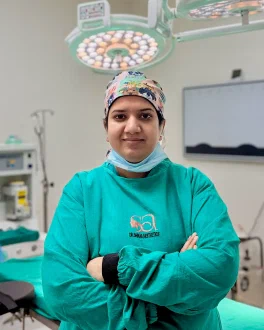
This guide covers why every removal leaves some trace, how technique and location shape the mark on Indian skin, and how the scar is cared for through its first year. In her practice, Dr. Shikha discusses the likely scar at a facial mole consultation before a method is chosen.
Who this article is for
- Anyone with a stable facial mole wondering what will be left behind
- Anyone weighing tiny mole removal on the face by laser against a small excision
- Anyone with medium-to-dark skin worried about a dark or light patch afterwards
- Anyone unsure the spot is a mole at all: skin tags and warts can look similar and are removed differently
- Anyone reading up on mole removal in Gurgaon who wants the scar question answered first
Can a mole be removed from the face without a scar?
Not completely. Any method that reaches the dermis, the deeper layer of skin, heals with some scar tissue, whether the mole is shaved, cut out or lasered. Technique shapes how visible that mark is: its length, whether it lies flat, whether it follows a natural facial line and whether it heals darker or lighter than the skin around it. The realistic goal is a fine, flat mark that fades over months, not skin with no trace at all.
Skin type, mole depth, sun exposure while healing and a personal tendency to thick scars also shape the result. One check comes before technique: a mole that has changed or looks irregular is examined and, if removal is advised, excised whole for histology, as set out in the comparison of surgical and laser mole removal.
Shave, punch, excision or laser: which suits which facial mole?
The mole decides the method: a raised mole that looks typical usually suits a shave, with no stitches and a flat, round mark. A small, deeper mole suits a punch excision closed with a stitch or two. A larger or deep flat mole, or one that must come out whole, suits an elliptical excision, which leaves a fine line. Laser suits only small, flat moles that a doctor has examined, ideally with dermoscopy, and judged clearly benign.
Raised moles: shave removal
Under local anaesthesia, a fine blade takes the mole off level with the skin. The shallow wound heals on its own in one to two weeks, and the mark usually fades to a flat spot that on darker skin can stay a shade lighter or darker. Some pigment may return from mole cells left below the shave line.
Small, deeper moles: punch excision
A circular blade removes the full depth of a small mole, typically up to about 4 to 5 mm across, and one or two stitches close it into a short line. Tiny mole removal on the face is often done this way when a shave would likely leave pigment behind.
Larger or deeper flat moles: elliptical excision
For flat mole removal from the face where the pigment runs deep, or for larger moles, the mole comes out as a narrow ellipse about three times as long as it is wide, so the edges meet without puckering. A 5 mm mole is removed with a small rim of normal skin, so it tends to leave a line of around 2 to 2.5 cm. On some sites the surgeon can shorten this with techniques such as an M-plasty.
Closing along the face’s natural lines
Relaxed skin tension lines run roughly with the creases that deepen with age, and an excision placed along them closes under less tension and tends to heal finer. Absorbable stitches beneath the surface take the strain, so the very fine surface stitches can come out early, before they leave track marks.
Mole laser removal on the face, and Indian skin
An ablative laser (CO2 or erbium) vaporises the mole layer by layer, without stitches. On Indian skin, mostly Fitzpatrick type III to V, the spot commonly heals darker for months (post-inflammatory hyperpigmentation), and a lighter patch, though less common, can be permanent. Deeper mole cells may survive, so regrowth is more likely and repeat sessions are often needed, each another chance of colour change or a shallow dent. No tissue is left to examine.
Nose, lip, eyelid, cheek and jaw: how location changes the plan
Location changes both the method and the likely mark. The cheek tends to be the most forgiving. The nose, lip border and eyelid have little spare skin and features that can be pulled out of shape, so they are planned conservatively, and the chin and jawline can be more prone to thickened scars.
- Nose: skin on the tip and nostril wings is thick, oily and tightly attached, so raised moles there are often shaved, while skin on the upper nose and sidewalls is thinner and usually closes well after a small excision; a deeper mole on the tip may need a small local flap to close without distorting the nostril rim.
- Lip line: on the border between lip and skin, a step of even a millimetre shows, so excisions cross the border at a right angle and it is realigned stitch by stitch.
- Eyelid: thin lid skin usually heals well, but a mole on the lid margin can leave a notch if excised, and any excision on the lower lid can pull the lid down if closed under vertical tension, so these are planned conservatively.
- Cheek: excisions can usually follow lines towards the smile fold. The larger risk is colour, because sun-exposed cheek skin tends to darken while it heals.
- Jawline and chin: the chin moves with every word, and the jawline near the ear is a site where keloids are more likely in those prone to them, so any history of raised scars is flagged at planning.
How does a mole removal scar heal on the face?
A facial mole removal scar tends to settle in stages. Stitches come out at around five to seven days, and the line then stays pink and slightly firm for six to twelve weeks, when sun protection and silicone do most of their work. Over three to six months it usually flattens and fades, and it keeps maturing for 12 to 18 months, sometimes longer on darker skin.
- From about week 2: once the surface has fully closed, silicone gel or sheets are typically used daily for two to three months.
- For at least six months: daily broad-spectrum sunscreen (SPF 30 or higher) on the site, plus shade outdoors. Sun darkens a healing scar, and on Indian skin that darkening can linger.
Infection and bleeding are uncommon after a small facial mole removal; increasing redness, swelling, discharge or pain should be reviewed promptly. Tissue removed by shave, punch or excision is usually sent for histology as a routine check.
When a scar heals poorly: revision and keloid care
Some facial scars widen, sink, thicken or stay dark. A thickened (hypertrophic) scar stays within the original line and often improves with silicone, with steroid injections if it persists. A keloid spreads beyond the wound edges and needs a longer plan, outlined in keloid treatment options. A widened or depressed line can sometimes be improved by scar revision surgery once it has matured, usually after six to twelve months.
Frequently asked questions
Is laser or surgery better for removal of moles on the face? Neither is better for every mole. Laser can suit small, flat moles that a doctor has examined and judged clearly benign; raised, deeper or larger moles usually do better with shave or excision, which also leave tissue for histology. On darker skin, laser carries a real chance of colour change, and the repeat sessions it often needs add to that risk.
Will a mole removal scar look darker on Indian skin? A dark patch is common on medium-to-dark skin and usually fades over several months with strict sun protection. A lighter patch is less common and can be permanent.
Should a dermatologist or a plastic surgeon remove moles on the face? Either can remove a small, typical mole. When an excision needs a closure planned around facial lines, the lip border or the eyelid, what matters most is experience in facial wound closure and reconstruction, which is a core part of plastic surgery training.
Can a mole come back after removal? It can, most often after laser or shave removal, because mole cells may remain deeper in the skin. Full-thickness excision carries a lower chance of regrowth, and a returning mole should be examined before it is treated again.
A facial mole tends to leave its least visible mark when the method fits the mole, the line follows the face and the healing skin is kept out of the sun. Consultations are with Dr. Shikha Bansal (MBBS, MS General Surgery, MCh Plastic & Reconstructive Surgery; Haryana Medical Council Reg No. 24859), where each mole’s depth, position and skin type is assessed before a method is recommended. This article is general information only and is not a substitute for medical advice; consult a qualified plastic surgeon about your own skin. Book a consultation