

Can gynecomastia go away on its own? Yes, often, but it depends on the cause and on how long the tissue has been there. Swelling from puberty and early swelling from a medicine settle in many cases. Tissue present for more than about a year usually stays, because by then it has changed from soft, active gland into firm, fibrous tissue. Puberty is the exception: there it can take up to 2 years to settle.
Men who ask “will gyno go away” are really asking about timing: how long to wait, and when waiting stops being useful. This post answers that cause by cause in one table, then gives a short self-check and the warning signs that should not wait. Where a cause has its own detailed guide, the table links there instead of repeating it.
Who this article is for
- Teenage boys and men who have noticed puffy nipples or a disc of tissue under one or both nipples
- Men who have lost weight and still have chest fullness
- Gym-goers who felt nipple tenderness during or after a steroid or SARM cycle
- Men over 50 with new chest enlargement
- Anyone deciding between more waiting and an assessment for gynecomastia surgery
Gland, fat or both: why it decides whether it goes away
Whether chest fullness can go away depends first on what it is made of. True gynecomastia is growth of glandular breast tissue, felt as a firm disc under the nipple. Pseudogynecomastia is fat alone, and mixed gynecomastia is both. Fat responds to weight loss and gland does not, so the same diet can flatten one chest and leave another almost unchanged.
Gland grows when the hormone balance tips toward oestrogen effect, and it can shrink if that imbalance resolves early. Chest exercise builds the muscle underneath but does not dissolve gland, and a bigger muscle can push the gland forward. Our guide on gynecomastia vs chest fat covers how to tell them apart.
Will gynecomastia go away? The cause-by-cause table
Early gynecomastia often goes away once its trigger is removed or outgrown; long-standing gynecomastia usually does not. The table shows, for each common cause, how likely it is to settle, the usual window, and when waiting tends to stop helping. These are typical ranges, not promises.
| Cause | Likelihood it settles | Typical window | When waiting stops helping |
|---|---|---|---|
| Puberty | High. Most pubertal gynecomastia regresses as hormones settle. | Usually 6 months to 2 years from onset. | Still clearly present around age 17-18. See teenage gynecomastia. |
| Prescription medicines | Moderate to high if caught early and the medicine is changed by the prescriber. | Often improves within a few months. | Tissue still present around 12 months after the prescriber stopped or switched the medicine. See medication-induced gynecomastia. |
| Steroids or SARMs | Partial. Early tender tissue may soften after the cycle, but a firm gland often remains. | Weeks to a few months after stopping. | Firm tissue months after hormones recover. See steroid-induced gynecomastia. |
| Weight gain (pseudogynecomastia) | High for the fat, none for any gland. | Follows steady fat loss over months. | Fullness under the nipple that remains at a stable, healthy weight. |
| Age-related low testosterone | Low to moderate. Treating a confirmed deficiency may help early tissue. Testosterone therapy should be prescribed and monitored by a doctor, as it can occasionally worsen breast tissue itself. | Months, if treated early. | Tissue present over 12 months, or firm tissue with normal hormone results. |
| Liver, thyroid or kidney disease | Variable. Early tissue often improves once the condition is treated. | Months after the condition is controlled. | Tissue that persists after the condition has been stable for about a year. |
The 12-month point: from tender to fibrous
The thread running through every row is time. In the first months, gynecomastia tissue is active: it tends to be tender or sensitive against a shirt, and this is when it is most able to shrink once the trigger goes. Over roughly 12 months, the active gland is gradually replaced by dense, scar-like fibrous tissue that is no longer tender, does not respond to hormone changes, and rarely shrinks on its own.
This is also why medicines, where a doctor considers them, tend to be used only in the early tender phase. They are prescribed off-label and only after an assessment, not something to take without a doctor.
How to tell which phase you are in
Three questions give a rough idea of whether the tissue is still active or has become fibrous. They are not a diagnosis, but they help decide whether waiting a little longer is reasonable.
- Is it tender? Soreness or a burning feeling under the nipple suggests active tissue. Tissue that has stopped hurting has often moved toward the fibrous phase.
- How long has it been there? Under 6 months in a teenager, watchful waiting is often reasonable. Adults with new chest enlargement should have an initial examination and basic tests, even if they then wait. At 6-12 months, an assessment is worth booking. Beyond 12 months, it is unlikely to go away without treatment. For teenagers, the usual guide is whether it is still present around age 17-18, not 12 months.
- How does it feel? A soft, rubbery swelling that changes over weeks is typical of early tissue. A firm disc that has not changed size in months usually stays.
Does gynecomastia go away with weight loss?
Weight loss shrinks the fat in chest fullness but not the gland. Men with pseudogynecomastia often improve a great deal with steady fat loss, while men with true or mixed gynecomastia usually see the outline sharpen and a puffy area behind the nipple remain. No chest workout spot-reduces gland, so reaching a stable weight and then reassessing is the practical approach.
When to see a doctor rather than wait
Some changes should not wait for the 12-month window. Male breast cancer is rare, but one-sided or rapid growth, a hard lump, nipple discharge or skin changes need prompt examination and usually imaging. See a doctor soon if you notice:
- Swelling on one side only, especially in an adult
- Rapid growth over weeks
- A hard, irregular or fixed lump, or one away from the nipple
- Nipple discharge, particularly if bloody
- Skin dimpling, a nipple pulling inward, or a sore that does not heal
- A lump in the armpit, or a lump or size change in a testicle
Some testicular tumours produce hormones that cause gynecomastia, which is why a testicular change matters.
Getting assessed in Gurgaon
An assessment in Gurgaon usually means a clinical exam, a chest ultrasound when the gland-fat balance or a lump needs clarifying, and blood tests chosen around the likely cause. Bringing recent reports can save a repeat visit. Useful ones include:
- Liver, thyroid and kidney function tests
- A hormone panel: testosterone, estradiol, LH, FSH, prolactin and, in some cases, hCG
- A full list of medicines and supplements, including gym products
Not everyone needs every test; our guide to gynecomastia tests, blood work and ultrasound explains which are ordered and why.
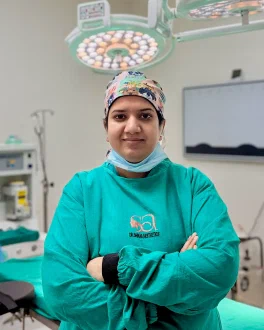
When tissue persists beyond the window for its cause, surgery is the usual treatment. Like any operation it carries risks, including bleeding or fluid collection, contour irregularity, asymmetry, visible scarring, nipple sensation changes and recurrence if the trigger continues, which your surgeon will discuss with you. It usually combines removal of the gland through a small incision at the edge of the areola with liposuction for surrounding fat, as needed. Larger cases with loose skin may also need skin removal, which leaves a longer scar. Gynecomastia surgery at the Sushant Lok 1 clinic is performed by Dr. Shikha Bansal, MCh Plastic & Reconstructive Surgery (Haryana Medical Council Reg. No. 24859).
Frequently asked questions
Can gynecomastia go away without surgery?
Yes, when it is caught early and the cause is removed or outgrown. Once tissue has been present for about a year and turned firm and fibrous, surgery is usually the only way to remove it.
How long does pubertal gynecomastia last?
In most teenagers it settles within 6 months to 2 years. If it is still clearly present around 17-18, or is causing real distress earlier, an assessment is reasonable.
Does gyno go away after stopping steroids?
Sometimes, partly. Early tender tissue may soften once natural hormone levels recover. A firm gland still present months later rarely goes away, and further cycles tend to enlarge it.
Will gyno go away if I lose weight?
The fat will shrink; the gland will not. A firm disc under the nipple that remains at a stable, healthy weight is likely glandular tissue.
Most gynecomastia that settles does so while the tissue is still tender and active: usually within the first year in adults, and within about 2 years during puberty. If yours has been there longer, feels firm, or is changing in a way that worries you, an examination can show whether waiting still makes sense. This post is general information only and not a substitute for medical advice; consult a qualified plastic surgeon about your own situation.