

You have noticed your chest looks different. Maybe fuller, puffier, or just not proportional to the rest of your body. So you Google it, try the pinch test from some Reddit thread, compare yourself to shirtless photos online, and end up more confused than when you started.
Happens more than you would think. Chest shape concerns are one of the most common reasons men walk into a plastic surgery clinic, and also one of the most misunderstood.
Here is the short version. Gynecomastia is chest enlargement caused by actual breast gland tissue. Pseudogynecomastia is chest fullness caused by fat. And a lot of men have both, which is why the “is it hard or soft?” test you found online does not work as well as people claim.
This article breaks down how to think about the difference, what actually matters during an evaluation, and when it is worth seeing someone like Dr. Shikha Bansal in Gurgaon about it.
You might find this useful if you:
- feel like your chest looks puffy or heavy, even when the rest of your body does not
- lost weight but still have fullness around the nipple or lower chest
- are not sure whether diet and exercise will fix it
- feel tenderness, unevenness, or a firm spot beneath the nipple
- want a medical explanation before making any decisions
The question that actually matters
Most men start with “Is it hard or soft?” or “Can I pinch it?” Those are the wrong questions.
The question that matters is: what is actually creating the chest shape you are seeing?
That could be glandular tissue, excess fat, loose skin from weight loss, asymmetry between the two sides, hormonal or medication effects, puberty-related changes, or (most commonly) some combination of these.
This is why two men can both say “I have man boobs” and have completely different things going on underneath.
Gynecomastia vs pseudogynecomastia: the basics
Gynecomastia means breast gland tissue is part of the problem. Pseudogynecomastia means the chest looks enlarged mainly because of fat. In practice, the line between them is blurry.
A rough comparison:
| Feature | Gynecomastia | Pseudogynecomastia (chest fat) | Mixed case |
|---|---|---|---|
| Main tissue | Glandular | Fatty | Both |
| Typical pattern | Puffiness centered near the nipple-areola | Diffuse fullness across the chest | Nipple puffiness plus wider chest fullness |
| Tenderness | Sometimes | Less common | Varies |
| Response to weight loss | Gland usually stays; surrounding fat may reduce | Often improves with body fat reduction | Partial improvement, but some fullness tends to remain |
| Surgery always needed? | No | No | No |
| Best next step when unsure | Clinical evaluation | Clinical evaluation | Clinical evaluation |
Use this as a starting point. Bodies do not read like textbooks.
Gynecomastia vs chest fat vs chest muscle vs a normal male chest
Four different chest states get mistaken for one another. Gynecomastia is gland-driven — firm tissue centered under the nipple, which tends to stay put even after body fat drops. Chest fat, or pseudogynecomastia, is fat-driven — softer, spread more widely across the chest, and it usually reduces as overall body fat comes down. Well-developed pectoral muscle is firm with a sharp lower border and tightens when the chest is flexed, while an unremarkable normal male chest is essentially flat, with a small amount of tissue under the areola that most men have.
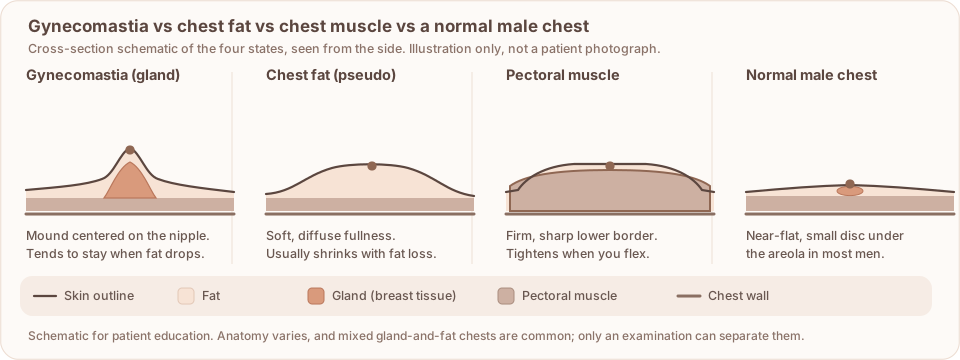
Side by side, they separate like this:
| Feature | Gynecomastia (gland) | Chest fat (pseudo) | Pectoral muscle | Normal male chest |
|---|---|---|---|---|
| Look at rest | Puffy mound centered on the nipple | Soft, wide fullness, often heaviest in the lower chest | Firm slab with squarer shoulders | Flat or near-flat contour |
| On flexing | Mound sits on top of the muscle and stays soft-edged | Fullness stays soft and largely unchanged | Tightens, lifts and squares off | Chest tightens, contour stays flat |
| As body fat drops | Nipple mound tends to remain, and can look more obvious | Usually reduces, occasionally clears completely | Becomes more defined | Stays flat |
| Edge definition | Nipple-centered, disc-like edge you can trace | No clear edge, blends into the chest wall | Sharp lower border along the fold | No mound to define |
| Feel | Firmer, rubbery disc under the areola | Soft and doughy, no distinct disc | Dense and firm, hardens on flexing | Thin tissue with a small disc under the areola |
What does chest fat look like, and what does gynecomastia look like?
Chest fat tends to look like soft, wide fullness with no single high point, while gynecomastia tends to look like a firmer mound sitting right behind the nipple. Men describe five recurring patterns, and none of them is a diagnosis on its own.
Puffy, nipple-centered mound. The nipple and areola sit on a small raised cone that shows through fitted shirts more than the rest of the chest does. This is the pattern most often gland-driven, though fat frequently sits around the gland as well. It tends to persist after weight loss.
Soft, diffuse chest fullness. The whole chest reads as full and soft rather than pointed, with no single spot standing out. Fullness like this usually tracks body fat elsewhere — abdomen, flanks, face — and softens as overall body fat comes down.
Lower chest fullness only. The heaviness gathers along the fold at the bottom of the chest while the nipple area looks reasonably flat. This is more often fat and skin than gland, and posture plus a chest that sits low on the ribs can exaggerate it.
Deflated or hanging chest. After significant weight loss the chest can look emptied out rather than firm, because skin that has been stretched for years does not always retract. What remains is usually loose skin plus a thin layer of residual fat.
Firm chest. Firmness means two very different things. Muscle tightens and squares off when flexed; a dense disc of tissue under the areola does not change on flexing. Firmness alone does not settle the question.
Why this is harder to figure out than the internet suggests
Online explanations make the distinction sound clean. It is not.
A gland can feel soft. Fat can feel dense. Skin quality changes the visual shape of the chest. Weight gain can layer on top of existing glandular tissue. One side can look different from the other. Puberty, medications, supplements, and steroids can all change how the chest develops over time.
A lean man with puffy nipples may still have some surrounding fat. A heavier man may assume it is all fat, yet have a firm gland sitting under the nipple. Someone who lost a lot of weight may mostly be dealing with loose skin and residual fat rather than active gland growth.
These are the cases where a quick self-test sends you in the wrong direction.
What doctors actually look for
No single sign gives you the answer, but these patterns tend to point in different directions.
Glandular fullness tends to look like:
- a noticeable mound or puffiness under or around the nipple
- a firmer disc-like area beneath the areola
- tenderness or sensitivity, especially if the change is recent
- projection that stays even after body fat drops
Fullness that is mostly fat tends to look like:
- generalized softness across the chest
- fullness that tracks with weight gain elsewhere on the body
- visible improvement when overall body fat reduces
- less nipple-centered prominence
Loose skin or contour change after weight loss tends to look like:
- a deflated or hanging appearance rather than a dense mound
- extra skin after major weight change
- uneven contour when the arms move or chest muscles contract
These are clues, not answers. A proper examination looks at the full picture.
Why the pinch test does not work
Men Google “how to check gynecomastia at home” or “if I can pinch it, is it just fat?” all the time. The problem is that these shortcuts are too simple for something with this many variations.
The pinch test cannot tell you how much gland is present. It cannot tell you whether fat is also playing a role. It tells you nothing about skin quality, chest shape, or whether your medications might be part of the picture. And it definitely cannot tell you whether you need a hormone check, a medication review, or just more time.
Touch alone is not a diagnostic tool. Mixed cases are common, asymmetry complicates things, and body image anxiety can make small differences feel bigger than they are.
When to get checked sooner rather than later
Most male chest fullness turns out to be gland, fat, or both — but not all of it does. See a doctor promptly if you notice a hard lump sitting off to one side rather than centered on the nipple, a lump that feels fixed to the skin or chest wall, nipple discharge or bleeding, skin dimpling or ulceration, the nipple turning inward, a lump in the armpit, or rapid growth on one side. Male breast cancer is uncommon — around 1% of all breast cancers — but it is why a new one-sided lump is examined rather than assumed. Depending on what the examination shows, evaluation may include an ultrasound, a mammogram, and blood tests covering hormones, thyroid, liver, and kidney function.
What causes chest fullness in the first place
There is rarely one single cause. During consultations, doctors typically ask about:
- Puberty. Teenage gynecomastia sometimes settles on its own over time.
- Weight gain. Extra body fat can create chest fullness or make an existing glandular problem look worse.
- Weight loss. Fat may reduce, but gland underneath can stay visible.
- Medications. Some medicines affect hormones or breast tissue response directly.
- Hormonal changes. Certain patients need endocrine review depending on symptoms and history.
- Supplements or steroid use. These can alter chest tissue development.
- Body type and genetics. Chest shape is partly about how your body distributes tissue overall.
Good treatment starts with understanding the history, not with jumping to conclusions.
Before you assume it is “just fat”
You do not need to diagnose yourself. But if you are trying to figure out whether an evaluation is worth your time, these questions help:
- Has the chest fullness stayed despite weight loss or regular exercise?
- Is the fullness more obvious around the nipple than the rest of the chest?
- Do you feel tenderness, sensitivity, or a noticeable change on one or both sides?
- Is one side different from the other?
- Did it start around puberty, after a medication change, after weight change, or after steroid or supplement use?
- Does your chest still bother you even when the rest of your body is relatively lean?
- Are you unsure whether the issue is fat, gland, skin, or some mix?
If several of these sound familiar, getting evaluated will probably save you months of guessing.
What mixed cases actually look like
The gym-goer who cannot get rid of the puffiness
He has cut body fat, built chest muscle, and the nipple area still pokes through fitted shirts. There is probably a glandular component, though some fat may be present too. Whether anything needs to be done depends on what examination shows, not on what it looks like through a t-shirt.
The man who lost weight but is not flat
He dropped a lot of weight and the chest got smaller but never went flat. Could be residual fat, loose skin, gland, or all three. Surgery is not automatic here. The first step is figuring out which element is actually creating the remaining shape.
The man with tenderness on one side
One side feels more sensitive and looks different. Asymmetry between the two sides is common in gynecomastia. What needs prompt attention is a firm lump that sits off-center from the nipple, feels fixed, or comes with nipple discharge or skin change — those findings get examined, and imaged if needed, before anything is assumed. History and timing matter more than comparing yourself to photos online.
When exercise, weight loss, or observation is the right move
Not every enlarged male chest needs a procedure. Depending on your age, body composition, and what examination shows, the plan might be:
- losing body fat if the fullness is mostly fat
- waiting it out in certain puberty-related cases
- reviewing your medications or supplements
- getting a hormone check if symptoms or history point that way
- an honest conversation about expectations if the concern is mild
If the fullness is mostly fat, weight management will probably do more than surgery. If there is a glandular or mixed component, exercise can still improve overall chest shape, but it may not fully resolve the nipple-centered fullness. That does not mean surgery is the automatic next step. It just means you need better information before deciding.
When seeing a plastic surgeon makes sense
A consultation is worth it when the problem has been there for a while, is not responding to lifestyle changes, or is bothering you enough that you want clarity.
During a consultation, Dr. Shikha Bansal typically evaluates:
- where the fullness is centered
- whether the chest is mostly fat, mostly gland, or mixed
- skin quality and any looseness
- asymmetry between sides
- tenderness, timing, and what has changed recently
- weight stability, medications, hormones, and your goals
If surgery comes up, the approach depends entirely on what is actually there. Some patients are better suited to gynecomastia treatment. Others are dealing with mostly fat, where liposuction may be more relevant. And some need further medical review before any procedure discussion makes sense.
The point is to get the diagnosis right first. Treatment decisions follow from that.
Frequently asked questions
Can chest exercises get rid of gynecomastia?
Exercise builds muscle and burns fat, which can change how your chest looks. But it does not remove glandular tissue. If fat is the main issue, getting leaner may help quite a bit. If gland is part of it, exercise alone usually is not enough to fully fix the shape.
If I lose weight and my chest is still full, does that mean it is gynecomastia?
Not necessarily. You could be left with residual fat, loose skin, gland, or some combination. Weight loss not fixing the problem is a reason to get assessed, not a diagnosis in itself.
Is gynecomastia always painful?
No. Some men notice tenderness, especially when the change is recent. Plenty of others have zero pain. Tenderness is one data point, not the answer.
Is a firm lump always gland and a soft chest always fat?
No, and this trips people up constantly. Tissue feel varies from person to person. A soft chest can still have gland underneath, and a denser spot is not automatically one thing or another.
Does every case need surgery?
No. Some get watched over time, some improve with weight management, some need a medication or hormone review first. Surgery is one option, not the default.
What if only one side looks enlarged?
Asymmetry is actually quite common. It is not always a cause for concern, but it does change how the evaluation goes because timing, tenderness, and tissue type all matter. An in-person exam will tell you far more than comparing yourself to photos.
Is it gynecomastia or just well-developed chest muscle?
Muscle and gland behave differently when the chest is flexed. Pectoral muscle tightens, lifts, and shows a sharp lower border along the fold that can be traced with a finger. A glandular mound sits on top of the muscle, stays centered on the nipple, and keeps its soft edge whether the chest is flexed or relaxed. Trained chests also look most defined at low body fat, so puffiness that becomes more obvious as you get leaner points away from muscle — and in gym-goers who have both, an examination is the only way to separate them.
Why does my chest look deflated instead of firm?
A deflated or slightly hanging look usually comes from skin that has lost elasticity, most often after significant weight loss or with age. Skin stretched over years does not always retract, so the chest can end up emptier but looser rather than firmer. Residual fat often stays in the lower chest at the same time, which is why the fold can still look full while the upper chest looks hollow. Skin laxity does not respond to further weight loss, so an examination is the usual next step to judge whether skin, fat, or gland is driving the shape.
What to do next
If you are going back and forth on whether this is gynecomastia, fat, or something mixed, another self-test will not settle it. An evaluation that looks at your actual tissue, your history, and what you want to achieve will.
You can book a consultation with Dr. Shikha Bansal in Gurgaon. The goal is straightforward: figure out what is causing the chest fullness, then decide together whether watching it, losing weight, checking hormones, or considering a procedure is the right move for you.