

Most men who enquire about a tummy tuck ask the same first question: “I have lost the weight and I train four days a week, so why is my stomach still sticking out?” A tummy tuck for men has two very different answers to that question, and only one can be solved in an operating theatre.
Almost everything written about abdominoplasty online assumes a post-pregnancy patient: stretched lower-abdominal skin and a scar hidden inside a bikini line. That is not the anatomy most male candidates present with. Men store fat differently, and male abdominal skin behaves differently under a surgeon’s hands. The recovery being planned around is a return to the barbell rather than to a toddler.
This guide covers only what changes when the patient is male: whether the fat is operable, how denser hair-bearing tissue alters drains and scar quality, where the scar sits against a waistband, and how the return to lifting is staged. The general groundwork is linked rather than repeated.
Who this article is for
This is for men considering abdominoplasty, particularly if you are:
- carrying a firm, protruding abdomen despite a stable weight and regular training
- 20–60 kg down after dieting or bariatric surgery, with a skin apron that no longer shrinks
- at a weight you have held steady for at least six months — large surgical database analyses show wound-healing complications and venous thromboembolism climbing as BMI rises, so most surgeons prefer a BMI under about 30 and many decline elective abdominoplasty above about 35; further weight loss also undoes the result
- unsure whether your problem is fat under the skin or fat behind the muscle
- worried a tummy tuck scar will show above your boxers or at the gym
If you are still deciding whether your belly is a fat problem or a skin problem, start with the liposuction versus tummy tuck anatomy guide. The general candidacy checklist sits in the tummy tuck candidate guide.
Can your belly fat be pinched? The test that decides male candidacy
Pinchable belly fat and loose skin are what an abdominoplasty removes. A hard, non-pinchable abdomen usually means visceral fat, which no cosmetic operation can reach — but not always: a separated rectus (diastasis) or a ventral hernia can also push the wall forward without pinchable fat, and both are surgically correctable. Examination distinguishes the three. Subcutaneous fat sits between skin and muscle and lifts between finger and thumb. Visceral fat sits inside the abdominal cavity around the organs, pushing the wall outward from within. Men accumulate visceral fat far more readily than women, which is why many male enquiries do not proceed to surgery.
The self-check is simple. Standing relaxed in front of a mirror, try to grasp the tissue two to three centimetres to the side of your navel. Tissue that lifts away in a thick, mobile roll is largely subcutaneous. An abdomen that is round and tight with almost nothing to gather, and that feels hard rather than soft to press, is the classic visceral pattern — a metabolic problem rather than a surgical one. In her Gurgaon practice, Dr. Shikha sees this pattern most often in men in their thirties and forties, which is why the pinch test is done at the first consultation.
Two qualifiers. Fat may be pinchable in some zones and not others: a subcutaneous roll at the flanks can sit on top of a visceral core, so surgery may improve the sides while doing little for front projection. The pattern also reads more clearly lying down, because a subcutaneous belly flattens and spreads sideways while a visceral one stays domed. Where visceral fat dominates, medical weight management is the recommendation rather than an operating date — closing a flap over a compartment still under pressure raises wound tension and worsens the contour.
How male abdominal tissue changes the operation
Male tissue gives the surgeon a heavier flap that redrapes less obligingly over a larger raw surface — which is why seroma risk runs higher, drains often stay in longer, and scars need more tension control. The anatomy behind that: male abdominal skin is thicker and more fibrous than female abdominal skin, with a denser supply of hair follicles and sebaceous glands, and the subcutaneous layer beneath is typically firmer and less mobile in clinical experience. None of that argues against surgery; it changes how the operation is planned and how aftercare is run.
- Drains and seroma risk. Fluid collection under the flap is the commonest complication after abdominoplasty, and a broad dissection leaves more dead space and disrupts more lymphatics, which is why the risk runs higher across the larger male abdomen. Where drains are used they are often kept longer in men; some surgeons instead place progressive tension (quilting) sutures to close the dead space and avoid drains altogether. Either way, compression garments are part of standard aftercare in this practice.
- Scar quality. Thicker dermis with more sebaceous activity is more prone to a raised or hypertrophic scar, and a scar closed under tension on thick skin can stay red for longer. Tension control at closure matters more here, not less, as does silicone once the wound is sealed and kept out of the sun. Scar maturation and scar care are covered in the guide to tummy tuck scars and scar care.
- Hair-bearing skin. Excising a horizontal strip of lower abdominal skin shifts the pubic hairline upward — rarely a cosmetic concern in men, but the incision is planned so a hair-bearing scar does not land in an awkward line.
Male candidates also tend to present later, and comorbidities such as diabetes, sleep apnoea and a smoking history are more commonly part of the picture — all of which are screened for at consultation. Smoking is among the most important modifiable risk factors for wound breakdown after abdominoplasty, and complete cessation for at least four to six weeks before and four weeks after surgery is a requirement, not a suggestion.
Where does a men’s tummy tuck scar sit?
A male abdominoplasty scar is planned to a boxer or waistband line rather than a bikini line — a low transverse scar running hip to hip, kept straighter than the deeply curved central line used in women. The navel is the second difference. In female surgery the umbilicus is reshaped as an aesthetic feature; in men the goal is simply a natural-looking vertical navel.
Scar planning for a man is a practical negotiation, so bring the garment you actually wear. Gym shorts sit at a different height from swim trunks, so the line is marked with the patient standing in the reference garment. A scar concealed under trunks may still show above compression shorts.
Stated honestly: the scar is long and permanent, and it starts out firm and red. It usually softens and pales over the first six to twelve months and continues maturing for 18 months or more — often longer in men and in darker skin types, where hypertrophic or pigmented scarring is more likely. A vertical component, where one is needed, cannot be hidden on a bare torso, and no surgeon can promise a specific appearance.
Flanks, love handles, and the weight-loss apron
Male fat is stored laterally at the flanks and lower back, so an operation limited to the front of the abdomen often leaves a flat centre with an unchanged lateral bulge and a visible step-off at each end of the scar. For most male candidates, contouring the flanks is what makes the result balanced rather than an optional upsell. Where the excess is circumferential the flanks are planned into the same sitting when it is safe to do so — combining lengthens anaesthesia time and increases blood loss, and it raises seroma and clot risk, so where BMI is higher or diabetes or significant cardiac or respiratory disease is present, the flanks are deliberately staged to a second sitting.
The technique menu itself is common to all patients and is compared in the mini versus full versus extended tummy tuck guide. Briefly: a mini rarely suits men. A full abdominoplasty with flank liposuction covers most male cases, and a belt lipectomy is reserved for circumferential excess after major weight loss.
The pattern that deserves its own mention is the fleur-de-lis abdominoplasty, because it applies disproportionately to men and is almost never discussed on general pages. After major weight loss the apron is often excess in two directions — vertical laxity as well as horizontal — and a horizontal excision alone leaves a loose waist. Whether that applies is decided on examination rather than by how much weight was lost. A fleur-de-lis adds a vertical midline excision to the transverse one, producing an inverted-T scar that narrows the waist at the cost of a permanent visible scar up the centre of the abdomen. The junction where the two scars meet is the commonest site of delayed healing, so the wound-complication rate runs higher than for a transverse-only abdominoplasty. That trade-off is the central decision for post-bariatric candidates, and it is best made once weight has been stable for six to twelve months and nutritional deficiencies corrected.
Recovery and returning to the gym
Expect drains, where they are used, for roughly the first week — sometimes longer — a compression garment for around six weeks, and desk work at about two to three weeks in a straightforward case. The six-week clearance quoted everywhere is not a single switch. Where muscle plication is part of the operation, the repair gains tensile strength gradually, and different lifts load it very differently.
Walking starts on day one and builds steadily. Light stationary cycling or an incline walk is often reasonable from three to four weeks. Seated, supported upper-body work without bracing may be considered from about six weeks, and lower-body work with progressive load from around eight. Direct core loading and heavy compounds such as deadlifts and squats are commonly held to around twelve weeks, then resumed at reduced weight. Breath-holding under load is the thing to avoid early, because intra-abdominal pressure spikes stress a repair.
These are general patterns, not a prescription; clearance depends on what was done and what the surgeon finds at review. The full timeline sits in the week-by-week tummy tuck recovery guide.
Risks deserve plain naming: bleeding, infection, seroma that may need repeated aspiration or a secondary drainage procedure, wound-edge healing problems, partial skin-flap or umbilical necrosis, fat necrosis, numbness below the scar that is often long-lasting, contour irregularity, wide or raised scarring, venous thromboembolism (deep vein thrombosis and, rarely, pulmonary embolism, which can be life-threatening), risks associated with general anaesthesia, and possible revision surgery. Risk-scored VTE prophylaxis and early mobilisation are standard. Risk rises with smoking, diabetes, higher BMI, and combined procedures.
Tummy tuck cost in Gurgaon: what drives a male quote
Cost tracks the extent of the operation rather than the patient’s gender. A straightforward full tummy tuck sits at the lower end of the practice’s range. Cases involving rectus repair plus flank contouring sit above that, and extensive post-weight-loss work — a fleur-de-lis pattern or a belt lipectomy with an overnight stay — sits higher again. Because the surgical work behind those three descriptions is genuinely different, a figure quoted before examination is not a quote.
What pushes a male estimate upward is specific: flank or 360-degree liposuction, a vertical fleur-de-lis component, and any concurrent hernia repair. Whether consumables and follow-up visits are bundled varies by practice, so the useful question is what a number includes rather than what the number is. Cost drivers are broken down further in the tummy tuck cost guide for India, and EMI options are available at the clinic.
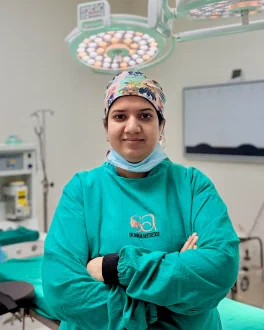
Surgery is performed by Dr. Shikha Bansal — MBBS (Gold Medalist), MS General Surgery, MCh Plastic and Reconstructive Surgery, SMS Medical College, Jaipur; Haryana Medical Council Reg No. 24859 — at the practice in Sector 43, Sushant Lok Phase I, Gurgaon, serving patients across Gurgaon and Delhi NCR.
Frequently asked questions
Can abdominoplasty for men fix a hard beer belly?
Usually not. A firm, round, non-pinchable abdomen is generally driven by visceral fat inside the abdominal cavity, which no cosmetic surgery can remove. Surgery addresses skin and the fat you can pinch in front of the muscle. A firm abdomen is not always visceral, though: a separated rectus (diastasis) or a ventral hernia can push the wall forward with no pinchable fat, and both are surgically correctable, so an examination is worth having before assuming nothing can be done. Where the cause is visceral fat, weight management comes first, with candidacy reassessed once weight is stable.
How long before I can lift heavy again after a tummy tuck?
Light activity resumes early, but heavy compound lifting and direct core work are commonly deferred to around twelve weeks and resumed at reduced load. Where muscle repair was performed, the timeline is driven by the strength of that repair rather than by how well you feel.
What is the tummy tuck price in India for men?
Cost tracks procedure extent, not gender. Adding flank contouring, a fleur-de-lis pattern or a concurrent hernia repair raises the estimate, because each adds operating time and surgical work. Abdominoplasty cost in India also varies with city and facility standard, which is why quotes are only comparable once you know what each one includes.
Do I need liposuction or a tummy tuck?
If the fat is pinchable and the skin still has good recoil with no overhang, liposuction alone may be enough. If skin hangs or has stretched past its ability to retract, excision is needed. Many male plans use both, with liposuction at the flanks alongside abdominal skin removal.
Next step
Male abdominal contouring succeeds or fails on candidate selection more than on technique. The men who do best are at a stable weight with pinchable subcutaneous excess rather than a firm visceral abdomen, and they accept a permanent scar.
This article is general information only and is not a substitute for medical advice; consult a qualified plastic surgeon about your own case. To discuss your anatomy and a realistic plan for scar position and getting back to training, book a consultation.