

If you are considering a tummy tuck, one of the most common questions is not whether there will be a scar, but what that scar may realistically look like, where it usually sits, and how it changes over time.
Honest answer: tummy tuck scars are real, and they matter. The operation removes loose skin and often tightens the abdominal wall, so an incision is necessary. Good surgical planning aims to place scars as discreetly as anatomy allows — often low enough to sit under many underwear or bikini styles — but “low” does not mean invisible. The trade-off for more skin removal is usually a longer scar.
This guide explains why tummy tuck scars happen, how scar patterns differ in mini, full, extended, and fleur-de-lis procedures, what the belly button scar means, what scar healing often looks like from the first few weeks to one year, and what practical scar care usually involves.
Who this article is for
This article is for people who are:
- interested in tummy tuck surgery but worried about visible scarring
- comparing different tummy tuck types and trying to understand how scar pattern changes with procedure extent
- wondering whether a shorter scar is always better
- trying to plan recovery and scar care more realistically before surgery
- looking for calm, medically responsible guidance rather than “scar-free” marketing language
It is especially useful if your main concern is not just getting a flatter abdomen, but understanding the trade-off between contour improvement and the scars required to achieve it.
Why tummy tuck scars exist
Tummy tuck scars exist because excess abdominal skin cannot be removed without making an incision. In many patients, the operation also includes tightening of stretched abdominal muscles, especially after pregnancy or major weight change. Both steps require access through the lower abdomen.
This is why a tummy tuck is different from liposuction. Liposuction mainly removes fat through much smaller access points, but it does not remove significant loose skin or repair muscle separation. If a patient has skin laxity, stretch-related looseness, or abdominal overhang, a smaller scar from liposuction alone may come with a less complete improvement in skin redraping. A shorter scar usually means a more limited operation — not a scar-free version of the same result.
That trade-off should be discussed openly in consultation. The real question is not “Can I avoid scars entirely?” The better question is “What scar pattern makes sense for the amount of skin excess and contour change I am trying to address?”
Where tummy tuck scars usually sit
The exact scar location varies by anatomy, skin excess, previous scars, and surgical plan, but most tummy tuck scars are designed to sit in the lower abdomen so they can be covered by many undergarments, with the line planned against a boxer or shorts waistband in male abdominoplasty. Placement still has to be safe and technically appropriate. Trying to force a scar too low can create tension and healing problems, so scar placement is a balance between anatomy and aesthetics, not purely a cosmetic preference.
Scar pattern comparison by procedure type
| Procedure type | Usual scar pattern | What it is designed to address | Important trade-off |
|---|---|---|---|
| Mini tummy tuck | Shorter horizontal lower abdominal scar | Mild loose skin mainly below the belly button | Shorter scar, but more limited skin removal and usually less correction overall |
| Full tummy tuck | Longer horizontal lower abdominal scar, plus a scar around the belly button | More significant lower abdominal skin excess and muscle laxity, often with upper abdominal skin redraping | More comprehensive contouring, but usually a longer scar and umbilical scar |
| Extended tummy tuck | Longer horizontal scar that extends further toward the flanks | Excess skin and fullness that continue beyond the front of the abdomen toward the sides | Better control of side contour in selected patients, but with a longer scar footprint |
| Fleur-de-lis tummy tuck | Horizontal lower abdominal scar plus a vertical midline scar | Significant horizontal and vertical skin excess, often after major weight loss | Most powerful skin reduction pattern in some anatomies, but also the most visible scar pattern |
These are general patterns, not guarantees. A surgeon may recommend a different approach depending on where your skin excess sits, whether you have old C-section or abdominal scars, and how much correction is realistically possible without putting too much tension on the closure.
Why some patients also have a belly button scar
Many people are surprised to learn that a full tummy tuck often includes a scar around the belly button. This happens because the abdominal skin is redraped downward after excess skin is removed. The belly button itself is usually brought out through a new opening in the skin rather than simply moved as a detached structure.
So in a full tummy tuck there are often two scar zones:
- the main lower abdominal scar
- the scar around the belly button
The belly button scar gets less attention than the lower scar, but it is an important part of realistic consent. In some patients it heals very discreetly; in others it may stay more visible, slightly thickened, darker, or irregular for longer. Like all scars, it matures over months rather than days.
What affects scar length and shape
Scar length is not chosen in isolation. It is driven by how much skin needs to be removed and how much tension would otherwise remain across the lower abdomen.
The main factors include:
- how much loose skin is present above and below the belly button
- whether the laxity extends toward the hips or flanks
- whether the surgery is mini, full, extended, or fleur-de-lis
- whether there is muscle separation that changes the contour plan
- skin quality, stretch marks, and tissue elasticity
- prior abdominal scars such as C-section scars
- body shape and how low the incision can be placed safely
This is why scar advice taken from another patient’s photograph can be misleading. Two people may both want “the smallest scar possible,” but if one has limited lower abdominal laxity and the other has wider skin excess after pregnancy or weight loss, the safer and more effective scar pattern may look very different.
The tension trade-off
When surgeons talk about scar trade-offs, tension is the central issue. If you try to remove more skin through a very short incision, the closure may be under too much stress — which can cause scar widening, poor contour balance, and healing problems. If you use a longer incision, tension distributes better and skin can be removed more completely, but the scar covers more distance.
So the question is not “how do I get the shortest possible scar.” The question is “what scar pattern actually fits your anatomy, your skin excess, and what you are trying to correct.” In some patients, especially after pregnancy, a mommy makeover discussion may also come up if abdominal surgery is being considered alongside breast procedures. That does not change scar biology, but it may affect overall planning and recovery conversations.
What tummy tuck scars may look like over time
Scars do not look their best early. In fact, many look more noticeable before they improve. This catches patients off guard, and it is worth understanding before surgery.
Healing timeline at a glance
| Time point | What scars may look like | What patients should keep in mind |
|---|---|---|
| Around 2 weeks | Fresh, pink to red, sometimes slightly uneven, with swelling nearby | Too early to judge final appearance; priority is incision healing and following wound-care instructions |
| Around 6 weeks | Closed but still pink, firm, sometimes raised or more noticeable than expected | Surface healing does not mean scar maturation is complete |
| Around 3 months | Often darker, redder, or thicker before later softening | This phase can be emotionally frustrating, but it is still early |
| Around 6 months | Many scars begin looking flatter and less inflamed, though still visible | Improvement is common, but scars are usually not “finished” yet |
| Around 12 months | More mature in many patients, often lighter and softer than earlier months | Final quality still varies by skin type, healing tendency, and scar care |
At 2 weeks
At about two weeks, the scar is still active and not ready for cosmetic judgment. The main goals are clean healing, protecting the incision, and watching for any signs of wound separation, infection, or unusual redness.
At 6 weeks
By six weeks, many patients are relieved that the incision is closed, but the scar can still look quite obvious. Pinkness, firmness, itchiness, and mild elevation are all normal at this stage. A scar that is visible at six weeks is not poorly healed. It is simply immature.
At 3 months
Around three months, many scars enter a phase that patients do not always expect: they may look darker, redder, or slightly thicker before they later settle. This is one reason that early online comparisons can be misleading. A scar that looks worrying at three months may continue changing significantly after that point.
At 6 to 12 months
Between six months and one year, many scars soften and become less inflamed. Some fade well. Some stay more visible. Some remain darker against surrounding skin, especially in patients who tan easily or are prone to post-inflammatory pigmentation. In the Gurgaon and Delhi NCR climate, sun exposure can worsen early pigmentation if the scar is not protected.
Scar maturation takes many months. Predicting final scar quality in the early phases is not realistic.
Basic scar care principles after tummy tuck
Scar care should always follow your own surgeon’s instructions first, because timing depends on how the incision is healing. Once the wound is appropriately closed and your surgeon allows it, common scar care principles may include:
- keeping the incision clean and dry during the earliest healing phase
- avoiding unnecessary tension, stretching, or friction on the scar
- wearing the recommended garment if advised for swelling control and support
- using silicone gel or silicone sheets when your surgeon says it is appropriate
- protecting the scar from sun exposure
- avoiding smoking and nicotine, which impair healing
Wound care comes before scar creams
In the first phase, the priority is wound healing, not cosmetic product use. Do not start ointments, silicone, massage, or over-the-counter scar treatments just because the incision “looks okay” without checking timing first.
Silicone can help, but it is not magic
Silicone gel or silicone sheets are commonly used because they may support better scar maturation in selected patients. They do not erase scars, and they do not work overnight. They are part of a scar management plan, not a guarantee.
Sun protection matters more than many patients expect
Fresh scars can darken with UV exposure. In India, where abdominal scars may be exposed during travel, holidays, or lighter clothing, sun protection matters for many months. Even if the scar is usually under clothing, brief repeated exposure can still affect pigmentation in some skin types.
Reducing tension helps
Scars often do better when early healing is not stressed by repeated stretching, twisting, or aggressive exercise before tissues are ready. This is one reason activity restrictions matter. Good scar care is not only about what you apply on the skin — it is also about how you protect the closure while the deeper tissues heal.
What can affect scar quality
No surgeon can guarantee exactly how a scar will mature because scar biology is partly individual.
Factors that may affect scar quality include:
- your natural tendency toward thicker, darker, or more noticeable scars
- skin tone and risk of hyperpigmentation
- smoking or nicotine exposure
- wound healing problems or infection
- high tension across the closure
- diabetes or other medical factors that affect healing
- early sun exposure
- poor adherence to post-operative instructions
Some patients are more prone to hypertrophic or darker scars even when surgery and aftercare are appropriate. That does not mean anything was done incorrectly. It means healing patterns vary from person to person.
When to speak with a plastic surgeon
Scar concerns are worth discussing before surgery, not after you have already assumed the scar will be “tiny.” A consultation is especially useful if:
- you are choosing between mini, full, extended, or fleur-de-lis tummy tuck
- you have a previous C-section or abdominal scar and want to know how it may affect incision planning
- you are tempted by a shorter-scar promise and want to understand what correction may be limited
- you have a history of thick, pigmented, or difficult scars elsewhere on the body
- you have an older abdominal scar that healed wide, thick, or raised and want to know whether it should be revised or excised as part of the plan (see scar revision surgery)
- you are wondering whether loose skin might be better addressed with tummy tuck rather than liposuction alone
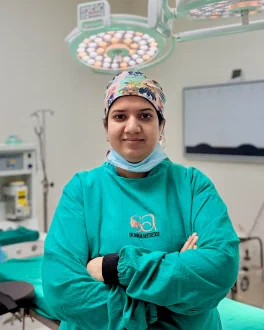
During consultation, Dr. Shikha Bansal can examine your skin excess, abdominal wall, existing scars, and healing risk factors to explain what scar placement is realistically achievable and what scar care plan may be appropriate for you.
Frequently asked questions
Are tummy tuck scars hidden?
They are usually planned to sit low on the abdomen so they can often be covered by underwear or many swimwear styles, but hidden is not the same as invisible. Scar visibility varies with clothing style, body shape, and healing pattern.
Is a mini tummy tuck scar always better?
Not necessarily. A mini tummy tuck usually gives a shorter scar, but it also treats a more limited problem. If you have more significant skin laxity, choosing a smaller scar may mean accepting a less complete correction.
Why is there a scar around the belly button?
In a full tummy tuck, the abdominal skin is typically redraped and the belly button is brought through a new opening. That usually creates a scar around the navel in addition to the lower abdominal scar.
When do tummy tuck scars start looking better?
Many scars remain pink, firm, or noticeable for several months before they soften and fade. Improvement often happens gradually over 6 to 12 months, and sometimes longer.
Can scar creams remove a tummy tuck scar?
No topical product can remove a tummy tuck scar completely. Some scar care measures may help the scar mature more favorably, but none should be presented as a guarantee.
Who is more likely to get darker or thicker scars?
Patients with a personal tendency toward hypertrophic scars, pigmentation changes, smoking exposure, healing problems, or higher tension on the incision may be at greater risk of more noticeable scars.
Next step
If scar concerns are one of the main reasons you are hesitating about surgery, that is worth addressing directly in a consultation — not glossing over. The right conversation is about which scar pattern fits your anatomy, what improvement that trade-off may offer, and how scar healing is typically managed over time.
If you would like individualized guidance, you can book a consultation with Dr. Shikha Bansal in Gurgaon to discuss whether a tummy tuck, liposuction, or a broader mommy makeover plan fits your goals and recovery priorities.