

The question behind this search is usually some version of is mine normal, asked after noticing that the inner lips project beyond the outer ones, or that one side is longer. So the answer belongs at the top, before anything surgical. What causes labia minora to stick out is, in the large majority of cases, ordinary anatomy. Labia minora vary enormously in length, width, thickness, colour and symmetry, and projecting past the labia majora is a common configuration, not a deformity.
In the most widely cited series, fifty premenopausal women were measured and labia minora length ranged from roughly 2 cm to 10 cm, with width varying just as widely and no statistically significant association with age, parity, ethnicity, hormonal use or history of sexual activity (Lloyd et al., BJOG 2005). Asymmetry between the two sides is commonly reported across the published series. There is no medically defined normal length, and neither colour nor symmetry follows a standard. Much of the anxiety on this topic comes from comparison against hair-removed, edited or pornographic images, and from the same shortage of plain anatomical information that keeps alive the belief that the hymen grows back.
What follows covers the real causes of enlargement and the symptoms that make surgery reasonable. It then compares the two main techniques, and sets out what the operation does not treat and the complications that can be permanent — over-resection above all. This is general information only and not a substitute for examination by a qualified plastic surgeon.
Who this article is for
This post is written for you if:
- You have noticed projection or unevenness and want to know whether it is normal before considering anything else
- You have physical symptoms — chafing during exercise, or pain from tissue folding inwards or catching during intercourse
- You noticed a change after childbirth; the timing guide for surgery after childbirth and caesarean explains why tissues are allowed to settle first
- You are weighing a functional complaint against an appearance concern, as patients do with septorhinoplasty, where breathing and shape are addressed together
- You have seen advertising for laser “vaginal rejuvenation” and want an assessment of what those devices do
What causes labia minora to stick out?
Protrusion is usually constitutional — the labia minora developed that way, and the outer labia are not full enough to cover them. Where enlargement is acquired, the recognised contributors are set out below. Side-to-side difference is commonly reported and is expected rather than unusual, much as breast asymmetry is close to universal.
The commonly described labia minora hypertrophy causes:
- Genetics and normal development. The largest factor. Size and projection are inherited traits, along with pigmentation, and are usually evident from adolescence.
- Puberty and hormones. Oestrogen drives labial growth, which is why labia minora size increases through the teenage years and often keeps changing into the early twenties.
- Pregnancy and childbirth. Vaginal delivery can tear or scar labial tissue and leave the two sides more uneven; a genuine increase in length is reported by some women, though objective evidence for it is limited.
- Ageing and menopause. Falling oestrogen thins the tissue and deflates the labia majora, so the inner lips become relatively more exposed without growing.
- Weight change. Substantial weight loss empties the labia majora and unmasks the labia minora.
- Trauma and skin disease. Piercings, straddle injuries, repeated friction, lymphoedema and inflammatory conditions such as lichen sclerosus can distort the tissue. Skin disease needs a dermatological diagnosis and treatment before anything surgical is considered. Lichen sclerosus in particular needs long-term follow-up and biopsy of any suspicious area because of a small risk of vulvar cancer, and operating on active disease can worsen it.
When is protrusion a functional problem rather than an appearance one?
Protrusion is a functional problem when the tissue produces mechanical symptoms: chafing or pain with cycling and gym work; a visible outline or discomfort in leggings and swimwear; tissue folding inwards or catching during intercourse; difficulty with hygiene, with recurrent dampness and irritation in the folds; and interference with tampon or menstrual cup use. Where none of that is present, the concern is about appearance, which is a different conversation.
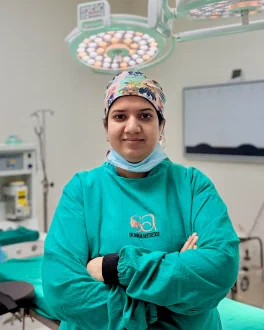
In her practice in Gurgaon, Dr. Shikha sees two accounts most often — chafing during cycling or gym work, and a visible outline in fitted clothing. Appearance-only worries tend to surface later in the same conversation.
Both categories are real, but they are handled differently. Functional complaints are mechanical and reproducible, and often respond to a conservative measure first, while appearance-only concerns need a longer conversation about normal variation before surgery is discussed at all.
Conservative measures come first, and in practice they relieve symptoms for some women without any operation: seamless cotton underwear, avoiding thongs and hard seams, padded shorts and a different saddle for cyclists, washing with water or a plain unscented emollient rather than soaps and douches, a barrier ointment for long rides, and treating any underlying dermatitis. Where symptoms persist despite all of that, surgery becomes reasonable to discuss.
What labiaplasty is — and what it does not do
Labiaplasty surgery reduces and reshapes the labia minora, usually as a day procedure under local anaesthesia with sedation or under general anaesthesia, taking around an hour, with fine absorbable sutures. The aim is symptom relief and an edge that sits within or close to the labia majora — not a standardised appearance. How the operation is assessed, planned and performed at the clinic in Gurgaon is set out on the labiaplasty procedure page.
What it does not do matters as much:
- It is not vaginal tightening. It does not touch the vaginal canal or pelvic floor and does nothing for laxity after childbirth.
- It does not treat urinary symptoms. Stress incontinence and prolapse need urogynaecology assessment, as does persistent urgency.
- It is not a “designer vagina” package. Bundles that add vaginal tightening and cosmetic extras such as bleaching to labiaplasty are marketing constructs, not a clinical protocol.
Watch this reel on Instagram
What “vaginal rejuvenation” actually means
The vaginal rejuvenation meaning in advertising is deliberately elastic: it covers surgery at one end and creams at the other, with laser and radiofrequency devices in between. The energy-device version deserves particular caution. In July 2018 the US Food and Drug Administration issued a safety communication warning that laser and radiofrequency devices marketed for vaginal “rejuvenation” or tightening were not cleared for those uses, and that reported adverse events included vaginal burns and scarring, along with pain during intercourse and chronic pain. That pattern — real device, unapproved marketed indication — is the same one described in the guide to non-surgical rhinoplasty and what a syringe cannot do.
Trim versus central wedge: what each preserves
A trim removes the natural labial edge; a central wedge preserves it. That is the difference patients are actually choosing between. A trim, or linear resection, excises the projecting free edge along its length, taking the darker, slightly ruffled border with it. A central wedge removes a V-shaped full-thickness segment from the widest part and rejoins the upper and lower portions, so the native border stays.
Trim. Technically straightforward and reliable for very wide or irregular labia, and it can address an edge that is itself thickened or darkly pigmented. The scar runs the full length of the border, can feel firm for some months, and the result may look straight or scalloped where the natural border has gone.
Central wedge. Keeps the natural colour transition and edge contour, with a shorter scar. The repair sits under more tension across a mobile area, so wound separation is more likely, and it suits very long or thick labia less well. Some cases need clitoral hood reduction alongside for balance, which carries its own risk, including altered clitoral sensation and scarring, and is not automatic.
Technique follows anatomy and symptoms, not preference. Neither produces perfect symmetry, and neither is reversible.
Over-resection: the outcome that cannot be undone
Removing too much is the most serious avoidable complication of this operation. An over-resected labium leaves the vestibule exposed and dry, can cause chronic soreness and pain with intercourse, and produces a tethered appearance that cannot reliably be rebuilt — reconstruction with local flaps is difficult and adds further scar. Conservative resection leaving a visible remnant is the safer error, since a small secondary reduction is a far easier problem to solve than an over-resected labium — though it still means a second procedure with its own anaesthesia, healing and scar. A request to remove “everything” is declined rather than accommodated.
Recovery, risks and revision
Expect two to four weeks of significant swelling and bruising, with the tissue looking uneven and alarming in the first fortnight. Most swelling settles by six to eight weeks and the final appearance takes three to six months. Desk work usually resumes within a week; light exercise at around four to six weeks; swimming, tampons and menstrual cups from six weeks and only on confirmation at review; intercourse at six to eight weeks, once the suture line has fully healed and on the surgeon’s confirmation at review.
Recognised risks include wound dehiscence — partial separation of the suture line, reported more often with wedge repairs, and associated with smoking and with early activity; partial tissue necrosis at the closure, also more relevant to wedge repairs; residual asymmetry and contour irregularity; over-resection; altered sensation, whether numbness or persistent hypersensitivity; bleeding or haematoma; infection; visible or tender scarring; and revision surgery in a small minority of cases, alongside the risks of sedation or general anaesthesia, which the anaesthetist assesses and discusses separately before the day of surgery. Altered sensation and scarring are usually temporary but can be permanent in a small number of cases. Healing in this area varies between individuals and outcomes cannot be guaranteed.
Age, consent and when the answer is not surgery
Labiaplasty in a minor is not appropriate outside a genuine functional or congenital indication, because labial development continues through puberty into the late teens and what looks disproportionate at fourteen frequently is not at nineteen. The same reasoning governs adolescent gynecomastia, where evaluation and waiting precede any operation.
Psychological screening matters when distress is out of proportion to the anatomy — where a woman describes her labia as disgusting or deformed, checks repeatedly, avoids sport or relationships, or brings images as a target. Body dysmorphic disorder is not treated by surgery — symptoms usually persist unchanged and can worsen, with high rates of dissatisfaction and repeat-surgery requests — so referral rather than an operating date is the correct response. Anyone unable to describe what is troubling them, or being pressured by a partner, is not a candidate.
Consultation, discretion and cost in Gurgaon
Cost depends on technique, whether one or both sides are treated, anaesthesia and facility charges, so a meaningful figure follows examination — a labiaplasty procedure cost quoted in an advertisement, before anyone has looked, is a marketing number. A quote should itemise surgeon’s fee, anaesthesia, day-care facility, dressings and routine follow-up.
The first visit is a clinical one: history and symptoms, a brief examination in a chair with a chaperone present, then a discussion of whether anything needs doing at all. Many consultations for this concern end in reassurance and conservative advice, which is a legitimate outcome rather than a failed appointment. A female surgeon and a chaperoned examination are available for this consultation, and privacy is treated as part of the care. The labiaplasty page covers what the consultation and the day of surgery involve, along with the recovery timeline and how privacy is handled.
Dr. Shikha Bansal practises in Sector 43, Gurgaon — MBBS (Gold Medalist), MS General Surgery, MCh Plastic & Reconstructive Surgery, registered with the Haryana Medical Council (Reg. No. 24859). In line with Indian medical advertising regulation under the DMR Act and the NMC code, no before-and-after imagery or outcome guarantees are published for this procedure.
Frequently asked questions
Why does my labia minora come out past the outer lips?
In most women this is simply how the tissue developed, and it is one of several normal configurations rather than a defect. It becomes more noticeable when the labia majora lose volume after weight loss or childbirth, and again after menopause. Projection alone, without symptoms, is not a medical reason to operate.
Why is my labia minora big on one side only?
Side-to-side difference is commonly reported and is expected rather than unusual, and it can become more obvious after childbirth or a local injury. One-sided reduction is possible where the longer side causes symptoms, though matching the two sides exactly is not achievable.
How much does labiaplasty cost in India?
It varies with technique, whether one or both sides are treated, and the anaesthesia and facility involved, so pricing is given after examination rather than over the phone. Ask for a written, itemised quote and be cautious about package pricing that bundles unrelated “rejuvenation” add-ons.
Does laser vaginal rejuvenation work instead of surgery?
Energy-based devices do not shorten projecting labia minora, and the US FDA warned in 2018 that such devices were not cleared for vaginal “rejuvenation” with vaginal burns, scarring and chronic pain among the adverse events reported to it. Where the concern is appearance-only and mild, no treatment is often the right answer.
Will labiaplasty tighten the vagina or help urinary leaking?
No. The operation is confined to external labial tissue and has no effect on the vaginal canal or pelvic floor, and none on prolapse or urinary leakage. Those symptoms need pelvic floor physiotherapy or urogynaecology assessment and should be evaluated separately.
Most women who search this question do not need an operation, and a consultation that ends in reassurance is a good use of the appointment. Where symptoms are genuine and conservative measures have failed, the decision is worth making slowly, with a clear understanding of which technique is proposed and what it permanently removes. Book a consultation to have it assessed properly.