The question that brings most people to this page is some version of “my nose surgery went wrong, can it actually be fixed?” The result has healed, the swelling is long gone, and what remains is a shape or a breathing change that does not match what was promised. That is a different situation from the panicked early weeks after surgery, and it deserves a different answer.
This guide is written specifically for people unhappy with a healed prior rhinoplasty result, not for anyone still in the bruised, swollen first month. If your concern is whether early swelling is normal or a sign of a complication, that question is covered separately in our guide on rhinoplasty side effects and when to call your surgeon. What follows starts where that post ends, at the settled but disappointing result, and walks through when a second opinion is genuinely warranted, why a corrective operation is harder than the first one, the timing rule that protects you, and what a revision consultation in Delhi NCR actually evaluates.
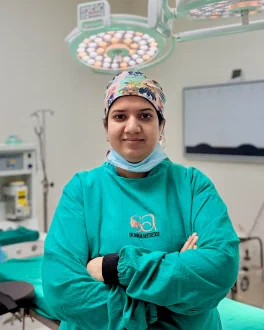
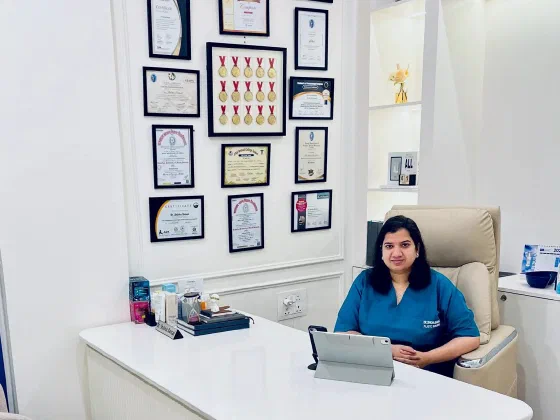
Revision (or corrective) rhinoplasty is its own discipline. In her Gurgaon practice, Dr. Shikha sees patients who were told their result was “final” when it was not, and others who were impatient with a result that simply had not finished settling. Telling those two apart is the first job of an honest consultation.
Who this article is for
This article is aimed at adults considering a corrective procedure for a previous nose surgery, specifically those who are:
- Living with a healed result they are unhappy with — asymmetry, a residual bump, an over-narrowed or “scooped” bridge, a pinched or collapsed tip, or a nose that looks operated-on.
- Noticing a breathing change that appeared or worsened after their first rhinoplasty.
- Unsure whether their disappointment is justified or whether the nose simply has not finished settling.
- Researching whether revision is possible, what it costs, and how to choose a surgeon for a redo specifically.
- Trying to understand graft and cartilage limits, which matter more for Indian noses — covered in our overview of Indian nose anatomy and ethnic rhinoplasty considerations.
If you have never had nose surgery and are weighing a first procedure, the rhinoplasty cost in India breakdown is a better starting point. This page assumes there is already a prior operation in the picture.
When is a second opinion actually warranted?
A second opinion is warranted when a healed result still bothers you after the nose has fully settled, generally at or beyond the 12-month mark, or when a clear functional problem such as new breathing difficulty has appeared. It is not warranted simply because the nose looks different at three months than you imagined; at that stage swelling is still resolving and judgement is premature. The distinguishing question is whether you are reacting to an unfinished result or a finished one.
There is an important difference between a settled-but-disappointed result and normal healing, and no two patients should be treated the same. Cosmetic impatience, wanting the final shape before the tissue has earned it, is common and understandable, but operating into a still-swollen nose can make things worse. A genuine indication for revision usually involves one or more of the following, present well after healing has run its course:
- Visible asymmetry that did not improve as swelling faded.
- Over-resection: too much bone or cartilage removed, leaving a scooped bridge, a “ski-slope” profile, or a nose that looks pinched and unnatural.
- A collapsed or pinched tip, sometimes with the nostrils visibly distorted.
- A breathing change: new or worsened nasal obstruction after the first surgery, which can point to structural weakening such as internal valve collapse.
- A residual deformity: the original concern (for example a dorsal bump) that was under-corrected.
These patterns are fixable far more often than people fear. What they are not is an emergency, and chasing a redo too early is the single most common mistake.
Why is revision rhinoplasty harder than the first operation?
Revision rhinoplasty is technically harder than a primary operation because the surgeon is no longer working on virgin tissue. Scar tissue has replaced clean surgical planes, the original cartilage may have been reduced or removed, and the underlying anatomy can be distorted by the previous surgery. The structural framework that supports the nose is often weaker, which means the corrective plan tends to focus on rebuilding support, not just refining shape.
A first rhinoplasty works with predictable layers. A redo does not. The differences that make it demanding include:
Scar tissue and distorted anatomy
Healing lays down internal scar tissue that obscures the planes a surgeon normally dissects through. Landmarks shift. What the camera and the consultation suggest may differ from what is found once the nose is opened, so a revision surgeon plans for contingencies rather than a single fixed sequence.
Depleted cartilage supply
A nose has a finite cartilage budget, and the first operation may have already spent much of it. If the septum was harvested or trimmed during the original surgery, the most convenient graft source may no longer be available. This is where revision planning becomes individual, and it is also where Indian-nose anatomy adds its own constraints — discussed below.
Weakened structural support
Over-resection in the first surgery can leave the framework under-supported, which is often why both the cosmetic and the breathing problems exist in the first place. Corrective work frequently means adding structure (grafts to rebuild a bridge or strengthen a tip) rather than removing more tissue. The approach (open versus closed) is chosen case by case; a re-do nose more often favours an open approach for direct access, a trade-off explained in our piece on open versus closed rhinoplasty.
The 12-month rule: why timing protects your result
The standard guidance is to wait at least 12 months after the previous rhinoplasty before operating again, except where a clear functional emergency or infection demands earlier attention. A nose continues to settle and refine for a full year, sometimes longer for thicker skin, so a result judged at three or six months is being judged unfinished. Re-operating into swollen, actively healing tissue raises the risk of a poorer outcome and makes the surgeon’s job harder, not easier.
There are two reasons the wait matters. First, the result you are unhappy with at month four may not be the result you have at month twelve; residual swelling, particularly at the tip and in thicker skin common to many Indian noses, can mask the true shape for a long time. Reviewing the week-by-week recovery timeline often reassures patients that what they are seeing is normal late-stage settling rather than a failure.
Second, tissue that has just been operated on is inflamed and fragile. Going back in too soon compounds scarring and makes it harder to achieve a clean, durable correction. Patience is not a delay tactic — it is part of the treatment. The exception is a functional problem such as significant breathing obstruction or signs of infection, which is assessed on its own timeline rather than made to wait a year.
Grafting and cartilage supply: the Indian-nose reality
For revision rhinoplasty, the realistic question is not whether grafts are needed but where the cartilage will come from once the septum has already been used. The usual order of preference is septal cartilage first, then ear (conchal) cartilage, and rib cartilage when larger or stronger grafts are required. In a redo nose, and particularly in many Indian noses, which tend to have softer, less projecting cartilage and thicker skin, the septum may already be depleted, pushing the plan toward ear or rib as the donor source.
This donor-site reality is something most cost pages and primary-surgery guides ignore entirely, yet it shapes the whole operation:
- Septal cartilage is the first choice for strength and convenience, but a previous surgery may have harvested it already.
- Ear (conchal) cartilage is a common second source, well suited to tip work, taken through a hidden incision behind the ear.
- Rib (costal) cartilage provides the volume and strength needed to rebuild a significantly over-resected bridge or a collapsed framework. It involves a second small operative site and is reserved for cases that genuinely need it.
Because Indian-nose anatomy often combines a softer cartilage framework with thicker, more sebaceous skin, revision frequently leans on adding well-shaped structural grafts to create definition that holds over time. How skin thickness and cartilage strength shape the graft plan is explored further in our ethnic rhinoplasty considerations article. The practical takeaway is that a corrective consultation must establish what cartilage remains before any promise about the outcome can be made.
What a corrective consultation evaluates
A revision consultation is more investigative than a primary one. Before any plan is offered, the assessment typically covers what was done before, what tissue is left to work with, and whether the goal is realistic. This usually includes a detailed history of the previous surgery (including operative notes if available), an examination of skin quality and remaining cartilage, an internal airway check, and standardised photographs.
Expect the conversation to include:
- The previous surgical record: what technique was used and, ideally, what was removed or grafted.
- A functional airway assessment, because breathing and shape problems often travel together after over-resection.
- An honest appraisal of remaining cartilage and where additional grafts would come from.
- Realistic goal-setting: a corrective result aims for a natural, well-supported nose, not perfection, and a candid surgeon will say what is and is not achievable.
A candidate for revision is broadly someone in good general health, with a fully healed result they remain unhappy with after appropriate waiting, and with reasonable expectations. As with any surgery, this article is general information only and is not a substitute for a personal assessment by a qualified plastic surgeon.
Risks of revision rhinoplasty
A corrective operation carries the same general surgical and anaesthetic risks as any nose surgery — bleeding, infection, an adverse reaction to anaesthesia, and a recovery that may not run perfectly smoothly. Two further considerations are specific to revision work and worth understanding before deciding.
The first is graft-related. Where the septum is depleted, cartilage is harvested from another site, and each donor source has its own trade-offs. Ear (conchal) cartilage can leave a minor change in ear contour at the harvest site. Rib (costal) cartilage involves a small second incision on the chest and carries a low risk of donor-site issues such as scarring, pain, or rarely pneumothorax (air around the lung); rib grafts can also warp or shift over time. Grafted cartilage may partially resorb or move, which can affect the final shape.
The second is the re-revision reality. Even a well-planned correction works through scarred, less predictable tissue, so a proportion of cases need further refinement to reach a stable result. None of this makes revision unsafe — it is routine, specialised surgery — but these possibilities should be weighed openly. A consultation is where individual risk is assessed against what the correction is trying to achieve.
Revision rhinoplasty cost in Gurgaon and the NCR
A revision rhinoplasty in the Delhi NCR region generally starts higher than a primary procedure. As an indicative guide only — final cost is always individual — a first-time nose surgery in India is commonly quoted in the region of Rs 70,000 to Rs 3,00,000 depending on complexity, and a corrective case typically starts above that band, often from around Rs 1,50,000 upward, because a redo is more demanding and frequently requires grafting. These figures are general market references rather than a quote for a specific nose; the clinic’s own “starting from” pricing is confirmed only after an in-person assessment, since the cartilage available and the work required differ from case to case.
A redo costs more than the original for concrete reasons, not as a premium for its own sake:
- Greater technical complexity — scar tissue and distorted anatomy mean longer, more meticulous operating time.
- Grafting requirements — harvesting ear or rib cartilage adds a step (and sometimes a second operative site) that a simple primary case may not need.
- Surgeon expertise — revision work draws on a narrower, more specialised skill set.
What a “starting from” quote in Gurgaon typically includes, and what it may not, varies between clinics — surgeon’s fee, anaesthesia, facility charges, and follow-up are the usual components to clarify. The drivers behind any nose-surgery quote are broken down in detail in the rhinoplasty cost in India guide. The clinic is located in Sector 43, Gurgaon, serving patients across Gurgaon and Delhi NCR; you can reach the clinic on the listed +91 number or book a consultation to discuss your specific case and a precise estimate.
Choosing a surgeon for a revision specifically
For a corrective case, “best rhinoplasty surgeon in Gurgaon” is the wrong search. The right criteria are revision-specific: meaningful experience with re-do noses, demonstrated comfort with cartilage grafting (including ear and rib), and a willingness to set realistic, honest expectations rather than promise a flawless result. Ask directly how many revision cases the surgeon handles, what graft sources they use when the septum is gone, and to see relevant before-and-after examples of corrective work — not just primary results.
Frequently asked questions
My nose surgery went wrong — can it be fixed?
In many cases a healed, unsatisfactory rhinoplasty result can be improved with corrective surgery, though the degree of correction depends on how much healthy cartilage and structural support remain. Common complaints — asymmetry, a scooped bridge, a pinched tip, or a breathing change — are frequently addressable. The realistic extent of improvement can only be judged at an in-person assessment.
What are the common side effects of rhinoplasty that suggest a problem?
Temporary swelling, bruising, and numbness are normal early side effects and are not signs of a failed surgery. Concerns that point to a problem are usually structural and persistent — a result that stays asymmetric after a year, an over-narrowed bridge, or new breathing difficulty. Acute warning signs in the first weeks are a separate topic covered in our rhinoplasty side effects guide.
How long should I wait before getting revision rhinoplasty?
The general rule is to wait at least 12 months after the previous surgery so the nose can fully settle before any corrective operation. Judging a result earlier risks acting on swelling that has not yet resolved. The main exception is a functional problem, such as significant breathing obstruction or infection, which is assessed on its own timeline.
Why does revision rhinoplasty cost more than the first surgery?
A revision is more technically demanding because the surgeon works through scar tissue and distorted anatomy, and it often requires cartilage grafting from the ear or rib. These factors add operating time and complexity, plus sometimes a second operative site. Where a primary nose surgery in India is commonly quoted in the region of Rs 70,000 to Rs 3,00,000, corrective surgery typically starts above that band, often from around Rs 1,50,000 upward, with the exact figure confirmed only after an in-person assessment.
Is non-surgical rhinoplasty an option to fix a botched result?
Non-surgical rhinoplasty using fillers can camouflage minor contour irregularities but cannot rebuild structure, reverse over-resection, or correct breathing problems. It is a limited, temporary option for small cosmetic touch-ups, not a substitute for surgical revision when the underlying framework is the issue. A consultation can clarify whether a specific concern is even suitable for it.
What is recovery time like after a revision compared with a first nose surgery?
Recovery follows a broadly similar pattern to a primary rhinoplasty — most visible bruising and swelling ease within a few weeks — but the final result of a revision can take a full year or more to refine, especially with thicker skin. Because revision often involves grafting, the early recovery may feel slightly more involved. The general week-by-week recovery timeline gives a realistic picture of the stages.
A measured next step
Being unhappy with a healed nose result is frustrating, but it is rarely the end of the road — and rushing the next decision tends to cost more than waiting for it. The most useful thing you can do is let the nose settle past the 12-month mark, gather your original surgical details, and have a candid assessment of what cartilage and support remain before committing to anything. Corrective rhinoplasty is a specialised field, and an honest consultation will tell you plainly what is achievable for your nose rather than what sounds reassuring. This article is general information only and not a substitute for personal medical advice; a procedure decision should follow an assessment by a qualified plastic surgeon. Dr. Shikha Bansal (MBBS, MS General Surgery, MCh Plastic and Reconstructive Surgery; Haryana Medical Council Reg No. 24859) consults on corrective and revision cases in Gurgaon. Book a consultation