
The first question most people search is what liposuction costs. The more useful question is who is holding the cannula. Two clinics in Gurgaon can quote the same “starting from” price for the same area, and one is run by a board-certified plastic surgeon operating in a proper hospital theatre while the other is a skin clinic offering fat removal as an add-on. The price tells you almost nothing about which is which.
This is a decision-stage checklist, not a complications explainer. The goal here is narrow and practical: how to confirm that the person you are about to trust with body contouring is actually qualified to do it, what to ask about anaesthesia and aspirate volume, how to check the operating theatre’s setup, and which answers should make you walk away. If you are still deciding whether liposuction is the right idea at all, or worried about complications, those are upstream questions handled in the liposuction risks and safety guide and the candidate guide. This page assumes you have already decided you want the procedure and now need to choose well.
Who this article is for
This may help if you are:
- comparing liposuction surgeons in Gurgaon, Delhi, or the wider NCR and unsure how to tell a qualified one from a marketed one
- being offered liposuction at a dermatology or “cosmetology” clinic and wondering whether that is appropriate
- planning a multi-area or larger-volume procedure and want to understand the anaesthesia and safety setup
- trying to decide what questions are worth asking in a consultation before you commit
- weighing technique claims like laser versus traditional liposuction and unsure how much they should affect your choice
Who is actually qualified to perform liposuction
This is the single most important thing to verify, and it is the thing cost-led pages never mention. In India, liposuction is a surgical procedure, and the recognised surgical specialists for it are qualified plastic surgeons.
MCh or DNB in Plastic Surgery — what the credential means
A plastic surgeon in India holds an MCh (Plastic & Reconstructive Surgery) or a DNB (Plastic Surgery) on top of a primary MBBS and, usually, a general surgery qualification. That super-specialty training is where a doctor learns surgical body contouring: fluid management, aspirate limits, managing the abdominal wall and contour, handling complications in theatre, and post-operative surgical care. It is a multi-year hospital pathway, not a weekend course.
Dermatologists and “cosmetologists” are not trained in this pathway. A dermatologist’s qualification (MD or DVL in dermatology) is in skin medicine. Some skin clinics market liposuction or “laser lipo” anyway, often using machine-led techniques, but a fat-removal procedure run by someone without surgical training removes one of your most important safety margins: a surgeon who can recognise and manage a problem on the table. The word “cosmetologist” in particular carries no standard medical meaning in India and should never be mistaken for a surgical qualification. Equipment branding is not a substitute for the operator’s training — that distinction is covered in the comparison of liposuction techniques.
The short rule: for liposuction, you want a plastic surgeon with an MCh or DNB in Plastic Surgery. Anything less qualified is a compromise on safety, regardless of how the clinic is branded.
How to verify the credential yourself
Claims on a website are not proof. Verification is straightforward and worth the ten minutes.
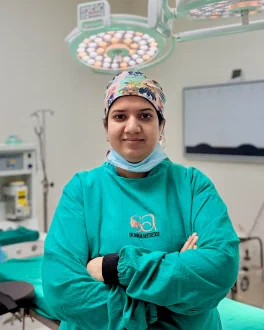
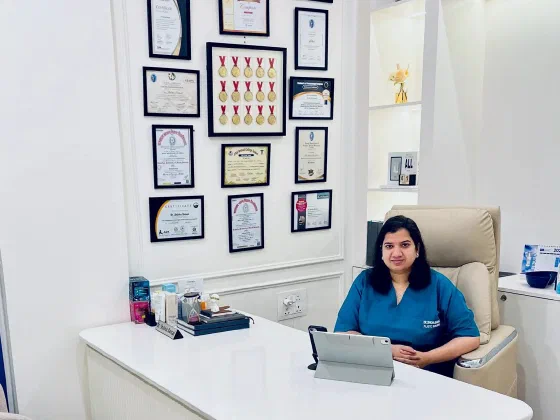
- Ask for the exact qualification and registration number. A qualified surgeon will give it without hesitation. In Gurgaon, the relevant body is the Haryana Medical Council, and every registered doctor has a registration number. Dr. Shikha Bansal, for example, is registered with the Haryana Medical Council under Reg No. 24859.
- Confirm the registration against the council. State medical council registers can be checked, and a registration tied to a plastic-surgery qualification is what you are looking for. A surgeon listing an MCh should be registered as such.
- Check where the MCh or DNB was earned. Recognised institutions and a clear training timeline matter. Vague phrasing like “trained in cosmetic surgery” without a named super-specialty degree is a flag, not a credential.
- Separate the surgeon from the brand. Large clinics sometimes advertise a senior name while a different, less-qualified person operates. Ask plainly: who will perform my surgery, and what is their qualification and registration number?
If a clinic resists giving a registration number or a named operating surgeon, treat that as an answer in itself.
The clinical questions that actually separate safe from unsafe
Once the credential checks out, the next layer is how the procedure will be run. These are vetting questions, and a good surgeon welcomes them.
Aspirate volume and large-volume liposuction
Liposuction has a safety ceiling. The total volume of fat and fluid removed in a single session affects how much fluid shifts inside the body and how much blood is lost, and it lengthens recovery — so removing too much in one sitting raises risk meaningfully. Procedures above roughly 5 litres of total aspirate are generally considered large-volume and are treated as a higher-risk category that typically calls for a properly equipped facility with overnight monitoring and careful fluid management — not a quick day-care slot.
A safe surgeon will set a realistic volume for your anatomy and may stage a larger contouring plan across more than one session rather than pushing everything into one operation. Be cautious of anyone promising to remove a very large amount in a single sitting, or treating liposuction as a weight-loss procedure. It is body contouring, not a substitute for losing weight. Ask directly: what total aspirate volume are you planning, and where will I be monitored afterwards?
Anaesthesia setup for multi-area cases
No cost-led page in this market discusses anaesthesia, yet it is central to safety — especially for multi-area work (abdomen plus flanks plus thighs, for instance), which involves more tissue and more fluid over a longer operating time.
- Who administers and monitors the anaesthesia? For anything beyond a small, single-area case under local anaesthesia, a qualified anaesthetist should administer and monitor sedation or general anaesthesia. Surgery and anaesthesia being handled by the same person, with no dedicated monitoring, is a setup to avoid.
- What monitoring is in place? Standard monitoring should be in place throughout the procedure, handled by trained clinical staff.
- How is the local anaesthetic dosed? Liposuction uses tumescent fluid containing local anaesthetic, and the safe dose scales with body weight and total volume. A surgeon who can explain how they keep within safe limits is demonstrating exactly the judgement you are paying for.
Case volume and area-specific experience
Experience is not just years on a profile; it is reps with your specific procedure. Abdominal and flank contouring, thigh work, arm contouring, and gynecomastia each have their own anatomy and pitfalls.
Reasonable questions to ask in the consultation:
- How many liposuction cases do you perform, and how often do you treat the area I want addressed — abdomen, flanks, thighs, arms?
- Can I see before-and-after results from your own patients with a similar body type and the same area treated?
- What does your typical recovery and follow-up look like, and who manages it?
You are not looking for a single magic number. You are checking that this surgeon does this work routinely, not occasionally. In her Gurgaon practice, Dr. Shikha most often contours the abdomen and flanks, frequently as part of a body-contouring plan rather than a single isolated area, which is the kind of pattern worth asking any surgeon to describe about their own caseload.
Where the surgery happens: the operating theatre
The operating theatre is part of your safety, not a detail. This is another vetting criterion missing from cost-led pages.
Day-care versus a hospital operating theatre
Many liposuction cases are done as day-care, which is reasonable for smaller, lower-volume procedures in a properly equipped setting. What matters is that the surgery happens in a real, sterile operating theatre with proper surgical equipment and trained staff — not a converted treatment room or a salon-style cabin.
For liposuction, look for:
- a proper operating theatre with sterile setup, not a treatment room
- trained clinical staff and proper monitoring during and after the procedure
- for larger-volume or multi-area cases, a setting that can provide overnight monitoring if needed rather than discharging you within an hour
- clarity on what happens if a complication occurs — which hospital, how quickly
If a clinic cannot describe its theatre standard or its emergency plan, that gap matters more than the price on the brochure.
Cost and planning in Gurgaon and Delhi NCR
Cost is real and worth understanding, but it should be the last filter applied after credential, safety setup, and facility — not the first. In Gurgaon, Delhi, and the wider NCR, liposuction is usually quoted on a “starting from” basis per area, and single-area abdomen or “tummy” liposuction sits at the lower end while multi-area contouring costs more. A quote that looks unusually cheap often excludes anaesthesia, the facility, consumables, or the compression garment.
A complete quote should make clear what is and is not included:
- surgeon’s fee and the named operating surgeon
- anaesthesia and anaesthetist’s fee
- operating theatre and facility charges
- consumables, compression garment, and follow-up visits
- what a revision or touch-up would cost if needed
Comparing two clinics only on headline price, without checking what each price includes, is how people end up paying twice. A breakdown of what a fair quote should contain is in the liposuction cost guide. Many clinics, including this practice, also offer EMI options, so ask how payment is structured rather than assuming the headline number is the full picture.
Frequently asked questions
How do I find a good liposuction surgeon in Gurgaon?
Start with the credential: confirm an MCh or DNB in Plastic Surgery and a valid Haryana Medical Council registration, not just a “cosmetic clinic” label. Then check the safety setup — who gives the anaesthesia, what total aspirate volume is planned, and whether the surgery happens in a proper, well-equipped operating theatre. Treat cost as the final filter, after qualification and facility, not the first.
Can a dermatologist or cosmetologist perform liposuction?
Liposuction is a surgical procedure, and the appropriate specialist is a qualified plastic surgeon with an MCh or DNB in Plastic Surgery. Dermatologists are trained in skin medicine, and “cosmetologist” is not a recognised surgical qualification in India. Some skin clinics market fat-removal procedures, but choosing an operator without surgical training removes an important safety margin if something goes wrong on the table.
What are the risks of getting liposuction, and is liposuction dangerous?
Liposuction is generally safe in suitable candidates when performed by a qualified plastic surgeon in a proper surgical setting, but it is still surgery and carries real risks, which is why operator and facility matter so much. Larger-volume and multi-area cases carry more risk than small single-area work. The full picture of complications and the red flags to watch for is covered in the liposuction risks and safety guide.
Who is a good candidate for liposuction?
Liposuction tends to work best for people near a stable, healthy weight who have localised fat deposits that resist diet and exercise, with reasonably good skin tone and realistic expectations. It is body contouring, not a weight-loss method, and it does not treat loose skin on its own. Candidacy depends on your overall health and anatomy, which a consultation assesses — there is more detail in the candidate guide.
What questions should I ask before liposuction surgery?
Ask for the surgeon’s exact qualification and Haryana Medical Council registration number, who will actually perform the operation, what total aspirate volume is planned, who administers and monitors the anaesthesia, and whether the surgery happens in a proper operating theatre. Ask to see the surgeon’s own before-and-after results for your body type and area. Clear, unhurried answers are part of what you are evaluating.
Does laser liposuction make a clinic safer or better?
Technology branding is not a proxy for safety or skill. Laser and VASER are simply tools, much like traditional liposuction, and the operator’s qualification and judgement matter far more than the machine. Be wary of clinics that lead with technology to distract from a missing surgical credential — the techniques comparison explains when the method genuinely matters and when it does not.
A note on choosing well
Choosing a liposuction surgeon is less about finding the cheapest quote and more about working through a short sequence: first confirm the operator is a qualified plastic surgeon, then check that the anaesthesia and aspirate plan are sound, and last that the surgery will happen in a proper operating theatre. A surgeon who answers these questions openly is showing you the judgement that keeps body contouring safe. This article is general information only and is not a substitute for medical advice; the right plan depends on your own health and anatomy, which a qualified plastic surgeon can assess in person. If you would like your case reviewed and your questions answered directly, book a consultation.